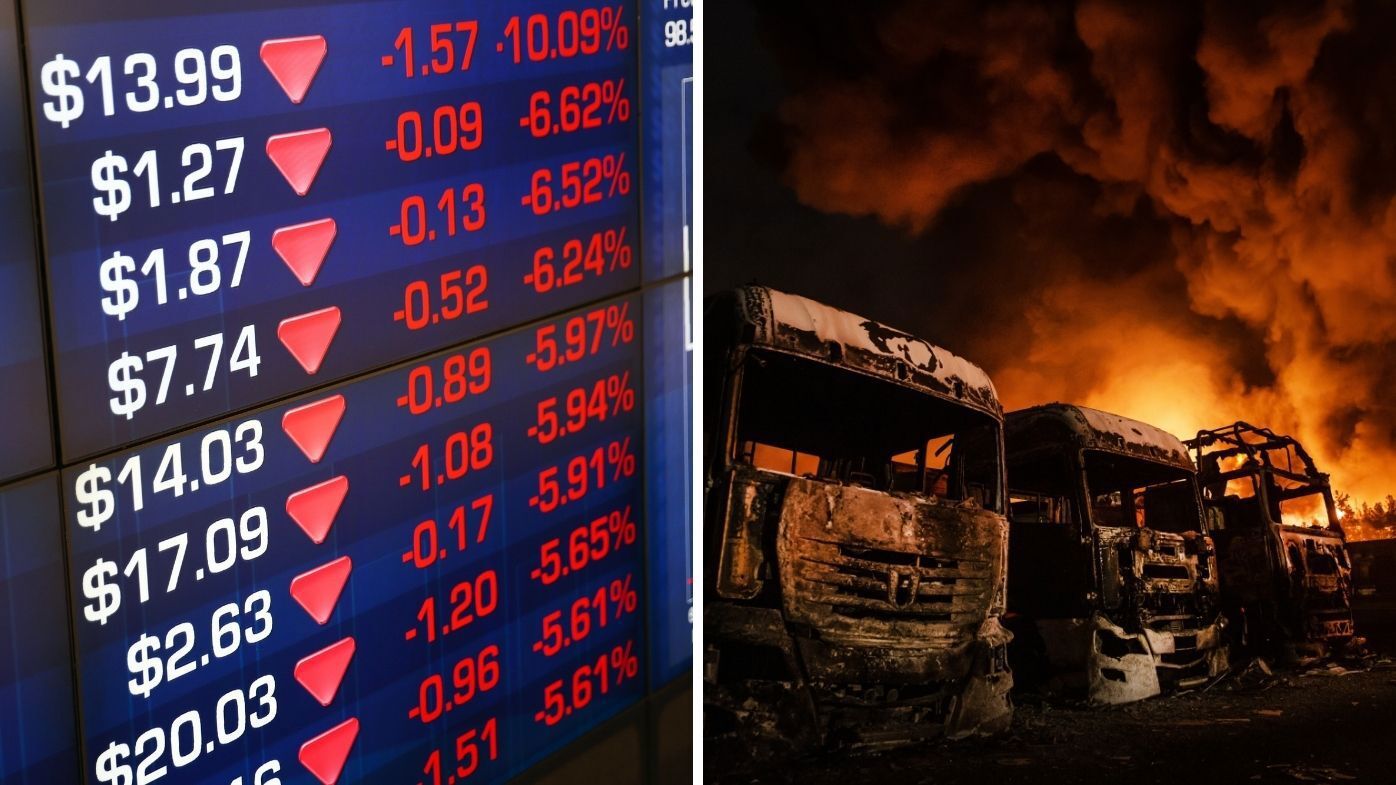
The sudden evaporation of $100 billion in market capitalization from the Australian Securities Exchange (ASX) is not a random fluctuation; it is a structural repricing event driven by the intersection of interest rate trajectories and sectoral concentration. When the market "wipes off" value on this scale, it reflects a shift in the weighted average cost of capital (WACC) that renders previous valuations obsolete. This contraction is the mechanical result of institutional portfolios rebalancing against a backdrop of macro-economic friction, specifically the recalibration of yield expectations and the cooling of commodity cycles.
Understanding this drawdown requires moving past the headlines of "market panic" and into the three structural drivers of Australian equity volatility: the Yield Gap Compression, the Resource Beta Sensitivity, and the Liquidity Feedback Loop.
The Mechanics of Value Evaporation
Market capitalization is a function of perceived future cash flows discounted back to the present. When $100 billion disappears in a concentrated window, the market is signaling that either the expected cash flows have diminished or the discount rate has increased.
In the Australian context, the discount rate is heavily influenced by the Reserve Bank of Australia (RBA) cash rate and the 10-year Treasury bond yield. As bond yields rise, the "equity risk premium"—the extra return investors demand for holding stocks over "risk-free" government debt—shrinks. Institutional mandates often dictate a shift from equities into fixed income when this premium falls below a specific threshold. This trigger-based selling creates a supply-side shock that the domestic retail market cannot absorb, leading to the rapid price resets witnessed.
The Yield Gap Compression
The ASX is uniquely sensitive to yield because of its high concentration in "income stocks," particularly the Big Four banks and major miners. Investors hold these assets for their franked dividends. However, when risk-free assets (Government Bonds) begin offering 4% or higher, the relative attractiveness of a 5% dividend yield—which carries equity risk—collapses.
- The Dividend Discount Model (DDM) Sensitivity: For companies like Commonwealth Bank (CBA) or Westpac (WBC), the valuation is highly sensitive to the terminal growth rate. A minor uptick in the required rate of return leads to a disproportionate drop in the Net Present Value (NPV) of future dividends.
- Capital Flight to Quality: Global fund managers viewing Australia as a "high-beta" play on global growth will exit regional markets first during periods of uncertainty, repatriating capital to US Dollar-denominated assets. This creates a currency-driven sell-off that exacerbates the nominal loss in share prices.
Resource Beta and the China Proxy
The Australian market remains a proxy for Chinese industrial activity. A significant portion of the $100 billion loss can be traced to the materials sector, specifically iron ore giants like BHP, Rio Tinto, and Fortescue.
The valuation of these entities is tied to the "spot price" of commodities, which currently faces a structural headwind: the transition of the Chinese economy from an infrastructure-led model to a consumption-led model. The "Resource Beta" refers to the amplified sensitivity of these stocks to global manufacturing data. When Chinese Purchasing Managers' Index (PMI) numbers disappoint, the ASX 200 experiences a non-linear downward move.
The $100 billion contraction represents a "de-risking" phase where investors are no longer willing to pay a premium for future commodity cycles that look increasingly flat. This is not a temporary dip but a fundamental reassessment of the long-term price floor for Australia's primary exports.
The Liquidity Feedback Loop
A market sell-off of this magnitude triggers internal mechanics that accelerate the decline. This is often referred to as a "Liquidity Cascade."
- Margin Calls: As prices drop, leveraged investors (including hedge funds and retail traders on margin) are forced to provide more collateral or sell their positions. This forced selling occurs regardless of the fundamental value of the stock.
- Stop-Loss Triggering: Institutional algorithms often have hard "stop" orders placed at key technical levels (e.g., the 200-day moving average). Once these levels are breached, the automated selling volume spikes, creating a "vacuum" where there are no buyers to meet the massive sell orders.
- ETF Outflows: The rise of passive investing means that when an investor sells an ASX 200 ETF, the fund manager must sell a proportional slice of all 200 companies. This spreads the contagion even to "healthy" companies with strong earnings, dragging the entire index down through cross-correlation.
Sectoral Vulnerabilities: Banks vs. Miners
The Australian index is top-heavy. The financial and materials sectors account for approximately 50% of the ASX 200. This lack of diversification means that a "bad day" for three or four specific companies—BHP, CBA, NAB, and CSL—can equate to a multi-billion dollar hit to the total market value.
The Banking Sector’s Interest Rate Paradox
While higher interest rates generally allow banks to expand their Net Interest Margin (NIM), there is a "tipping point" where the benefit of higher margins is offset by the risk of loan impairments. The market is currently pricing in the fear that the "mortgage cliff"—the transition of borrowers from low fixed rates to high variable rates—will lead to a spike in bad debts.
The $100 billion loss reflects a pivot in investor sentiment: moving from "higher rates are good for bank profits" to "higher rates are a threat to bank solvency and credit growth." Credit growth in the housing sector is the primary engine of the Australian economy; if that engine stalls, bank valuations must be downgraded.
The Healthcare and Tech Exception
The few sectors that offer "defensive" growth, such as healthcare (CSL) and technology (Xero), are often traded at much higher Price-to-Earnings (P/E) multiples. During a liquidity event, these high-multiple stocks are often hit the hardest because their valuations are the most sensitive to changes in the discount rate. A company trading at 40x earnings is "more expensive" to hold when interest rates are 4% than when they were 0.1%. Consequently, even companies with impeccable balance sheets are caught in the $100 billion sweep.
Tracking the Velocity of Capital
To determine if the $100 billion loss is a precursor to a recession or a standard market correction, analysts must look at the velocity of the sell-off and the destination of the capital.
If the capital is moving into "Defensive Proxies"—gold, utilities, and consumer staples—the market is signaling a cyclical downturn. If the capital is leaving the Australian ecosystem entirely (moving into USD or Eurobonds), it indicates a loss of confidence in the domestic "Growth Story."
Current data suggests a "Risk-Off" migration. Investors are not necessarily abandoning the Australian economy, but they are recalibrating their portfolios to reflect a world where "easy money" is gone and capital has a significant cost again.
Operational Strategy for the Current Volatility
For institutional and sophisticated investors, a $100 billion wipe-out provides a diagnostic of market resilience. The strategy should not be "buying the dip" indiscriminately, but rather identifying companies whose price has disconnected from their "Economic Value Add" (EVA).
- Isolate Beta from Alpha: Distinguish between stocks falling because of the index-wide sell-off (Beta) and those falling due to deteriorating internal fundamentals (Alpha). Quality assets caught in the "ETF drag" represent the highest recovery potential.
- Monitor the Credit Spread: If corporate bond spreads begin to widen alongside the equity sell-off, it indicates a credit crunch. Until spreads stabilize, equity floors are difficult to find.
- Analyze the Real Yield: Equity markets generally bottom out when the real interest rate (nominal rate minus inflation) begins to plateau.
The current contraction is a necessary, albeit painful, adjustment to a high-interest-rate environment. The $100 billion "loss" is the market's way of resetting the equilibrium between risk and reward. The primary risk moving forward is not the volatility itself, but the potential for a "policy error" by the RBA—raising rates too far into a weakening economy, which would transform this valuation reset into a structural impairment of corporate earnings.
The strategic play is to move up the quality curve. Prioritize companies with low debt-to-equity ratios and high "pricing power"—the ability to pass on costs to consumers without losing volume. In a capital-constrained environment, "cash-flow positive" is no longer a goal; it is a requirement for survival. Avoid companies relying on "terminal value" growth projections and focus on those delivering current, tangible yields that can compete with the risk-free rate.