The air inside Terminal A at Newark Liberty International Airport doesn't smell like jet fuel or stale pretzels anymore. It smells like forest floors after a rainstorm. High above the check-in counters, a massive digital water curtain drops perfectly timed droplets that spell out "Welcome" and "New Jersey" in liquid calligraphy. It is a marvel of engineering, a soothing, $200 million spectacle designed to make you forget that you are about to be squeezed into a metal tube for six hours.
But look past the shimmering mist. If you watch the logos flickering on the digital kiosks—United, American, Delta, JetBlue—you aren't just looking at brands. You are looking at the front lines of a silent war that is about to change the price of your next family vacation.
That water feature isn't just art. It is a symbol of a massive, expensive upgrade that has turned Newark into one of the most desirable hubs in the world. And in the brutal logic of the airline industry, when a piece of land becomes this valuable, the big players stop sharing. They consolidate. They squeeze.
Consider a traveler we’ll call Sarah. Sarah is standing under that water-art display, holding a backpack and a budget ticket. She chose Newark because, for years, it was the scrappy alternative to the polished dominance of JFK. It was the place where smaller, low-cost carriers could find a "slot"—a permission slip to take off or land—and offer a $99 fare to Florida.
Sarah represents the "invisible stake" in the current chaos of US aviation. She doesn't care about quarterly earnings or antitrust litigation. She cares that her flight to see her mother is now $350 instead of $150. She is the collateral damage in a shift toward what economists call a "fortress hub" mentality.
The Illusion of Choice
For decades, the American sky was a chaotic, crowded bazaar. New airlines popped up every few years, burning bright and crashing hard, but always keeping the "Big Three"—United, Delta, and American—looking over their shoulders. Competition was the friction that kept prices from sliding into the stratosphere.
That friction is disappearing.
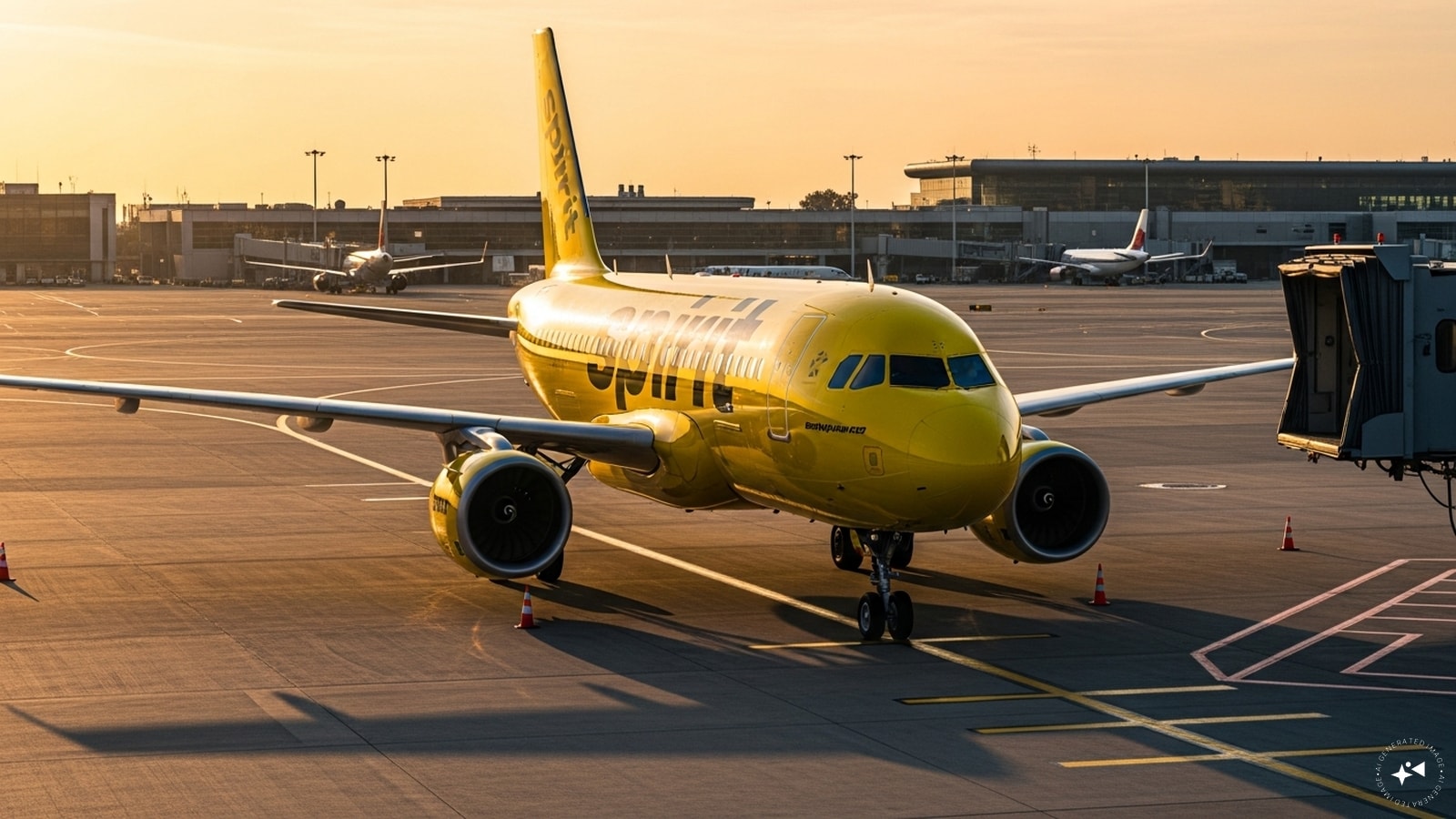
The industry is currently staring down a massive wave of consolidation. When JetBlue attempted to buy Spirit Airlines, the Department of Justice stepped in, arguing that the merger would eliminate the "Spirit Effect"—the phenomenon where the mere presence of a low-cost carrier in an airport forces the giants to drop their prices. The courts agreed. The merger was blocked.
But here is the irony that the standard news reports miss: the giants don't need to buy the small airlines to kill the competition. They just need to control the gates.
At airports like Newark, the "real estate" is more than just concrete. It is time. There are only so many minutes in a day when it is safe or efficient to land a plane. These slots are the gold bullion of the sky. When an airport undergoes a multi-billion dollar renovation—adding water features, gourmet dining, and high-tech security—the cost of operating out of that airport skyrockets.
Small, budget-friendly airlines can't afford the rent. They get pushed to the fringes, to smaller airports two hours away from the city center, or they simply vanish. United Airlines currently controls the lion's share of Newark. For Sarah, the water-art display is beautiful, but it is effectively a "No Trespassing" sign for the budget airlines she relies on.
The Ghost of the Deregulation Act
To understand why this is happening now, we have to look back at 1978. That was the year the government decided to stop telling airlines where they could fly and what they could charge. It was supposed to be the dawn of the golden age of the consumer. For a while, it was. People who had never flown before could suddenly afford a seat.
But capitalism has a way of tidying up messes. The mess of fifty competing airlines eventually settled into a handful of massive entities. We are now living in the logical conclusion of that 1978 dream. The industry has reached a point of "perfected" efficiency.
Efficiency, however, is rarely the friend of the traveler.
Efficiency means every seat is full. Efficiency means every plane is smaller. Efficiency means that if one airline dominates a specific geography—like Delta in Atlanta or United in Newark—they have no incentive to lower prices. Why would they? Where else are you going to go?
The Hidden Cost of Comfort
There is a psychological trick being played in these new, high-end terminals. When you walk through a space that feels like a luxury hotel, you are less likely to complain about a $15 sandwich or a $400 coach ticket. The environment signals "premium," and our brains adjust our expectations accordingly.
The water-art at Newark is a distraction from the hardware. While we marvel at the synchronized droplets, the "Big Three" are standardizing the experience. They are moving toward a world where they don't compete on price, but on "loyalty ecosystems." They want you to have their credit card, stay at their partner hotels, and fly through their fortress hubs.
This is the "Consolidation of Experience."
If you look at the recent earnings calls for major carriers, they aren't talking about winning over new customers with low fares. They are talking about "premium revenue." They are chasing the traveler who doesn't look at the price tag, leaving Sarah and her $99 dream behind.
The Domino Effect
What happens at Newark doesn't stay at Newark. The US airline industry is a series of falling dominoes. When one major hub becomes a fortress, the competitors feel the pressure to fortify their own strongholds.
If United tightens its grip on the New York/New Jersey area, JetBlue feels the need to merge with someone else just to survive. If JetBlue can't merge, it has to cut costs, which usually means cutting the very "budget" routes that made it popular in the first place.
The result is a thinning of the herd.
We are approaching a reality where the US aviation market looks like a utility company—like your water or electric provider. You have one choice. You pay what they ask. You accept the service they provide. But unlike a utility company, there is no government board cap on how much an airline can charge you to go home for the holidays.
The Human Toll of the Boardroom Battle
Let’s go back to the terminal.
Sarah is watching the water fall. She notices that the Spirit Airlines counter is tucked into a corner, staffed by two people with a line stretching out the door. The United counters are vast, automated, and humming with the quiet energy of a well-oiled machine.
The struggle of the "Ultra Low-Cost Carrier" (ULCC) is the struggle for the soul of American travel. If these airlines can't survive the rising costs of "artistic" airports and the aggressive scheduling of the giants, the sky becomes a gated community.
We often talk about airline consolidation in terms of "synergy" and "network density." Those are cold words. The warm reality is a father missing his daughter’s graduation because the "Spirit Effect" died in his city, and the remaining carrier doubled the fare. The reality is a small business owner who can't afford to fly to a trade show, or a student who can't get home for a funeral.
The invisible stakes are the moments we miss because the math no longer works for us.
The Final Approach
There is a tension in the air that no amount of lavender-scented mist can mask. The industry is at a breaking point. On one side, you have the push for grander, more expensive infrastructure that requires massive, stable, and wealthy airlines to fund. On the other, you have the American promise of mobility—the idea that the sky belongs to everyone, not just those with a corporate card.
The water-art at Newark is a masterpiece. It is also a tombstone for an era of travel that was messy, cheap, and accessible.
As the drops fall, spelling out words in the air, they tell a story of a disappearing middle ground. The giants are getting bigger. The small are being erased. And we, the passengers, are left standing in the mist, wondering when a trip to the sky became a luxury we could no longer afford to dream about.
The next time you walk through a breathtaking new terminal, don't just look up at the architecture. Look at the departure board. Count the logos. If you only see two or three names repeated over and over, you’ll know the price of the beauty surrounding you.
The water is falling, but the floor is rising.