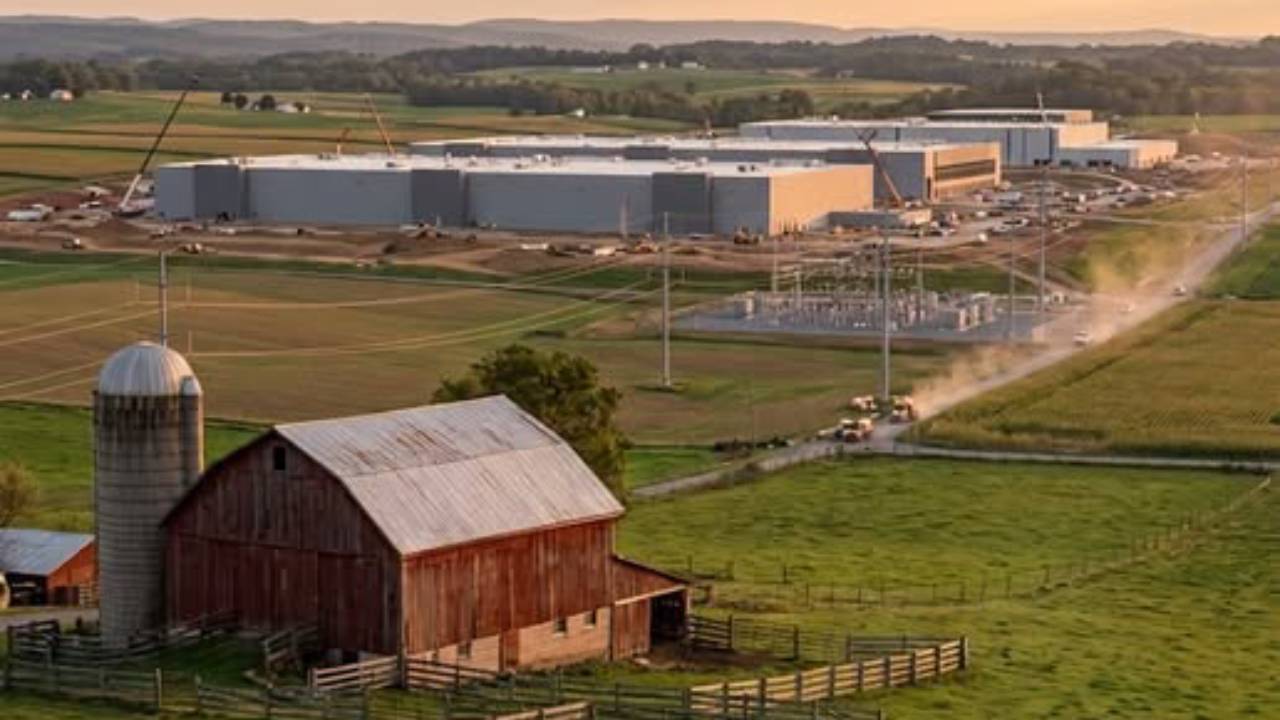
Agricultural land in strategic corridors no longer trades on soil fertility, crop yield, or livestock capacity. The transaction yielding $586 million across 1,700 acres in Pennsylvania—including an 89-acre hog farm acquired for $22 million—represents a fundamental re-pricing of rural real estate driven by infrastructure proximity rather than agricultural productivity. At an average valuation of $344,705 per acre across the broader transaction and $247,191 per acre for the single livestock parcel, these assets were priced as critical utility nodes for industrial expansion and hyperscale digital infrastructure.
Deconstructing this capital deployment requires analyzing three primary valuation drivers: infrastructure density, regulatory entitlement speed, and site assembly economics. For another perspective, check out: this related article.
The Infrastructure Proximity Multiplier
Standard agricultural acreage in Pennsylvania historically trades between $6,000 and $12,000 per acre, dependent on soil quality, slope, and water access. The $247,191 per acre valuation achieved by the 89-acre hog farm reflects a 20x to 40x multiple over baseline agricultural value. This premium is directly linked to four non-negotiable physical attributes required by industrial developers and data center operators:
- Power Grid Interconnection: Proximity to high-voltage transmission lines (typically 138kV to 500kV) and existing sub-stations. Securing grid connection queues through regional transmission organizations like PJM Interconnection can take four to seven years. A parcel situated contiguous to existing high-capacity power lines eliminates transmission buildout delays.
- Fiber Optic Backbone Integration: Direct physical access to long-haul dark fiber conduits along transportation corridors, ensuring low-latency data transmission.
- Water Rights and Discharge Capacity: Industrial facilities and evaporative cooling data centers require millions of gallons of daily water access along with established municipal or industrial discharge permits.
- Logistical Arterials: Immediate access to interstate highways capable of supporting heavy transport equipment during construction and operational phases.
When a property possesses all four attributes, the valuation model shifts from agricultural yield metrics to site replacement cost and time-to-market arbitrage. For a developer facing $10 million per month in delayed revenue due to power queue bottlenecks, paying a $20 million premium for an immediately developable site represents rational capital allocation. Similar reporting on the subject has been shared by Business Insider.
Site Assembly and Scalability Economics
Assemblage economics dictate that aggregated contiguous acreage commands an exponential premium over individual fragmented parcels. Securing 1,700 acres for $586 million demonstrates the execution of a multi-parcel aggregation strategy designed to bypass parcel fragmentation constraints.
The Fragmented Parcel Penalty
Large-scale infrastructure projects require contiguous tracts to optimize operational footprints, minimize perimeter security costs, and maximize structural efficiency. Acquiring 1,700 acres through individual negotiated transactions across dozens of distinct land owners introduces three core risk vectors:
- Holdout Leverage: A single property owner in the center of a planned development can demand an exorbitant sum or block project execution entirely.
- Title and Encumbrance Complexity: Compounding title searches, mineral rights disputes, and historic agricultural easements increase legal overhead and closing timelines.
- Zoning Variance Heterogeneity: Negotiating zoning changes across multiple local jurisdictions creates regulatory friction and extended approval cycles.
The Assemblage Premium
The average price of $344,705 per acre across the full 1,700-acre footprint indicates that larger, fully assembled contiguous tracts command higher per-acre valuations than smaller individual parcels like the 89-acre hog farm ($247,191 per acre). This valuation differential proves that developers are paying a premium for aggregation completeness, risk elimination, and direct access to major utility corridors across the larger boundary.
Agricultural Conversion Friction and Residual Value
Converting an operational livestock facility into an industrial construction site presents distinct operational cost structures that directly influence net acquisition pricing.
The valuation of $22 million for the 89-acre hog farm reflects the net present value of the land minus environmental remediation and decommissioning liabilities. Operational swine facilities contain specific site encumbrances:
- Lagoon Remediation: Anaerobic manure storage lagoons require environmental testing, sludge removal, backfilling, and soil stabilization.
- Structural Demolition: High-density animal housing structures require specialized waste removal and slab extraction.
- Subsurface Contamination Risks: Soil testing for elevated nitrogen, phosphorus, and heavy metals is required prior to securing commercial construction permits.
The willingness of buyers to absorb these remediation obligations while paying $247,191 per acre underscores the dominant value of the underlying location over the physical liability of existing structures.
Regional Re-Valuation Mechanisms in Pennsylvania
Pennsylvania's geographic position within the PJM market zone makes its agricultural corridors prime targets for industrial reallocation. Capital is migrating out of saturated submarkets toward secondary regions offering unconstrained power access and contiguous land availability.
Grid Capacity Bottlenecks in Surrounding Markets
Northern Virginia's Data Center Alley—traditionally the world's highest-density digital infrastructure market—faces severe power availability constraints. Dominion Energy has signaled extended timelines for bringing new transmission lines online. This power bottleneck has forced capital north into Pennsylvania markets served by PJM, where power transmission capacity remains available relative to regional demand.
The Regulatory Arbitrage of Rural Townships
Local land-use regulations in rural Pennsylvania townships often present lower political resistance and faster permitting cycles compared to urbanized or heavily suburbanized jurisdictions. When rural municipalities welcome industrial development for property tax base expansion, time-to-entitlement drops significantly.
A reduced timeline from site control to construction commencement preserves capital efficiency. Discounted cash flow models applied by infrastructure funds heavily penalize long permitting delays; reducing the approval cycle from 36 months to 12 months increases net present value, justifying inflated initial land purchase prices.
Capital Deployment Execution Protocol
For institutional investors, family offices, and developers evaluating rural land positions with utility adjacency, executing maximum value capture requires a structured four-phase process.
Phase 1: Infrastructure and Transmission Mapping
Identify agricultural parcels within a 0.5-mile radius of high-voltage electric transmission lines and natural gas trunk lines. Query regional power authority queue maps to identify sub-stations with unallocated capacity. Prioritize properties adjacent to existing fiber optic rights-of-way.
Phase 2: Title and Rights De-Risking
Verify clear ownership of mineral, water, and air rights. Agricultural properties in Pennsylvania frequently harbor severed oil, gas, or mineral leases that introduce clouding on title during industrial development. Terminate active agricultural leases or structure leaseback agreements with strict, expedited vacation clauses.
Phase 3: Pre-Emptive Entitlement Structuring
Execute option contracts rather than direct land purchases when securing assembly footprints. Secure conditional use permits, zoning modifications (shifting from Agricultural/Residential to Light/Heavy Industrial), and highway occupancy permits prior to closing capital execution.
Phase 4: Strategic Liquidation Sequence
Negotiate directly with end-user infrastructure funds or primary developers rather than mid-tier brokers. Frame the asset valuation strictly around saved development timelines, avoided power queue costs, and assembled acreage premiums rather than regional agricultural real estate comps.
To capture maximum enterprise value in utility-adjacent real estate, initiate immediate GIS spatial analysis across target utility corridors, cross-referencing sub-station capacity with contiguous parcel ownership records to secure option contracts ahead of institutional aggregators.