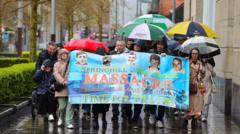
Justice is not a cold case file. It is not a podium in a wood-paneled room where a coroner spends weeks reciting facts that have been public knowledge for half a century. When we talk about the 1972 shootings—or any legacy case from the Troubles—the media falls into a predictable, lazy rhythm. They focus on "closure." They focus on the "findings." They treat the courtroom like a time machine that can somehow fix the past.
It can’t.
The standard narrative suggests that these inquests are a moral necessity. We are told that by dragging 54-year-old memories through a modern legal sieve, we are honoring the victims. In reality, we are performing a high-stakes piece of theater that costs millions, clarifies nothing, and serves only to reopen wounds without providing the surgical precision required to heal them.
The Myth of Modern Memory
The biggest lie in the legal system is the idea that human memory is a digital recording. It isn’t. Science tells us memory is reconstructive. Every time a witness recalls an event from 1972, they aren't playing a tape; they are rewriting a script influenced by decades of news reports, family conversations, and personal bias.
Elizabeth Loftus, a titan in the field of cognitive psychology, has proven for decades how easily "false memories" are planted. When a coroner asks an octogenarian to recall the exact positioning of a rifleman in a chaotic, smoke-filled street from five decades ago, they aren't seeking truth. They are seeking a narrative.
- The Degradation Factor: Biologically, the brain loses the ability to distinguish between what was seen and what was heard later.
- The Stress Loop: Trauma doesn't sharpen memory; it fragments it. High-cortisol events lead to "weapon focus," where a witness might remember a gun but forget the face of the person holding it.
- The Feedback Trap: Witnesses have read the previous reports. They’ve seen the documentaries. Their "testimony" is often just a subconscious collage of every piece of media they’ve consumed since the event.
We are basing "legal findings" on the most unreliable data set imaginable. It is an insult to the scientific method and a disservice to the families who expect a certainty that biology simply cannot deliver.
The Industry of Perpetual Grief
Let’s be honest about who these inquests actually serve. They serve a sprawling legal industry that has turned "legacy cases" into a recurring revenue stream.
I’ve watched departments burn through entire annual budgets on a single inquest. We are talking about millions of pounds in legal fees, expert witness costs, and administrative overhead. For what? To reach a verdict that "unjustified killing occurred"—a fact that anyone with a pulse and a history book already knew.
If the goal is genuinely to help the families, why aren't we taking that £10 million and investing it in the communities that are still suffering from the economic aftershocks of the conflict?
- Opportunity Cost: Every pound spent on a 1972 inquest is a pound not spent on mental health services for the youth of those same neighborhoods today.
- Bureaucratic Bloat: These proceedings move at a glacial pace because the process is the product. The longer it takes, the more billable hours are generated.
- The Closure Fallacy: "Closure" is a Hallmark card concept, not a psychological reality. Does a 300-page report from a coroner actually stop the grieving process? Usually, it just provides a new document for both sides to argue about for another decade.
We are prioritizing the ghosts of the past over the children of the present. That isn't justice. It’s an accounting error.
The False Equivalency of Forensic "Facts"
Coroners today try to apply 2026 forensic standards to 1972 crime scenes. It is a logical train wreck.
In 1972, scene preservation was a joke. Ballistics were primitive. Chain of custody for evidence was often nonexistent. When a modern expert stands up and gives a "definitive" take based on a grainy photograph and a lost bullet fragment, they are practicing creative writing, not science.
The "lazy consensus" is that more investigation always leads to more truth. That’s a fallacy. In many cases, more investigation leads to more noise. You end up with "competing experts" who are essentially paid to interpret the same void of information in two different ways.
The Reality of "Unjustified"
In many of these legacy shootings, the legal bar for "justified" use of force was fundamentally different in the 70s than it is now. We are retroactively applying modern human rights frameworks to a guerrilla war zone.
Imagine a scenario where a soldier in a high-tension riot hears a shot. He fires back. In 1972, his training and the standing orders (the Yellow Card) gave him a specific set of rules. In 2026, we judge him by a completely different set of societal expectations. This isn't to excuse the killings—many were objectively horrific—but to point out that the legal theater of an inquest is designed to find "fault" in a vacuum that doesn't account for the chaos of the time.
The Brutal Truth About Accountability
People want "accountability." They want someone in handcuffs. But the inquest system is specifically designed not to do that. It is a fact-finding mission, not a criminal trial.
By the time the coroner delivers findings, the primary actors are often dead or so infirm that prosecution is a physical impossibility. We are chasing shadows. We are putting "The Crown" or "The State" on trial, which results in a symbolic victory at best and a taxpayer-funded apology at worst.
If you want accountability, stop looking at the courtroom. Look at the policy. The failure wasn't just a soldier with a gun or a rebel with a bomb; it was a systemic collapse of political leadership. No coroner’s report can fix a political void.
The Actionable Alternative: Truth Over Trials
If we actually cared about the families, we would stop the adversarial legal posturing.
The South African Truth and Reconciliation Commission had its flaws, but it understood one thing: you cannot get the full truth while people are afraid of prosecution. Our current system encourages silence. Soldiers stay quiet to avoid jail. Paramitaries stay quiet to avoid retaliation.
We should be trading immunity for honesty.
- Abolish the Legacy Inquest: It is a failed format. Stop the drain on the public purse.
- Establish a Truth Commission: Give everyone a seat at the table with the guarantee that their words won't be used to bury them.
- Direct Restitution: Take the legal fees and give them directly to the descendants of the victims. No strings attached. No lawyers taking a 40% cut.
Stop Asking the Wrong Questions
The media asks: "Will the coroner find the killings were justified?"
That is the wrong question. The right question is: "Why are we still pretending that a legal ruling in 2026 changes the reality of 1972?"
We are obsessed with the "finding" because it allows us to feel like we’ve done something. It’s a collective ego trip. We get to feel morally superior to the people of the past while doing absolutely nothing to solve the systemic issues that lead to violence today.
The status quo is a comfort blanket for a society that refuses to move on. It’s time to stop the theater. It’s time to admit that some wounds cannot be healed by a gavel.
Close the files. Fund the future. Let the dead rest.