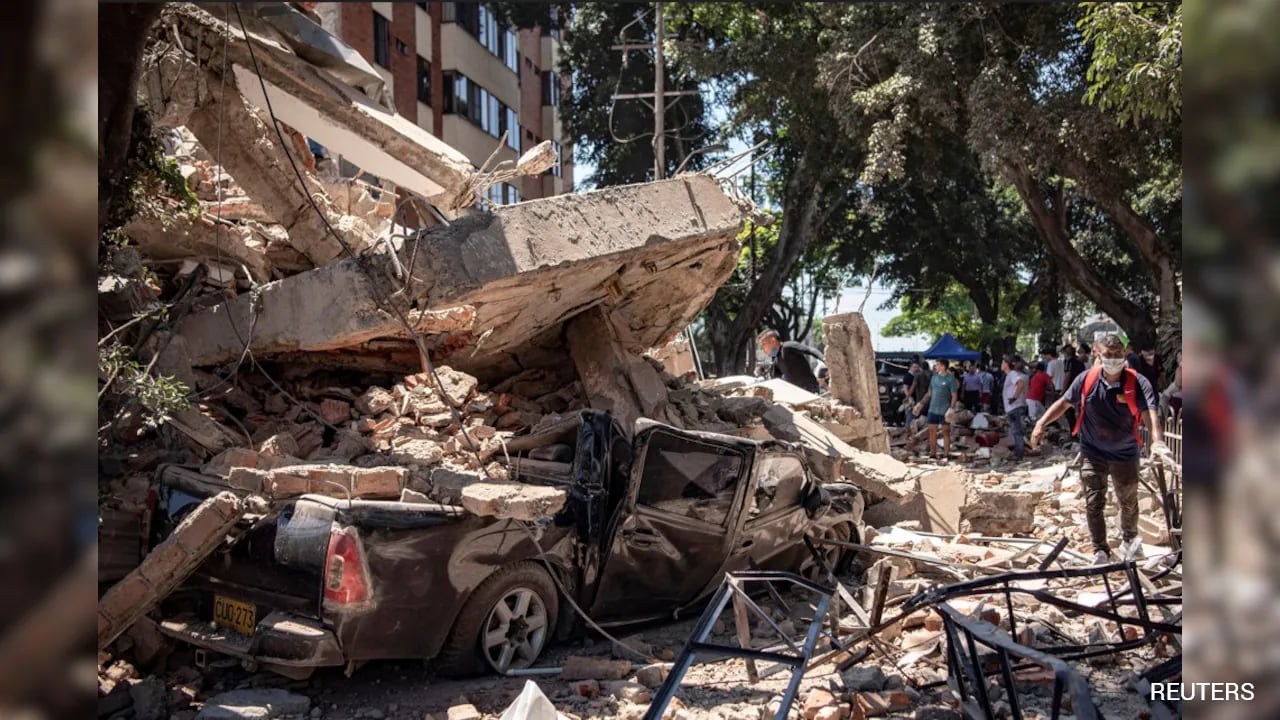
Ground doesn't usually turn to liquid quite that fast. When a 7.4 magnitude earthquake struck western Colombia, it didn't just rattle coffee cups; it brought entire city blocks down to size in seconds.
If you're tracking the aftermath of the disaster centered near Chocó, the numbers are staggering. Over 130 people are confirmed dead, hundreds more are injured, and thousands of families are staring at piles of rubble where their homes used to stand. Cities like Pereira and Cali took the heaviest hits, with hospitals partially collapsing and airport ceilings raining debris onto terrified passengers.
Let's look at what actually happened on the ground, why the destruction was so severe, and what comes next for a country now scrambling under a declared national state of emergency.
The Anatomy of a Monday Morning Disaster
The quake hit at 7:34 AM local time. People were heading to work, kids were getting ready for school, and the streets were busy. That timing matters. It meant commercial districts and older neighborhoods were packed when the ground started violently rolling.
The epicenter hit near San José del Palmar in the remote western Chocó department, at a depth of roughly 100 kilometers. Because it registered a 7.4 magnitude, the shockwaves didn't just stay local. They radiated outward across the country, rocking skyscrapers in Bogotá hundreds of miles away and sending residents fleeing into the streets in their pajamas.
Yet, the true devastation concentrated in the western coffee-growing region and the Pacific zone. In Pereira, streets filled with thick plumes of grey dust as multi-story buildings pancaked inward. In Cali, parts of the University Hospital gave way, trapping patients and medical staff in pediatric and neonatal wards.
Why Did So Many Buildings Collapse
When a major seismic event hits, structural integrity dictates survival. Colombia sits right along the active Pacific Ring of Fire, meaning earthquakes aren't an abstract concept. They're an inevitability.
Even so, the sheer volume of destruction—with roughly 1,600 buildings sustaining damage and dozens completely flattened—exposed brutal vulnerabilities in regional infrastructure. Older masonry structures, common throughout Pereira, Manizales, and Cali, lacked the modern seismic retrofitting needed to absorb that kind of lateral energy.
In Manizales, historical architecture took a direct hit when parts of a neo-Gothic cathedral tower crumbled right onto the main nave. Across the affected departments, schools, health centers, and key roadways suffered catastrophic failures.
Local officials faced immediate bottlenecks. Air traffic authorities had to shut down or heavily restrict operations at several regional airports, including Matecaña International in Pereira and facilities in Quibdó, Armenia, and Manizales. When runways are blocked by fallen ceiling panels and regional highways are cut off by landslides, getting emergency relief teams into isolated pockets of Chocó becomes an agonizing test of logistics.
The Human Toll and the Search for Survivors
Behind every statistic is a frantic search party. Digital databases set up by worried relatives quickly logged thousands of missing persons reports. Families crowded around collapsed storefronts and residential complexes in Cali and Pereira, using bare hands, shovels, and buckets to clear concrete chunks while waiting for heavy machinery to arrive.
President Abelardo de la Espriella stepped into a massive crisis just days into his term, rushing to declare a national emergency to unlock federal funds and deploy military personnel for rescue operations. International aid offers immediately started rolling in from neighboring countries and the United States, but the immediate hours belonged to local volunteers passing debris down human chains.
If you have family or friends in the affected regions of western Colombia, communication lines remain spotty due to damaged cell towers and power outages. Local authorities are urging everyone to stay away from damaged or cracked structures, as aftershocks continue to threaten weakened foundations. Check official municipal channels for updates on relief collection points, shelter locations, and emergency medical stations if you are on the ground trying to help.