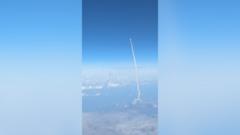
When the Artemis II mission clears the tower at Kennedy Space Center, the roar of the SLS rocket will be felt by thousands on the ground, but the most exclusive view won't be from the VIP bleachers. It will be from seat 14F on a routine flight to Atlanta or London. As NASA prepares to send humans back toward the moon for the first time in over half a century, the intersection of commercial aviation and deep-space exploration is creating a logistical headache that the FAA and airlines are only beginning to acknowledge.
This isn’t just about a lucky viral video captured through a scratched Plexiglass window. It is about the complete transformation of our national airspace into a theater of orbital mechanics. For decades, rocket launches were isolated events that happened behind the "iron curtain" of restricted zones. Today, they are high-frequency disruptions that force pilots to choose between staying on schedule and giving their passengers a front-row seat to history.
The Mechanics of a High Altitude Encounter
Seeing a rocket from a plane isn't a matter of luck. It is a matter of physics and the specific geometry of the Florida coast. When the Artemis II SLS rocket ignites, it carries a plume of superheated exhaust that expands rapidly as it hits the thinner atmosphere of the upper stratosphere. At 35,000 feet, a commercial jet is sitting right at the edge of the troposphere, providing a clear line of sight that can extend for hundreds of miles.
The SLS is the largest rocket ever built. Its solid rocket boosters produce a trail of aluminum oxide and water vapor that reflects sunlight even when the ground is in total darkness. This is known as the twilight phenomenon. If the Artemis II launch occurs during the "golden hour"—just before sunrise or after sunset—the rocket will climb out of the Earth’s shadow into direct sunlight while the observer on the plane remains in the dark. The result is a glowing, neon-blue nebula that looks more like a celestial event than a man-made machine.
But this visual spectacle hides a complex dance of air traffic control. To keep those passengers safe, the FAA must clear "temporary flight restrictions" or TFRs. These are massive blocks of invisible territory that are closed to all civilian traffic. When a launch window opens, the Atlantic corridor becomes a maze.
Why the FAA Struggles with the Launch Boom
The sheer frequency of modern launches—driven by SpaceX, United Launch Alliance, and now the Artemis program—has turned the Florida air corridors into a bottleneck. In the past, a single launch might delay a few dozen flights. With Artemis II, the scale of the rocket and the complexity of its trajectory mean the "keep-out" zones are larger and more restrictive than ever before.
Airlines hate these delays. Every minute a Boeing 787 spends circling or taking a longer route around a restricted zone burns thousands of pounds of fuel. Yet, there is a strange marketing irony at play. While the corporate offices at Delta or United are crunching the numbers on lost revenue, their pilots are often looking for ways to give passengers a glimpse of the action.
The reality of these sightings is often less about a planned "fly-by" and more about the chaotic reality of modern logistics. If a flight is delayed at the gate, it might inadvertently end up in the perfect position to see the SLS punch through the clouds. It is a collision of two worlds: the high-efficiency, low-margin world of commercial travel and the high-risk, high-cost world of lunar exploration.
The Physical Risks of Proximity
We have to talk about the danger that nobody mentions in the viral TikTok captions. If a commercial aircraft is close enough to see the detailed staging of a rocket, it is potentially in a zone of increased risk. Rockets are essentially controlled explosions. If an SLS vehicle were to suffer a catastrophic failure—what engineers call "Rapid Unscheduled Disassembly"—the debris field would spread across thousands of square miles of ocean and airspace.
The FAA calculates "Expectation of Casualty" (Ec) metrics for every launch. They ensure that the risk to any individual on the ground or in the air is lower than one in a million. However, as launch cadences increase, the mathematical probability of a "close call" with falling debris or atmospheric turbulence caused by the rocket's wake becomes a factor that safety boards must monitor.
The wake vortex of a rocket like the SLS is massive. As the vehicle goes supersonic, it creates shockwaves that can ripple through the atmosphere. While a plane at 30,000 feet is miles away from the actual flight path, the atmospheric displacement is significant. Pilots aren't just worried about hitting the rocket; they are navigating the literal wake of a moon-bound ship.
The New Era of Space Tourism for the Masses
Artemis II isn't just a test flight. It is the beginning of a sustained presence on the moon. This means the sight of a rocket from a commercial window will transition from a "once-in-a-lifetime" event to a routine part of the travel experience.
We are seeing the birth of an "accidental" space tourism industry. You don't need a $200,000 ticket on a suborbital flight to see the curvature of the Earth and a rocket ascending to the stars. You just need a window seat on a flight from JFK to Miami and a pilot who is willing to tip the wing.
This creates a new set of expectations for travelers. We are already seeing "launch chasers" booking flights specifically timed to coincide with NASA windows. They use apps to track the TFRs and flight paths, hoping to be the ones to capture the definitive shot of the SLS heading for the lunar south pole.
The Logistics of the View
To maximize the chance of seeing Artemis II from the air, a passenger needs to understand the "Dogleg" maneuver. Most rockets launched from Cape Canaveral don't go straight up; they tilt East/South-East to take advantage of the Earth's rotation.
- Window Selection: If you are flying North to South, you want a window on the left side of the plane (Port).
- Timing: The first three minutes of the launch are the most visible. Once the rocket passes the Max-Q phase (maximum dynamic pressure), it is moving so fast that it will disappear from view in seconds.
- Altitude: The higher the plane, the thinner the air, and the less distortion you get from the cockpit or cabin windows.
The Infrastructure Crisis Hidden in the Clouds
The real story isn't the beauty of the launch; it’s the strain on our infrastructure. The United States hasn't updated its primary air traffic control technology in decades. We are using 20th-century tools to manage a 21st-century space race.
When NASA launches Artemis II, they aren't just using a rocket; they are hijacking the most congested airspace in the world. The "Space Data Integrator" (SDI) is a new tool the FAA is using to try and shrink these restricted zones. It allows controllers to see the rocket's position in real-time alongside commercial planes. Before SDI, the FAA had to close massive blocks of air "just in case." Now, they can open and close them like a surgical strike.
But it’s not perfect. The system still relies on manual coordination between NASA, the Space Force, and civilian air traffic centers. One communication glitch can ground hundreds of flights or, worse, leave a commercial jet too close to a launch corridor.
The Visibility Paradox
There is a final, more philosophical tension at work here. We live in an era where everything is recorded, yet the Artemis II mission represents a return to a type of exploration that is inherently "out of sight." Once the rocket clears the atmosphere and the boosters drop away, the four astronauts inside the Orion capsule will be further from humanity than any person has been since 1972.
The commercial passengers who see the launch from their windows are the last ones to see these explorers with the naked eye. After that, they become pixels on a NASA TV feed, beamed back from a distance of 240,000 miles. That brief moment of visibility from a Boeing or Airbus is the only physical link between the mundane world of business travel and the extraordinary reality of deep space.
We have reached a point where the mundane and the miraculous share the same sky. The person watching a movie on their iPad and the person looking out the window at a lunar rocket are separated by only a few inches of glass and a few thousand feet of altitude.
If you find yourself on a flight over the Atlantic during the Artemis II window, put the phone down. The sensors on your camera cannot capture the scale of a thirty-story building propelled by millions of pounds of thrust. The blue glow of the ionized air, the orange flame of the boosters, and the realization that four people are sitting on top of that fire—that is something no viral video can convey.
Would you like me to research the specific flight paths and airline schedules that offer the highest probability of intersecting with the Artemis II launch window?