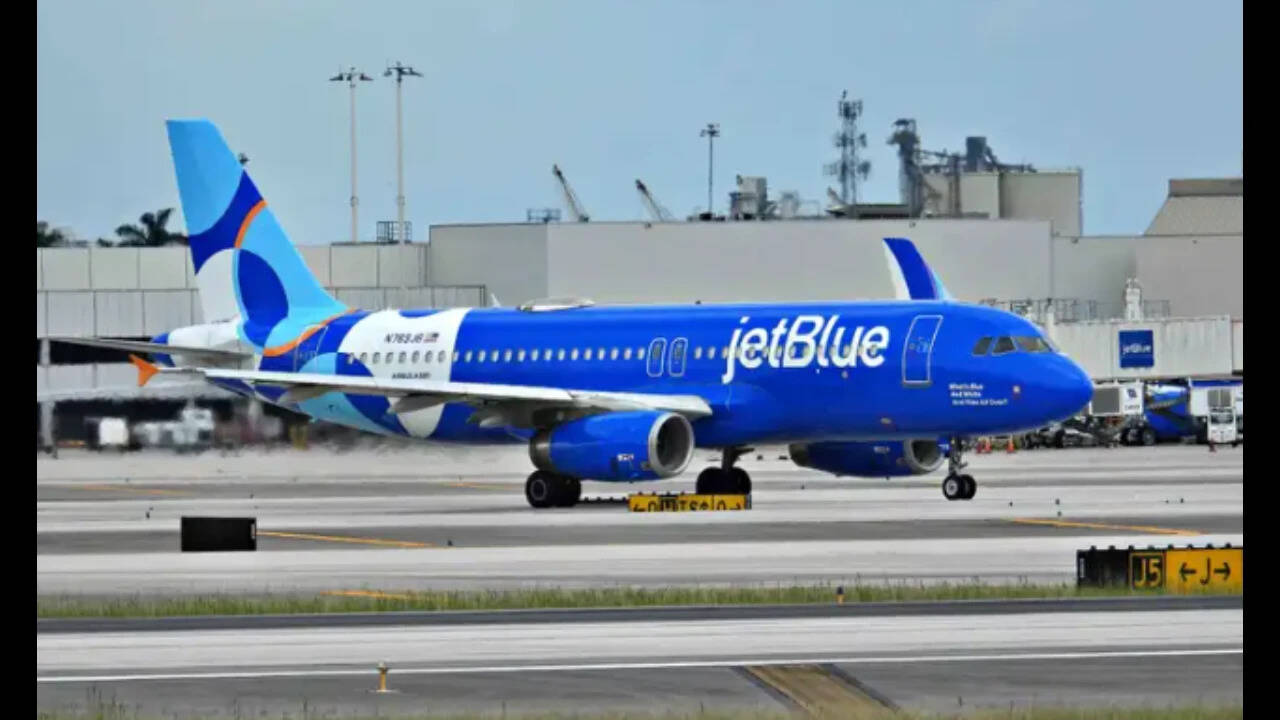
Five people ended up in the hospital after JetBlue Flight 1717 hit violent turbulence on its way from San Juan to Orlando. That's the headline version. If you've ever flown across the Atlantic or the Caribbean during peak convective weather, you already know how fast a smooth cruise at 35,000 feet can turn into absolute chaos inside the cabin.
When a commercial airliner drops suddenly in clear air or near a storm cell, physics doesn't care how experienced the flight crew is. Anything—and anyone—not strapped down instantly becomes a projectile. On Flight 1717, the jolt was severe enough that four passengers and one crew member sustained injuries requiring immediate medical transport once the Airbus A320 touched down at Orlando International Airport.
Breaking Down the Incident on JetBlue Flight 1717
Let's look at the timeline and hard facts of what went down aboard JetBlue Flight 1717. The aircraft departed Luis Muñoz Marín International Airport (SJU) in San Juan, Puerto Rico, bound for Orlando International Airport (MCO) in Florida. This is a routine, heavily traveled corridor over open water, typically taking just under three hours.
Mid-flight, the plane encountered severe turbulence. Unlike light chop—the kind where your coffee ripples and the flight attendants keep serving ginger ale—severe turbulence involves large, abrupt changes in altitude and attitude. The aircraft experiences significant variations in airspeed, and passengers are violently forced against their seatbelts. If those belts aren't fastened, people hit the overhead bins.
JetBlue confirmed that the flight landed safely in Orlando without declaring an emergency diversion to an alternate airport, meaning the aircraft itself remained structurally sound and fully controllable throughout the ordeal. Emergency medical technicians from the Greater Orlando Aviation Authority Fire Rescue met the plane right at the gate. Five people—four passengers and a single flight attendant—were evaluated on-site and transported to a local hospital for further treatment.
Why Flight Attendants Take the Brunt of Severe Turbulence
You'll notice a pattern across almost every major turbulence report filed with the National Transportation Safety Board (NTSB). Flight attendants get hurt at a disproportionately higher rate than passengers.
Why? Because they're standing up doing their jobs when the invisible wall of air hits. While passengers have the luxury of sitting buckled into padded seats, cabin crew members are walking the aisles, securing heavy beverage carts, or checking lavatories right up until the last second before turbulence strikes. On Flight 1717, that injured crew member was likely caught mid-task when the vertical acceleration spiked.
The Invisible Threat Over the Caribbean and Atlantic
Most travelers assume turbulence only happens when you fly straight through a dark, angry thundercloud. That's completely false. In fact, some of the most dangerous bumps in aviation happen in crystal-clear blue skies.
Pilots call this Clear Air Turbulence (CAT). It occurs when two bodies of air moving at wildly different speeds collide, usually near the jet stream or along the boundaries of upper-level troughs. Because there's no moisture or cloud formation involved, standard onboard weather radar—which relies on bouncing radio waves off water droplets and ice crystals—can't see it coming.
The route between Puerto Rico and central Florida sits right in a meteorological crossroads. Even when CAT isn't the culprit, convective activity over the Atlantic produces invisible ripples called gravity waves that radiate miles away from visible storm tops. Your pilot might be steering twenty miles clear of a thunderstorm cell on their radar screen and still get slammed by violent vertical drafts spilling off the storm's anvil.
What "Severe" Actually Means in Aviation Terms
The Federal Aviation Administration (FAA) classifies turbulence into four distinct categories, and people misuse these labels constantly:
- Light: Slight, erratic changes in altitude or attitude. You feel a mild strain against your seatbelt, and walking is still relatively easy.
- Moderate: Similar to light turbulence, just with greater intensity. Unsecured objects move around, walking becomes difficult, and food service stops immediately.
- Severe: Large, abrupt changes in altitude and attitude. The aircraft may be momentarily out of control, occupants are forced violently against their seatbelts, and walking is impossible. This is what hit JetBlue Flight 1717.
- Extreme: The aircraft is violently tossed about and is practically impossible to control. Structural damage can actually occur here.
Are Turbulence Injuries Getting Worse?
If it feels like you're reading news stories about JetBlue, United, or Singapore Airlines hitting severe turbulence every other week, you aren't imagining things. The data backs it up.
Atmospheric scientists at the University of Reading published a widely cited study examining four decades of meteorological data. Their findings were blunt: severe clear-air turbulence over the North Atlantic has increased by roughly 55% since 1979. Warmer air holds more energy and creates sharper temperature gradients at high altitudes, which supercharges wind shear along the jet stream.
Does this mean planes are falling out of the sky? No. Modern commercial airliners like the Airbus A320 are over-engineered to withstand absurd aerodynamic stress. The wings on an A320 can flex upward by several feet without snapping—far beyond anything Mother Nature throws at them on a bad day over the Bahamas.
The real danger isn't the airplane breaking. It's the soft human bodies inside a metal tube traveling at 500 miles per hour. According to FAA statistics, turbulence is the leading cause of non-fatal injuries to airline passengers and flight crews in the United States. Between 2009 and 2022, the FAA recorded 163 serious turbulence injuries—meaning injuries requiring at least 48 hours of hospitalization, bone fractures, or internal organ damage. Nearly 80% of those victims were crew members, and the remaining passengers almost universally shared one critical mistake. They took their seatbelts off.
What Pilots and Airlines Do to Dodge Rough Air
When a pilot hits unexpected rough air like the crew on JetBlue Flight 1717 did, a massive communication chain kicks off instantly behind the scenes.
First, the captain files a PIREP (Pilot Weather Report) directly with Air Traffic Control. They'll report their exact altitude, aircraft type, and the severity of the chop. Within seconds, controllers relay that warning to every other jet trailing behind them on the same airway, allowing nearby flights to request immediate altitude changes—climbing or descending 2,000 to 4,000 feet to find smoother air.
Airlines also rely heavily on predictive software now. Carriers like JetBlue, Delta, and American use real-time eddy dissipation rate (EDR) data streamed straight from aircraft accelerometers to ground servers. Instead of relying on a pilot's subjective guess of what "moderate" feels like, sensors measure the exact vertical G-forces acting on the fuselage and map those pockets onto tablets inside the flight deck.
Still, technology has limits. Even the best predictive models can't pinpoint every localized pocket of wind shear five minutes before impact. Sometimes, the plane hits the bump first, and the seatbelt sign comes on three seconds too late.
Practical Rules to Protect Yourself on Your Next Flight
You can't control the atmosphere over the Atlantic, and you can't see clear-air turbulence out the window. You can completely eliminate your odds of becoming a hospital statistic if your flight hits an air pocket like Flight 1717.
Stop treating the seatbelt sign like a suggestion. Honestly, it's the simplest habit in travel, yet half the cabin clicks their buckle open the exact second the chime turns off at 10,000 feet.
Keep your seatbelt fastened low and tight across your hips every single second you're sitting in your seat. If you're sleeping, pull your blanket over the buckled belt so flight attendants don't have to wake you up to check it when rough air hits.
Think twice before getting up to use the bathroom when you're flying through known convective zones—like afternoon summer flights into Florida or over the Caribbean. If you do need to walk the aisle, keep one hand near the top of the seatbacks as you move so you have an anchor point if the floor suddenly drops out from under your feet.
Finally, skip hot coffee or tea when the air feels even slightly bumpy. Scalding liquids are responsible for a massive percentage of minor turbulence burns that never even make the local news. Keep your heavy laptops and hard-sided water bottles stowed under the seat in front of you rather than loose on your lap or tray table, because a two-pound metal flask turns into a brick during negative-G drops. Buckle up, keep it tight, and let the pilots handle the weather.