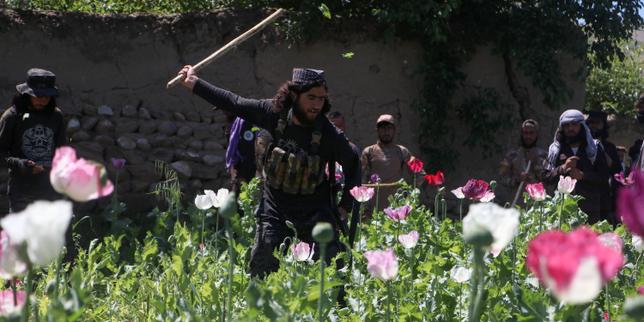
The global narcotics market is currently undergoing its most violent structural shift in decades, triggered not by a law enforcement breakthrough, but by a domestic policy shift in Kabul. When the Taliban authorities enforced a rigorous ban on poppy cultivation in 2022, the move was widely dismissed as a temporary diplomatic ploy to gain international legitimacy. It wasn't. Satellite imagery and ground-level trade data now confirm a staggering 95% reduction in opium production across Afghanistan. This has effectively removed the world’s primary source of heroin, creating a supply vacuum that is being filled by far more lethal alternatives.
The ban has shifted the burden of the drug trade from a rural agricultural issue to a geopolitical security crisis. For decades, the opium economy functioned as a massive, informal social safety net for millions of Afghan farmers. By dismantling this economy without providing a viable financial alternative, the current administration has inadvertently destabilized the entire regional trade architecture. The result is a surge in synthetic drug production and a desperate scramble by trafficking networks to find new routes and products.
The Economic Ghost of the Poppy Fields
Opium was never just a "drug problem" in the Hindu Kush. It was the only functioning credit system in a country largely cut off from global banking. Under the salaam system, traders provided advance payments to farmers during the lean winter months in exchange for a portion of the future harvest. This kept families fed when the snow blocked the passes.
By banning the crop, the authorities didn't just stop a harvest; they liquidated the credit market. Recent reports from the ground indicate that rural debt is skyrocketing. Without the poppy, farmers have turned to wheat or pomegranates, but these crops offer a fraction of the return and require infrastructure—cold storage, irrigation, and reliable transport—that simply does not exist.
The immediate fallout is a massive internal migration. Laborers who once moved across provinces for the harvest are now fleeing toward the borders of Iran and Pakistan. This is an economic displacement masquerading as a law enforcement success. The international community, while publicly celebrating the reduction in heroin flow, is now facing the secondary consequence: a potential refugee crisis driven by the sudden evaporation of the rural GDP.
The Rise of the Methamphetamine Pivot
Nature and black markets both abhor a vacuum. As the opium supply dried up, the Afghan "narco-industrial complex" quickly pivoted to ephedra, a wild herb that grows abundantly in the central highlands. This plant is the raw material for methamphetamine.
This transition represents a significant escalation in the complexity of the regional drug trade. Unlike opium, which requires vast tracts of land and months of labor, methamphetamine is produced in small, mobile laboratories that are nearly impossible to track via satellite. The profit margins are also significantly higher. A few kilograms of high-purity meth are worth more than a ton of raw opium and are infinitely easier to smuggle across the porous borders of Central Asia.
The New Chemistry of Conflict
The shift to synthetics has fundamentally changed the power dynamics of the borderlands.
- Infrastructure: Old smuggling routes used for heroin are being repurposed for meth and Captagon.
- Logistics: Traffickers no longer need to wait for a seasonal harvest, making the supply chain year-round.
- Chemistry: The reliance on wild ephedra is being supplemented by industrial-grade precursors smuggled in from neighboring industrial powers.
This "synthetic turn" means that even if the poppy ban remains in place, the region remains a global hub for illicit substances. The players have changed their product, but the underlying machinery of the shadow economy remains intact and, in many ways, has become more resilient.
Regional Neighbors and the Double Edged Sword
The states surrounding Afghanistan find themselves in a precarious position. For years, Iran and Tajikistan served as the primary transit corridors for Afghan heroin bound for Europe. They paid a heavy price in terms of domestic addiction rates and border violence. On paper, the Taliban’s ban should be a victory for Tehran and Dushanbe.
The reality is more complicated. The sudden disappearance of heroin has paved the way for the "Fentanyl-ization" of the Eurasian market. In the United States, the shortage of organic heroin led to the total dominance of synthetic opioids, which are significantly more deadly. Europe and Western Asia are now staring down that same barrel. If the Afghan heroin supply does not return, organized crime groups will inevitably turn to synthetic opioids to maintain their margins.
Furthermore, the loss of the opium tax—once a major source of revenue for local warlords and officials—has created a power struggle over what remains. Conflict is no longer about controlling the poppy fields; it is about controlling the checkpoints and the chemical precursor trade. This shifts the violence away from the farms and into the cities and border crossings, directly threatening the stability of neighboring regimes.
The Myth of Replacement Crops
International NGOs have long advocated for "alternative livelihoods," suggesting that saffron or high-value nuts could replace opium. This narrative ignores the brutal math of the illicit trade. Opium is a high-value, non-perishable, and easily transportable commodity. A farmer can store a bag of opium paste under their floorboards for years, and its value will likely appreciate. It is, in effect, a hard currency.
Wheat is bulky, perishable, and its price is subject to the whims of the global market. To make wheat as profitable as opium, an Afghan farmer would need access to mechanized equipment and international trade agreements that are currently blocked by sanctions.
The "success" of the ban is therefore built on a foundation of extreme poverty. The Taliban are currently using their internal security apparatus to enforce the decree through fear and direct destruction of fields. This is a short-term solution. History shows that when the central authority’s grip weakens—or when the economic pressure on the rank-and-file becomes unbearable—the poppy has a way of returning to the soil.
A Global Supply Chain in Flux
We are witnessing a massive reorganization of the global drug trade. The "Golden Crescent" is evolving. The move toward synthetics suggests that the era of the agrarian narco-state is ending, replaced by a more decentralized, chemical-based model. This has profound implications for global health and security.
Key Pressure Points in the Current Market
| Factor | Heroin Era | Synthetic Era |
|---|---|---|
| Production | Seasonal / Weather-dependent | Continuous / Laboratory-based |
| Detection | High (Satellite-visible fields) | Low (Small, mobile labs) |
| Potency | High | Extreme (Microgram dosages) |
| Economic Impact | Broad rural participation | Narrow, technical elite |
The international community's refusal to engage with the de facto government in Kabul complicates any effort to manage this transition. Without a coordinated plan to provide real economic alternatives, the world is essentially conducting a massive, uncontrolled experiment on the global drug market. We have successfully removed a known evil—heroin—only to invite a far more unpredictable and lethal successor in the form of mass-produced synthetic stimulants and opioids.
The focus must move beyond the simple metrics of hectares destroyed. Real success would look like a stable Afghan economy that doesn't rely on the "black box" of illicit trade to survive. As long as the formal economy is strangled by isolation and lack of infrastructure, the shadow economy will simply find a new chemical formula to thrive. The poppy fields may be empty, but the supply lines are busier than ever.
Security forces in the region are already reporting a surge in the seizure of synthetic precursors. These chemicals aren't coming from the mountains; they are coming from the global industrial supply chain. This means the "Afghan drug problem" is no longer confined to Afghan borders. It is a failure of global trade oversight and a testament to the adaptability of organized crime. The ban has not solved the problem; it has merely changed its state from a solid to a liquid, allowing it to flow into even more dangerous corners of the world.
The true test will come in the next twenty-four months as the remaining stockpiles of old opium are exhausted. When the heroin finally runs out in the streets of Moscow, Berlin, and London, the synthetic tidal wave will hit. That is the moment we will realize that a "drug-free" Afghanistan, achieved through economic starvation rather than development, is a pyrrhic victory of the highest order.
Stop looking at the maps of destroyed fields and start looking at the shipping manifests of chemical wholesalers. That is where the next war is being fought.