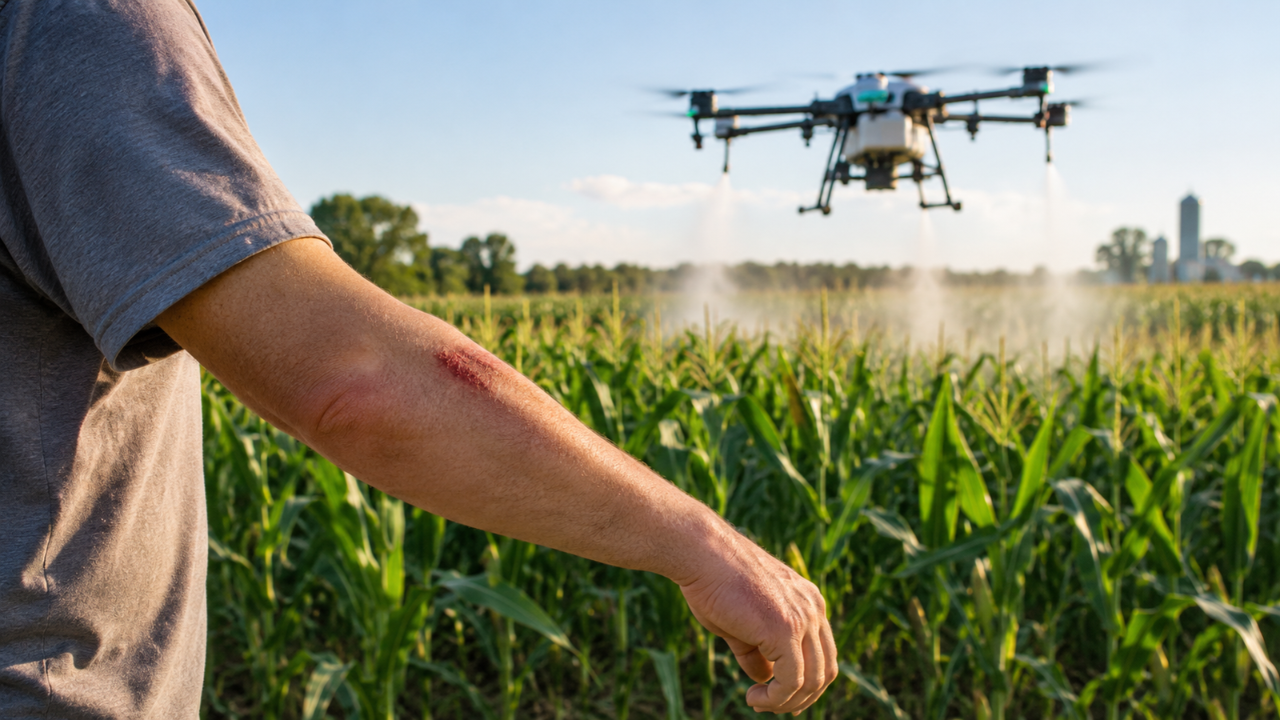
When an agricultural spraying drone struck Lonnie Howard in Indiana in 2024, the resulting legal determination that the operating farmer bore no liability exposed a structural divide in modern tort law. Operators and insurers routinely assume that unmanned aerial vehicles carry the same strict liability burdens as traditional crop-dusting aircraft or hazardous chemical applications. This assumption is flawed. The exoneration of the Indiana operator demonstrates that when autonomous or remotely piloted agricultural machinery intersects with third-party injury, courts evaluate liability through the traditional mechanics of negligence, duty of care, and assumption of risk rather than strict liability frameworks.
To manage operational risk in precision agriculture, commercial applicators, farm managers, and risk underwriters must deconstruct the legal and operational variables that governed this outcome. Understanding why liability did not attach requires separating federal aviation compliance from state-level premises and negligence doctrines.
The Structural Architecture of Agricultural Drone Liability
Liability in heavy agricultural drone operations is governed by four distinct legal mechanisms. When an incident occurs, the court does not apply a single blanket rule; instead, it filters the facts through a sequential hierarchy of fault.
- Ordinary Negligence and the Reasonable Operator Standard: Under standard tort principles, a plaintiff must prove four elements: duty, breach, causation, and damages. If an operator follows manufacturer guidelines, maintains visual line of sight, and executes pre-flight safety protocols, proving a breach of duty becomes mathematically and legally difficult.
- Premises Liability and Entrant Classification: In rural and agricultural settings, the legal duty owed by a landowner or operator shifts dramatically depending on the injured party's status—invitee, licensee, or trespasser. An unauthorized or unexpected entrant into an active spray zone triggers a drastically reduced duty of care, often requiring the plaintiff to prove willful or wanton misconduct rather than simple carelessness.
- Comparative Fault and Assumption of Risk: Indiana operates under a modified comparative fault regime (the 51% bar rule). If the injured party's own actions—such as ignoring perimeter warnings, approaching an active low-altitude flight path, or entering a marked operational zone—contribute to more than 50% of the proximate cause of the injury, recovery is completely barred.
- The Rejection of Abnormally Dangerous Activity: Historically, aerial pesticide application via manned fixed-wing aircraft occasionally triggered strict liability under the Restatement (Second) of Torts, which holds parties liable regardless of fault if an activity is deemed "abnormally dangerous." However, the deployment of low-altitude, GPS-fenced unmanned aircraft systems (UAS) lacks the kinetic mass, wide drift radius, and high-altitude unpredictability of manned aircraft. Courts increasingly classify agricultural drones as standard farm machinery rather than ultrahazardous instruments.
The Operational Mechanics of the 2024 Incident
Evaluating the non-liability outcome in the Lonnie Howard incident requires isolating the physical and procedural variables inherent to heavy-lift spray drones. Modern agricultural UAS—such as platforms carrying 10 to 40 liters of liquid payload—operate within tightly constrained aerodynamic and geographic envelopes. Unlike manned crop dusters flying at 100+ knots, agricultural spray drones typically operate at altitudes between 10 and 20 feet above the crop canopy at speeds under 15 to 20 miles per hour.
Because the operational envelope is localized, the causal chain of a physical strike narrows to two primary vectors: mechanical/software failure or spatial encroachment.
Vector A: System Integrity and Regulatory Compliance
When a drone strikes an individual, investigators immediately audit the flight controller logs, obstacle avoidance telemetry, and Federal Aviation Administration (FAA) Part 137 compliance records. Part 137 governs agricultural aircraft operations, requiring specific certifications for dispensing chemicals.
If telemetry confirms that the drone remained within its pre-programmed geofence, maintained proper altitude, and exhibited no uncommanded erratic behavior, the operator effectively neutralizes claims of negligent piloting. The machine performed its intended function within its designated boundary.
Vector B: Spatial Encroachment and Warning Protocols
The second variable is perimeter control. Heavy agricultural drones generate substantial acoustic signatures—often exceeding 75 to 85 decibels at close range due to large-diameter rotors moving heavy payloads. The physical presence of the aircraft is rarely covert.
When a third party enters the operational footprint of a loud, low-flying agricultural machine, the legal analysis shifts from the pilot's control inputs to the plaintiff's situational awareness. Under comparative fault doctrines, walking into the path of active, visibly operating farm equipment—whether a combine harvester, a center-pivot irrigation system, or a spray drone—places the burden of avoidance on the pedestrian. If the operator established reasonable visual buffers or if the injured party lacked authorization to be within the operational corridor, the operator's legal exposure collapses.
Why Traditional Aviation Precedents Fail in UAS Litigation
A common strategic error among plaintiffs' counsel and risk managers is importing manned aviation case law directly into commercial drone disputes. Manned aviation law evolved around the concept that an aircraft falling from the sky poses an unavoidable, catastrophic hazard to ground-based bystanders who have zero ability to detect or evade the threat.
Agricultural drone operations invert this physical reality across three dimensions:
- Kinetic Energy Profiles: A manned Air Tractor fully loaded weighs roughly 16,000 pounds. A heavy agricultural drone weighs between 150 and 220 pounds fully loaded. While capable of causing serious blunt-force trauma or lacerations upon direct impact, the kinetic energy differential changes how courts weigh the inherent danger of the machine.
- Precision Containment: Manned crop dusters require wide turnarounds over neighboring properties, highways, and structures, creating continuous third-party exposure. Agricultural drones execute zero-radius turns directly inside property boundaries. Third-party exposure only occurs when an external party breaches the farm's perimeter or when a catastrophic flyaway occurs.
- Acoustic and Visual Transparency: At 15 feet off the ground, an agricultural drone is directly within the human field of vision and hearing. Unlike an overhead airliner or a high-speed fixed-wing aircraft, ground personnel can observe the drone's exact trajectory, speed, and spray pattern in real time.
This divergence means that legal defenses successful in tractor or forklift accidents—such as open and obvious danger doctrines—apply directly to agricultural drones. If a hazard is open and obvious to a reasonable person, the property owner or operator generally has no duty to protect against it, provided the operator did not actively steer the machine into the victim.
The Cost Function of Operational Risk Management
While the Indiana ruling establishes a favorable precedent for operators, relying on favorable tort doctrines after an accident is a losing financial strategy. Litigation defense costs alone can bankrupt a small commercial application business even when the verdict favors the defense. Farm operators and commercial applicators must treat legal defensibility as an engineering problem, optimizing their standard operating procedures (SOPs) to generate irrefutable evidentiary trails before an incident occurs.
To secure an automatic summary judgment or rapid dismissal in the event of a strike, an operation must satisfy four operational metrics:
1. Automated Telemetry Retention
Flight logs are the black box of precision agriculture. Operators must configure their ground control stations to automatically archive high-frequency telemetry data—GPS coordinates, altitude, airspeed, stick inputs, and radar/binocular vision obstacle-avoidance logs—for a minimum of three to five years (matching typical state statutes of limitations for personal injury). In the absence of objective telemetry, a lawsuit devolves into competing eyewitness testimonies, which destroys the viability of early dismissal.
2. Verifiable Perimeter Hardening
Relying on informal verbal warnings is operationally negligent. When spraying near public roads, residential borders, or multi-use paths, operators must deploy physical signage indicating active low-altitude drone operations. Photographing the deployed signage with timestamped, geotagged mobile devices prior to takeoff creates a permanent evidentiary record proving the operator satisfied their duty to warn.
3. Geofence Buffer Calibration
Software geofences must never be drawn directly on the physical property line or edge of a public right-of-way. Wind gusts, GPS drift, and braking distances at maximum payload weight require a spatial buffer. Operators should program a hard electronic boundary at least 30 to 50 feet inside any public-facing perimeter, forcing manual spot-treatment or ground-rig application for the outer margin if third-party foot traffic is present.
4. Separation of Regulatory Entities
Many farm operations blur the line between their core land-holding entity and their drone spraying operations. Operating heavy UAS under a distinct Limited Liability Company (LLC) with dedicated commercial aviation liability coverage—separate from standard farm umbrella policies—isolates land and equipment assets from litigation exposure. Standard farm liability policies frequently contain aviation exclusions that void coverage the moment an unmanned aircraft leaves the ground, leaving the operator personally exposed to legal defense fees.
Limitations of the Non-Liability Precedent
Operators must recognize the strict boundaries of the Indiana outcome. The exoneration of the farmer in the Lonnie Howard case does not grant blanket immunity to agricultural drone pilots. The legal shield holds only when the operator maintains strict procedural discipline.
The non-liability defense will fail immediately under three specific conditions:
- Regulatory Non-Compliance: If the pilot lacks an active FAA Part 107 certificate, operates without required Part 137 exemptions for heavy drones (over 55 pounds), or fails to hold state-mandated commercial pesticide applicator licenses, the plaintiff can invoke negligence per se. Under this doctrine, violating a safety statute automatically establishes a breach of duty, stripping the operator of standard negligence defenses.
- Chemical Drift and Off-Target Exposure: The Howard incident involved a physical kinetic strike. Had the injury resulted from toxic chemical drift onto an adjacent property or public roadway, state pesticide control statutes and strict environmental liability rules would apply. Physical impact and chemical trespass are adjudicated under entirely different statutory frameworks.
- Defeated Safety Systems: If post-incident forensic analysis reveals that the pilot manually disabled factory obstacle-avoidance sensors (such as omnidirectional phased-array radar) to fly faster or closer to structures, a court will likely view the action as reckless disregard for safety, shifting the fault calculation decisively toward the operator.
Strategic Execution for Operators and Underwriters
The legal trajectory for agricultural unmanned aircraft is hardening around a clear operational divide: disciplined, compliant operators are protected by traditional negligence and comparative fault standards, while informal operators face catastrophic exposure through negligence per se and policy exclusions.
Commercial applicators and farm enterprises must immediately audit their aviation risk posture against three concrete benchmarks. First, eliminate all informal spraying operations by verifying that every flight is backed by active Part 107, Part 137, and state chemical credentials, ensuring no statutory violation can be weaponized by opposing counsel. Second, mandate pre-flight geotagged photographic documentation of perimeter warning signage alongside automated cloud archiving of all flight controller telemetry. Third, restructure insurance coverage to replace general farm umbrella policies with dedicated UAS hull and liability underwriting that explicitly covers heavy-lift agricultural payloads and third-party bodily injury. Treating every spray mission as a documented, auditable aviation operation ensures that if a physical strike occurs, the evidentiary record compels a non-liability ruling before the case ever reaches a jury.