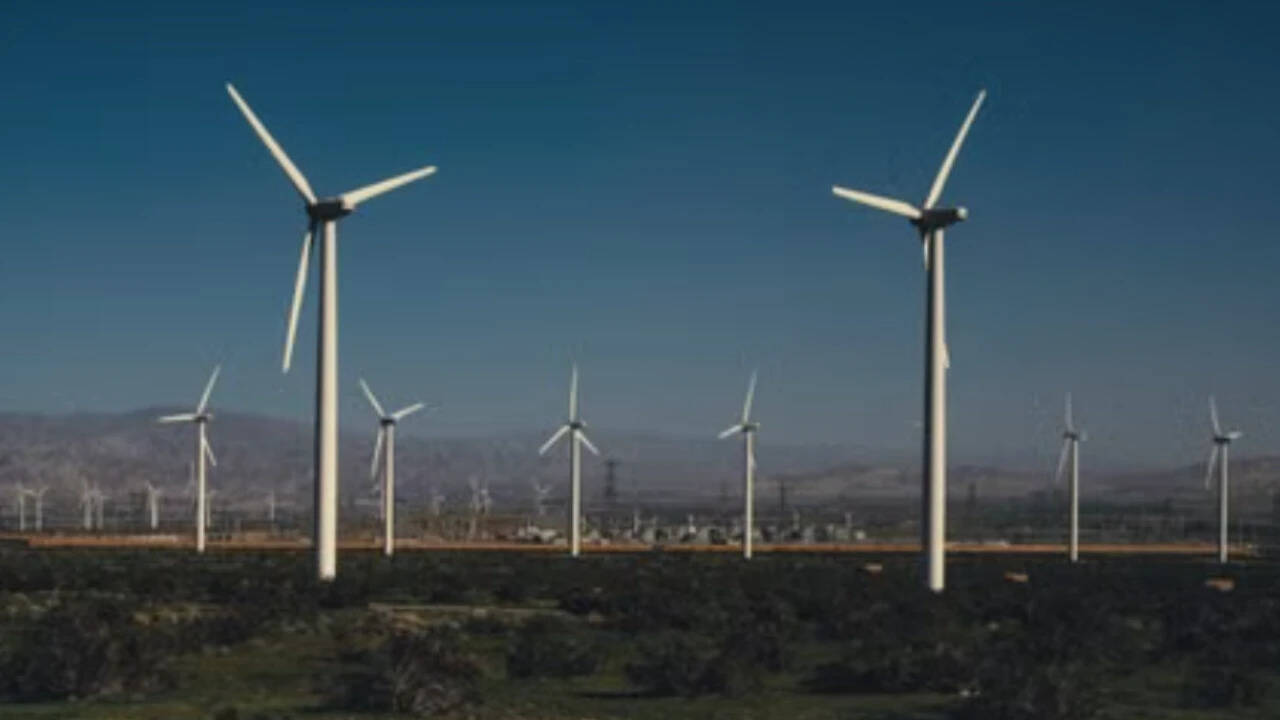
Land ownership in rural economies traditionally confines financial returns to biological yield cycles. Soil fertility, precipitation anomalies, and global commodity pricing dictate the baseline revenue of agricultural assets, leaving landowners exposed to systemic volatility outside their control. Introducing industrial wind energy infrastructure into an operating farm alters this economic model. Rather than relying entirely on crop output, the asset owner diversifies revenue streams by shifting from pure biological production to dual-use industrial land leasing. Examining the economics of a four-turbine deployment generating thirty thousand dollars in annual passive income reveals the mechanics of this transition, exposing how fixed-infrastructure leaseholds function as a structural hedge against agricultural commodity risk.
The Economic Architecture of Industrial Wind Leases
To understand how an agricultural landowner captures thirty thousand dollars annually from four wind turbines, one must dissect the financial mechanics governing utility-scale renewable energy development. Energy companies do not purchase the land outright; instead, they secure long-term easements and lease agreements. These contracts typically span twenty to thirty years, featuring renewal options that lock in predictable, inflation-adjusted cash flows.
The payment structure within these agreements generally relies on a hybrid model designed to align the interests of the developer and the landowner. During the pre-construction and development phase, the landowner receives option payments—compensating them for tying up the land while environmental studies, transmission interconnection queues, and permitting processes clear. Once operational, revenue shifts to an active royalty structure. This usually takes the form of a guaranteed minimum annual payment per turbine, or a percentage of the gross revenue generated by the electricity produced, whichever is greater.
For a four-turbine installation yielding thirty thousand dollars, the math indicates an average baseline of seven thousand five hundred dollars per turbine per year. In real estate and capital investment terms, this represents an annualized yield derived from minimal surface footprint utilization. While a modern wind turbine stands hundreds of feet tall and requires a concrete foundation and access road, the actual land taken out of agricultural production amounts to roughly half an acre per turbine. The remaining acreage surrounding the towers remains fully arable, allowing the farmer to continue planting crops right up to the base of the industrial infrastructure.
Capital Efficiency and Opportunity Cost Analysis
Evaluating the net financial impact requires examining opportunity cost. Traditional farming requires continuous capital expenditure on seed, fertilizer, diesel, equipment maintenance, and seasonal labor. These inputs carry high elasticity and exposure to supply chain shocks. In contrast, wind lease revenue carries near-zero marginal operational costs for the landowner.
When a farmer compares thirty thousand dollars of passive lease income to crop revenue, the metrics shift dramatically when measured against risk-adjusted return on capital.
- Input Exposure: Crop production requires massive upfront capital with delayed realization periods. Wind leases require no operational capital from the landowner.
- Surface Efficiency: Industrial infrastructure consumes less than five percent of the total leased parcel, preserving ninety-five percent of the land for agricultural yield.
- Counterparty Risk: Renewable energy developers are typically backed by institutional capital or utility conglomerates, offering high contract enforceability compared to volatile grain markets.
This structure creates an effective financial shock absorber. During drought cycles or commodity price crashes, the baseline lease revenue provides liquidity that stabilizes farm cash flow. This mirrors the function of a traditional retirement account distributions model, where fixed income generation cushions equity volatility.
Grid Interconnection and Siting Economics
The deployment of wind turbines is not driven by wind velocity alone; proximity to transmission capacity dictates project viability. Landowners sitting under high-voltage transmission lines possess a unique locational advantage. Developers prioritize sites where interconnection costs remain manageable, as routing power over long distances erodes project margins.
The siting process involves rigorous micro-siting to maximize aerodynamic capture while minimizing wake effects between adjacent turbines. For the landowner, this means negotiating lease terms that account for future grid expansions, battery storage integration, and potential repowering phases. As turbine technology evolves, developers frequently replace older, smaller nacelles and blades with higher-capacity units on existing foundations—a process that can trigger bonus payments or escalated royalty structures if negotiated correctly into the initial easement contract.
Structural Limitations and Long-Term Liabilities
While the upside of diversifying agricultural land with wind infrastructure is evident, rigorous analysis requires acknowledging structural liabilities and contract risks. Landowners enter multi-decade encumbrances that alter the legal title of the property. Future buyers of the land must accept the encumbrance, which can occasionally complicate generational farm transfers or parcel subdivisions.
Furthermore, decommissioning liabilities represent a critical contractual variable. Modern lease agreements must contain strict, legally binding provisions requiring the developer to establish an escrow or bond for complete removal of concrete foundations, cabling, and towers at the end of the project lifecycle. Without these covenants, landowners risk inheriting massive industrial remediation costs once the operational lifespan of the turbines expires.
Additionally, potential interference with aerial agricultural spraying, localized microclimatic wind shadows, and temporary construction-phase disruptions require careful mitigation in the legal drafting of the easement.
Strategic Capital Allocation
Capturing industrial lease revenue alters the financial profile of an agricultural operation, but the long-term utility of that capital depends entirely on its deployment. Treating wind lease payments as operational cash flow for day-to-day farming expenses squanders the structural advantage of the asset.
The optimal strategic play involves treating the guaranteed lease income as a debt-service vehicle or a diversification engine. By leveraging predictable, non-correlated cash flows against low-interest agricultural financing, the farm enterprise can acquire adjacent land parcels, invest in precision agriculture technology to drive down biological production costs, or build external liquid portfolios. Shifting from a single-variable commodity producer to an integrated land-and-energy landlord protects the enterprise against structural market shifts, turning rural real estate into a dual-yield industrial platform.