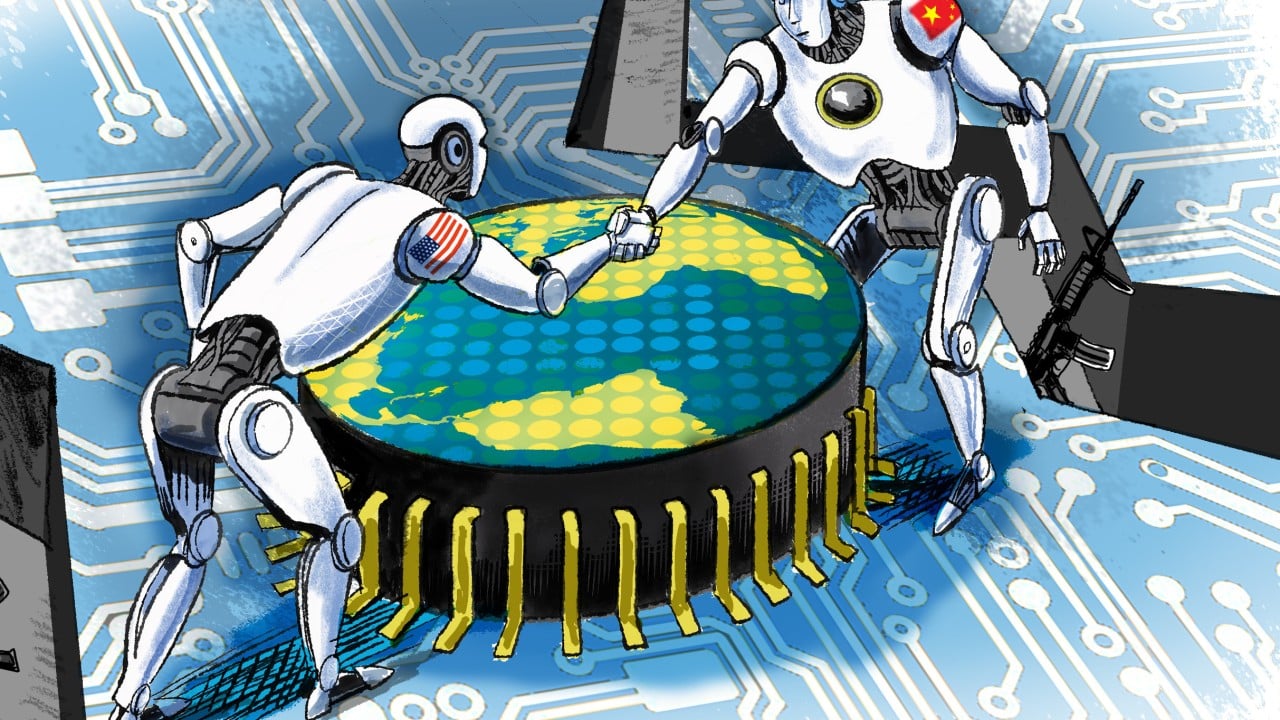
The political consensus reached between Washington and Beijing looks ironclad on paper. For two consecutive administrations, American and Chinese leaders have affirmed a shared, non-binding principle: humans, not autonomous algorithms, must retain sole authority over nuclear launch decisions. It is a comforting narrative designed to reassure a nervous global public that the ultimate red button will never be pushed by a machine.
But this diplomatic agreement fails to address the actual threat. While diplomats celebrate the promise of keeping a human "in the loop" for the final launch command, both superpowers are aggressively integrating machine learning and predictive software into the surrounding systems that inform that human. The danger is not a rogue rogue algorithm initiating an unauthorized missile strike. The real crisis is the systemic distortion of the data, early warning networks, and sensory inputs that a human leader relies on to make a life-or-death choice during a high-stakes standoff.
By automating the eyes and ears of national command authorities, the United States and China are building an inadvertent escalation trap. If an automated system misinterprets a conventional cyberattack or an electronic warfare drill as a prelude to a first strike, a human commander might formally order a retaliation based on corrupted, machine-generated certainty. The human remains in the loop, but they are functionally acting as a rubber stamp for a flawed algorithmic premise.
The Flawed Logic of Meaningful Human Control
To understand why the current diplomatic framework is insufficient, one must examine how military decision-making operates in a crisis. National leaders do not make decisions in a vacuum; they depend on a sprawling, interconnected web known as Nuclear Command, Control, and Communications (NC3).
Modern NC3 architectures are under immense strain. The proliferation of hypersonic missiles and stealthy drone platforms has compressed the window for verifying an inbound attack from hours to mere minutes. In response, military planners on both sides are turning to advanced software to ingest data from hundreds of radars, satellites, and signals intelligence feeds, parsing the information far faster than a team of human analysts ever could.
This is where the illusion of human control shatters. When an AI-driven system processes millions of data points to deliver a simplified, binary threat assessment to a commander, it introduces specific, critical vulnerabilities.
The Automation Bias Trap
Human operators have a documented psychological tendency to trust machine outputs over their own intuition, particularly under high stress. If an early warning platform flags a high-probability inbound threat, a commander has little time or capability to cross-examine the underlying training data or the weights assigned to specific sensor anomalies. The machine creates the reality; the human merely signs off on it.
The Black Box Problem
Deep neural networks cannot explain why they reached a specific conclusion. If an algorithmic tool flags a sudden deployment of Chinese mobile missile launchers as an imminent attack rather than a routine exercise, it cannot provide the reasoning behind its assessment. A president or premier is forced to choose between trusting an opaque probabilistic calculation or risking national destruction.
Context Blindness
Software excels at pattern recognition but fails completely at geopolitical nuance. An algorithm trained on historical data sets cannot factor in the subtle diplomatic signals, back-channel communications, or psychological posturing that define real-world brinkmanship. It treats a crisis as a closed mathematical optimization problem, ignoring the messy human variables that often prevent conflict.
Weaponizing the Fog of War
The integration of predictive algorithms into the strategic equation creates dangerous new flashpoints when crossed with offensive cyber operations. Chinese military texts frequently focus on using advanced software to locate and track the most survivable elements of the American nuclear deterrent, such as submerged ballistic missile submarines and mobile launchers.
[Adversary Cyber Infiltration]
       │
       ▼
[Corrupted NC3 Sensor Data] ──► [Algorithmic Speed-Up] ──► [Compressed Decision Window]
       │                                                         │
       ▼                                                         ▼
[False Threat Confirmation] ───────────────────────────────► [Inadvertent Escalation]
If a state believes its second-strike capability is becoming transparent and vulnerable due to an adversary's superior tracking algorithms, the incentive to shift toward a launch-on-warning posture increases dramatically. The fear of losing one's nuclear deterrent creates a "use it or lose it" dynamic, compressing decision timelines even further.
Furthermore, the introduction of automated malware poses a direct threat to strategic stability. AI-enabled cyber tools can autonomously probe NC3 networks, altering their behavior to evade detection while hunting for zero-day vulnerabilities.
Imagine a scenario where an autonomous cyber tool, deployed to gather routine intelligence, accidentally triggers an automated defensive response inside an adversary's early warning network. The defensive system, interpreting the automated intrusion as the opening salvo of a coordinated decapitation strike, instantly accelerates its readiness posture. This movement is immediately picked up by the other side's predictive satellites.
Within minutes, both nations are locked in a high-speed algorithmic feedback loop, where every automated defensive measure is interpreted by the opposing side as an aggressive preparation for war.
The Hidden Failure Modes of Military Simulation
Military planners often assert that rigorous testing and air-gapped systems will prevent these cascading failures. This confidence misjudges the fundamental nature of machine learning models.
Traditional military hardware is deterministic. A missile or a radar system is engineered to operate within fixed parameters; if a component fails, the failure mode is usually predictable and traceable. Advanced software models, by contrast, are inherently probabilistic and adaptive. They do not fail gracefully. Instead, they suffer from sudden, catastrophic shifts in performance when confronted with environments that differ even slightly from their training data.
During a genuine crisis between major powers, the geopolitical environment will be entirely unprecedented. There is no historical training data for a high-intensity conflict between two nuclear-armed states operating in a heavily contested information environment. Confronted with chaotic, novel inputs, an automated command-support tool may experience an out-of-distribution error, generating highly confident but completely erroneous assessments.
If a system hallucinates a threat during peacetime, human operators can spot the error and reset the program. If it hallucinates an inbound strike in the middle of a tense naval standoff in the South China Sea, the friction of the moment makes a catastrophic misinterpretation terrifyingly plausible.
Moving Beyond Meaningful Human Control
The current bilateral dialogues between the United States and China are stuck in an obsolete paradigm. Focusing exclusively on who pulls the trigger ignores the reality of how modern military systems are built, deployed, and managed. To prevent technological competition from driving an unintended nuclear conflict, both Washington and Beijing must pivot toward concrete, technical constraints on the architecture of command.
Verifiable Architectural Separation
Instead of relying on vague political declarations about human intent, the two nations must negotiate strict boundaries on where machine learning can and cannot be deployed. Automated analytical tools must be strictly cordoned off from the core data verification streams of NC3 networks. Sensor data validation must rely on traditional, transparent, and auditable code, ensuring that the information reaching a commander has not been filtered through an unpredictable predictive model.
Mutual Constraints on Strategic Undersea Tracking
To preserve the stability of mutual assured destruction, both sides should explore geographic or technological limits on the deployment of autonomous underwater vehicles designed to hunt ballistic missile submarines. Maintaining the invulnerability of the second-strike deterrent reduces the pressure on leaders to rely on rapid, machine-assisted launch postures.
Shared Technical Standards for Joint Verification
The United States and China should establish a dedicated, permanent technical working group composed of computer scientists, systems engineers, and nuclear command experts. The objective should not be diplomatic platitudes, but the creation of shared protocols for testing, evaluating, and bounding the software models used in strategic early warning networks. This includes building clear, bilateral communication channels specifically designed to resolve algorithmic anomalies before they escalate.
The true danger of the modern tech race is not that a cold, calculating machine will choose to destroy humanity. The danger is that human leaders, blinded by the promise of technological speed and overwhelmed by the pace of modern conflict, will willingly surrender their judgment to a ghost in the bunker.