Pop archaeology loves a ghost story.
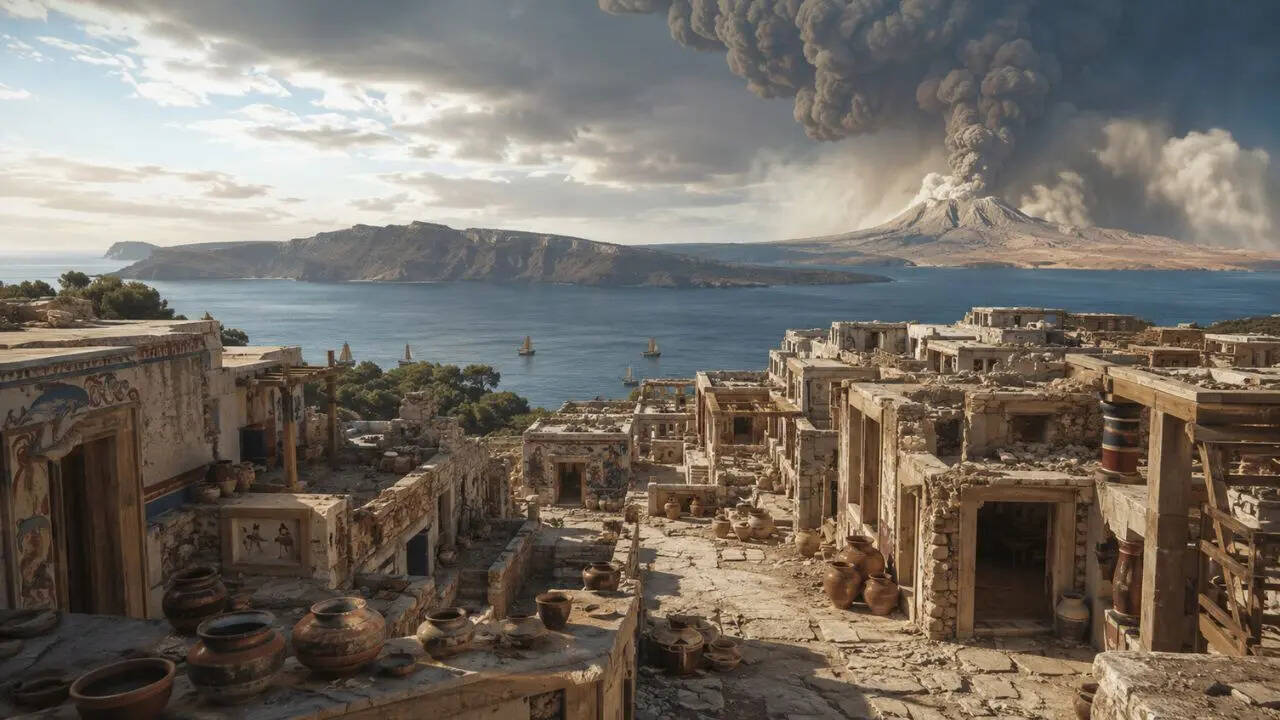
The narrative surrounding Akrotiri—the Bronze Age settlement on the island of Thira (Santorini) buried by a cataclysmic volcanic eruption around 1600 BCE—is always served with a heavy dose of melodrama. You know the script. Archaeologists dig up a pristine city preserved in ash, realize there are no skeletons, and immediately queue the eerie music. The residents vanished without a trace! Where did they go? Was it Atlantis? It is romantic. It sells television documentaries. It is also complete nonsense.
The "mystery" of the missing Akrotiri refugees is a manufactured puzzle, built on a fundamental misunderstanding of ancient maritime logistics and human behavior. The residents did not vanish into thin air, nor were they swallowed by supernatural forces. They did exactly what any highly advanced, seafaring civilization would do when the ground started shaking.
They looked at the warning signs, packed their valuables, walked down to the harbor, and rowed away.
The Myth of the Sudden Apocalypse
The core flaw in the conventional narrative is the assumption that the Minoan eruption of Thira happened in the blink of an eye, catching the population completely off guard like Pompeii.
Pompeii is the wrong mental model.
At Pompeii, the deadly pyroclastic surges hit within hours of the initial activity. The residents were suffocated by toxic gas and buried where they stood. We have the plaster casts to prove it. Akrotiri is a completely different geological story.
Volcanologists like David Pyle and researchers studying the stratigraphy of the Thira eruption have long pointed out that the event had distinct phases. There was a precursor phase. The volcano did not just clear its throat; it threw an absolute tantrum before the main event.
- Pre-eruption earthquakes: Strong seismic activity rocked the city months, perhaps even a year, before the final blowout.
- The cleanup attempt: Excavations show clear evidence that walls were repaired, and debris was cleared from streets after an initial earthquake but before the ash started falling.
- Zero casualties: Not a single human skeleton has been found in the volcanic ash layers of Akrotiri.
- No valuables left behind: Unlike Pompeii, where gold coins and jewelry litter the floors, Akrotiri was systematically emptied of portable wealth and metal tools.
This was not a sudden panic. It was a planned, staged evacuation. The "silence" left behind isn't a mystery; it is evidence of a highly organized society executing a crisis management plan.
The Logistical Reality of a Bronze Age Evacuation
Let us look at the math. Estimates for the population of Akrotiri at its peak range from 2,000 to 5,000 people.
To the untrained observer, moving 5,000 people off an island sounds impossible for the second millennium BCE. But Akrotiri was not an isolated farming village. It was a maritime superpower. It was the central trading hub of the Aegean Sea, packed with merchants, sailors, and shipwrights.
The famous West House fresco found at the site depicts a massive fleet of sophisticated, multi-oared ships. These were not primitive canoes. They were large, deep-sea vessels capable of carrying dozens of passengers and tons of cargo.
[Estimated Population: 5,000]
       ÷
[Average Fleet Capacity: 50-80 people per large vessel]
       =
[Required Ships: 60 to 100 vessels]
For a major Bronze Age naval hub, assembling a fleet of 60 to 100 ships across the region to evacuate a vital port is not a logistical miracle. It is a Tuesday.
The residents had days, if not weeks, between the warning earthquakes and the first major pumice falls to load their ships with their most valuable possessions—bronze tools, textiles, and family heirlooms—and set sail. They left behind the heavy pottery, the storage jars (pithoi), and the structural walls because you do not waste precious cargo space on clay pots when the mountain is smoking.
Why We Aren't Finding the Refugees
The next question people ask is flawed from the outset: If thousands of people escaped, why haven't we found their remains elsewhere?
This question assumes that refugees carry a neon sign that says "I am from Akrotiri."
In the Late Bronze Age, Thira was culturally part of the wider Minoan sphere of influence. The people of Akrotiri dressed like Cretans, wrote in Linear A like Cretans, painted like Cretans, and used the same pottery styles as Cretans.
Imagine a scenario where a massive hurricane hits Miami, and 50,000 residents evacuate to Atlanta, Houston, and New York. Three thousand years from now, if an archaeologist digs up a house in Atlanta, how will they identify a Miami refugee? They won't. The material culture—the clothing, the tech, the language—is identical.
When the ships left Thira, they scattered to neighboring islands. They went to Crete, just 70 miles to the south. They went to Naxos, to Milos, and to the Greek mainland. They integrated into existing communities where they already had trade relationships. Their DNA blended into the broader Aegean population.
They didn't disappear. They just changed their address.
The Danger of Romanticizing History
The insistence on keeping the "mystery" of Akrotiri alive reveals a deeper flaw in how we consume history. We prefer a tragic ghost story over a boring success story.
Acknowledging that the people of Akrotiri successfully evacuated their city means admitting that ancient peoples were highly competent, rational actors with sophisticated emergency responses. It strips away the mystical "Atlantis" allure and replaces it with human agency, seamanship, and logistical competence.
The real story of Akrotiri isn't that a city was lost to the ash.
The real story is that thousands of people looked into the mouth of a waking supervolcano, organized a flawless naval evacuation, saved their entire population, and sailed out into the Aegean to build new lives elsewhere.
Stop looking for ghosts where there are only smart survivors.