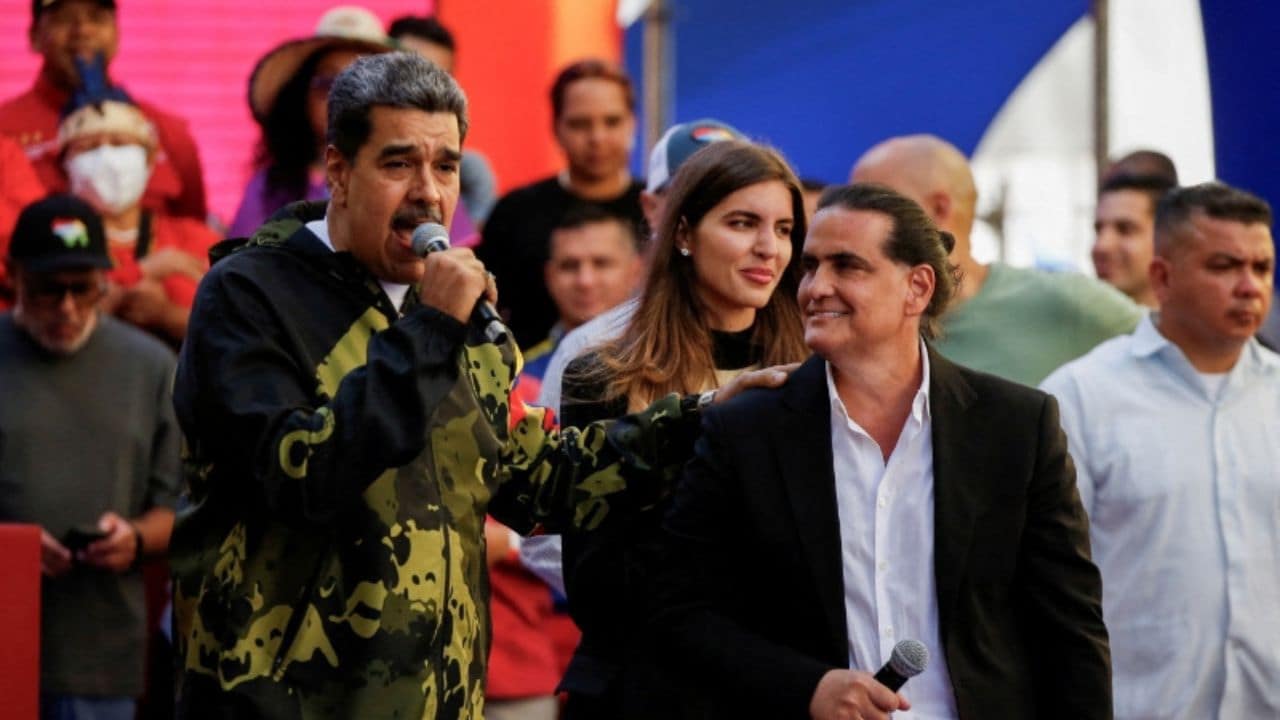
The unsealing of federal money laundering charges against Alex Saab in a Miami court is being heralded by mainstream media and Washington consensus as a triumphant masterclass in international law enforcement. The headlines write themselves: the Department of Justice finally hooks the notorious "bag man" of deposed Venezuelan President Nicolás Maduro. We are told this is a lethal blow to a multi-billion-dollar transnational syndicate that plundered food programs meant for starving citizens.
This narrative is dangerously naive. It completely misreads the mechanics of modern state-sponsored financial engineering.
By focusing on the lurid details of shell companies, fake invoices, and inflated Mexican milk contracts, Western prosecutors are treating a structural, geopolitical survival mechanism like a common Sicilian mafia racket. They are celebrating a tactical arrest while losing the strategic war against sovereign sanctions evasion. Alex Saab did not just outsmart the international banking system for personal enrichment; he designed an alternative, parallel economy that kept a blockaded regime breathing for a decade. Clawing him back into a U.S. courtroom does not break that architecture. It merely forces the evolution of a far more resilient, un-trackable system.
The Illusion of Jurisdictional Supremacy
The Justice Department’s indictment alleges that Saab and his co-conspirators routed hundreds of millions of dollars through American financial institutions to launder illicit profits from the CLAP food program and illegal state oil sales. The underlying assumption here is the traditional crown jewel of U.S. hegemony: if you touch a single U.S. dollar, or if your wire transfer bounces through a correspondent bank in Manhattan, Washington owns you.
I have watched compliance departments at global banks burn tens of millions of dollars building transaction monitoring systems designed explicitly to catch guys like Saab. They look for the classic red flags: shell networks in Hong Kong, sudden pivots from textile trading to multi-billion-dollar PDVSA oil allocations, and payments flowing to opaque entities in Turkey or the UAE.
But here is the structural blind spot: Western law enforcement views the U.S. financial system as an inescapable web. In reality, it is increasingly operating as an introductory training ground for sanctioned actors.
Saab used American banks during the early, sloppy phases of his operations. When U.S. economic sanctions crippled Venezuela’s ability to interact with the traditional global financial architecture from 2019 onward, the network did not collapse. It migrated. It transitioned to asset-swapping, crude-for-fuel barter arrangements with Iran, and non-Western clearing channels that completely bypass the SWIFT network.
Charging Saab for historical dollar-clearing violations is looking through the rearview mirror. The real game has already moved to decentralized, non-dollar networks where American subpoenas carry zero weight.
The Fallacy of the Bag Man Criminal Label
To understand why this prosecution misses the point, you have to dismantle the very premise of what a "bag man" is in the 21st century. The mainstream press frames Saab as a parasitic opportunist who simply extracted wealth from a dying nation.
While the inflation of food prices and the distribution of substandard goods under the CLAP initiative are well-documented, labeling Saab as merely a corrupt contractor fundamentally misunderstands his function. Saab was an ad-hoc sovereign central banker operating under conditions of total economic warfare.
When a state is completely locked out of the global financial system, traditional trade rules disappear. You cannot open a standard letter of credit to import grain when your central bank is sanctioned. In this ecosystem, the individual who can mobilize shadow shipping fleets, secure alternative lines of credit through obscure middlemen, and convert physical crude oil into liquid capital isn't just a criminal entrepreneur. They are an essential piece of state infrastructure.
By prosecuting Saab under standard domestic money laundering statutes, the United States is trying to apply a civilian criminal framework to what is effectively an unconventional geopolitical conflict. This creates a dangerous miscalculation: Washington assumes that removing the architect destroys the building. It does not. The economic vacuum left by Saab’s deportation by Venezuelan acting leader Delcy Rodríguez does not dry up the shadow trade; it simply creates an open bidding war for his replacement among smarter, more subterranean operators.
The Flawed Logic of the Flip
The prevailing wisdom among regional analysts is that Saab's return to Florida custody is a death blow to the remnants of the Maduro inner circle because he will "flip." This is the classic DEA playbook: squeeze the financial coordinator until he sings about the politicians, the drug routes, and the hidden assets. After all, Saab previously had a brief, quiet flirtation with DEA cooperation back in 2018.
But assuming Saab is a silver bullet witness is highly speculative strategy. Consider the timeline. Saab was arrested in Cape Verde in 2020, extradited to the U.S. in 2021, and then pardoned by the Biden administration in a 2023 prisoner swap. He returned to Caracas to a hero's welcome, was placed in charge of foreign investment, and sat at the highest levels of the economic cabinet.
Then the geopolitical landscape fractured. Maduro was captured by U.S. special forces earlier this year, Delcy Rodríguez took the reins of power, and suddenly Saab is stripped of his title, treated as a Colombian foreigner to bypass constitutional protections against extraditing citizens, and loaded onto a DEA plane.
Saab is a survivor who understands that his leverage exists only as long as his knowledge remains proprietary. If he coordinates completely with U.S. prosecutors, his value drops to zero, his remaining international assets become targets for asset forfeiture, and his protection vanishes. Furthermore, the networks Saab ran were highly compartmentalized. The idea that one man possesses a master ledger that can dismantle the entire global network of sanctions-busting operations from Russia to Tehran is a Hollywood fantasy.
The High Cost of the Institutional Double Standard
There is an inherent reputational risk to the Western financial enforcement apparatus that nobody wants to openly discuss. The escalation of this case highlights a deep structural hypocrisy that actually accelerates the abandonment of Western financial institutions by non-aligned states.
The Justice Department is aggressively prosecuting Saab for using shell companies and fraudulent invoices to move money through the United States. Yet, the entire offshore financial architecture that enabled Saab—from the British Virgin Islands to Delaware LLCs and Swiss wealth managers—is actively maintained and protected by Western legal frameworks.
We penalize the specific actor while preserving the very systemic vulnerabilities that allowed them to operate. This uneven application of financial pressure does not deter illicit finance; it merely tells sovereign adversaries exactly which jurisdictions are no longer safe.
When the U.S. uses its financial system as an overt weapon of foreign policy—unsealing indictments, executing long-arm jurisdiction extraditions, and undoing presidential pardons via new investigations—it forces the rest of the world to build a financial system completely insulated from Western leverage. Every high-profile arrest of a sovereign intermediary like Saab acts as a marketing campaign for the adoption of central bank digital currencies (CBDCs), alternative clearing mechanisms, and non-Western economic blocs.
Stop Tracking the Money, Track the Assets
The current approach to combating state-level financial crime is broken because it is obsessed with the flow of capital rather than the control of physical assets. We spend years tracing wire transfers through correspondent bank accounts when we should be focusing on the physical points of intersection where shadow economies meet the real world: shipping registries, maritime insurance, and commodity ports.
If the goal is to actually disrupt transnational networks that exploit state resources, the strategy must change:
- Dismantle the Maritime Shadow Fleet directly: Stop tracking the bank accounts of the shell companies that own the tankers. Focus instead on the classification societies, flag states, and digital transponder networks that allow these vessels to sail under the radar.
- Acknowledge the Sovereign Nature of the Problem: Accept that sanctions evasion by state actors is a permanent feature of multipolar geopolitics, not a temporary criminal anomaly that can be solved via the Southern District of Florida.
- Target the Enablers Within Western Jurisdictions: Shift the focus from the foreign intermediaries to the Western compliance officers, lawyers, and corporate registry agents who facilitate the setup of these structures.
The unsealing of the indictment against Alex Saab is a neat public relations win for an administration looking to project strength. But do not confuse a legal spectacle with systemic victory. Saab is in a jail cell, but the blueprint he perfected for operating an economy entirely outside the reach of the U.S. dollar is being studied, refined, and deployed by every adversarial state on the planet. The shadow economy won this round a long time ago.