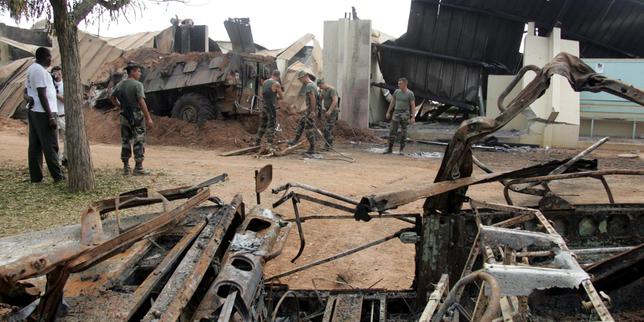
Litigation targeting private intermediaries in sovereign military actions exposes structural flaws in international accountability frameworks. When victims of the November 2004 Bouake bombing in Cote d'Ivoire initiated legal action against an arms broker, they targeted a node within a decentralized supply chain rather than the state actors who authorized the engagement. This strategic choice reveals a fundamental diagnostic challenge in transitional justice and transnational tort claims. Traditional legal structures struggle to assign liability when state immunity shields sovereign actors, forcing plaintiffs to redirect legal pressure toward commercial facilitators who operate in regulatory gray zones.
The tactical utility of pursuing an arms merchant lies in bypassing jurisdictional immunities that protect sovereign states from foreign domestic courts. Yet this approach colludes with a distinct systemic risk. It treats a logistical conduit as the primary architect of a state-sanctioned military operation, misallocating fault and overestimating the operational control held by commercial vendors. Understanding why these legal maneuvers recur requires dissecting the mechanics of illicit arms procurement, the limits of extraterritorial jurisdiction, and the financial architecture that sustains cross-border weapons trafficking during civil conflicts.
The Mechanics of Transnational Arms Intermediation
Arms brokers do not manufacture the materiel they move, nor do they dictate the strategic objectives of the armed forces that purchase it. Their function is strictly transactional. They bridge the gap between regulatory compliance and demand by exploiting jurisdictional arbitrage.
Jurisdictional arbitrage occurs when an intermediary routes transactions through states with lax enforcement, opaque corporate registration laws, or non-existent end-user monitoring. In the Bouake incident, the Su-25 aircraft deployed by government forces required maintenance, munitions, and logistical support sourced through third-party networks. The supply chain operated across multiple borders, insulating the ultimate decision-makers from direct liability.
[Sovereign Command] ---> [State Procurement Office] ---> [Offshore Broker] ---> [Sub-Contracted Logistics] ---> [Operational Deployment]
When analyzing this chain, a strategic error commonly made by legal strategists is treating the broker as a co-conspirator rather than a commercial utility. A broker optimizes for margin and execution speed, not military strategy. By shifting accountability from the military chain of command to the procurement layer, civil litigation attempts to solve an enforcement vacuum by substituting a financially vulnerable target for an immune sovereign entity.
The Jurisdictional Bottleneck in Cross-Border Torts
Victims seeking redress for extraterritorial violations face a steep jurisdictional gradient. Domestic courts in Europe or North America possess limited competence over acts committed by foreign militaries on foreign soil unless specific statutory hooks exist, such as universal jurisdiction statutes or specialized tort acts.
The Three Barriers to Extradition and Civil Redress
- Sovereign Immunity Doctrines: State actors and military assets deployed under official orders are shielded by doctrines of foreign sovereign immunity, preventing plaintiffs from suing foreign governments in domestic tribunals.
- Attribution Deficit: Establishing a direct causal link between a commercial broker's delivery of generic military hardware and a specific war crime requires proving that the broker had actionable knowledge of the unlawful intent of the end-user.
- Evidentiary Decay: Over decades, flight logs, banking records, and communication intercepts degrade or disappear, shifting the evidentiary burden onto plaintiffs who lack subpoena power in the jurisdictions where the operational decisions were made.
These barriers create a structural enforcement gap. Because victims cannot compel the sovereign state to stand trial, they redirect their litigation budgets toward civil actions against corporate entities involved in the supply chain. This is a pragmatic adaptation to structural limitations, but it distorts the nature of legal accountability. It forces civil courts to adjudicate matters of state warfare through the lens of commercial negligence or complicity in international crimes.
Financial Traceability and Asset Recovery Mechanisms
To evaluate the viability of targeting arms merchants, analysts must examine the financial architecture of grey-market weapons deals. Transactions rarely involve transparent wire transfers through major clearing banks. Instead, they rely on layered corporate structures, shell companies registered in secrecy jurisdictions, and payment mechanisms designed to obscure the identity of the beneficial owners.
When families of victims file civil claims seeking financial restitution, they confront an asset protection strategy designed specifically to withstand state-level sanctions. Arms brokers operating in high-risk zones typically maintain minimal physical assets in jurisdictions vulnerable to asset seizure. Equipment is leased, capital is converted into liquid assets or distributed across non-extradition territories, and corporate entities are dissolved once a contract is fulfilled.
[Layered Shell Companies] ---> [Offshore Accounts in Non-Cooperative Jurisdictions] ---> [Liquid Assets / Nominee Holdings]
This financial obfuscation renders standard civil judgments toothless. Even if a court issues a favorable ruling establishing civil liability, the probability of executing that judgment against the personal or corporate assets of an international arms broker approaches zero unless law enforcement agencies have already frozen those funds through criminal proceedings. Civil litigants are therefore left bearing the cost of complex cross-border litigation without a realistic mechanism for recovery.
Systemic Divergence Between Criminal Intent and Commercial Supply
A rigorous assessment of the Bouake litigation requires distinguishing between two distinct legal categories: complicity in international crimes and breach of commercial duty.
Complicity requires proof of practical assistance, encouragement, or moral support that had a substantial effect on the commission of the crime, coupled with knowledge that the assistance would be used for unlawful acts. Commercial arms brokers operate under a veil of plausible deniability. They secure end-user certificates—often forged or issued by corrupt officials—which legally insulate them from liability under international trade law.
When courts attempt to bridge this gap by applying civil tort standards to war crimes, they encounter a category error. Tort law measures damages based on negligence or foreseeable harm within a commercial context. Mass casualty events resulting from military airstrikes are acts of state violence governed by international humanitarian law, not commercial malpractice. Applying tort frameworks to military supply chains stretches legal definitions to their breaking point, creating precedents that fail to deter future violations while offering false hope to victims.
Strategic Allocation of Legal and Advocacy Resources
Victims and advocacy groups must calculate the return on investment for their legal campaigns. Directing finite resources toward civil suits against private intermediaries yields low systemic return due to jurisdictional hurdles, asset concealment, and the divergence between commercial supply and military command responsibility.
A more effective allocation of advocacy capital focuses on strengthening institutional mechanisms that target the enabling environment of illicit arms flows. This includes pushing for mandatory disclosure of beneficial ownership in international trade, increasing the investigative capacity of multilateral sanctions committees, and pressuring governments to waive sovereign immunity in cases involving gross violations of international humanitarian law.
Shift the primary legal objective from civil compensation through proxy defendants toward institutional accountability for state actors. Prioritize the enforcement of arms embargoes at the point of origin through real-time maritime and aviation tracking rather than retroactive civil litigation against intermediaries who can easily dissolve and reform under new corporate identities.


