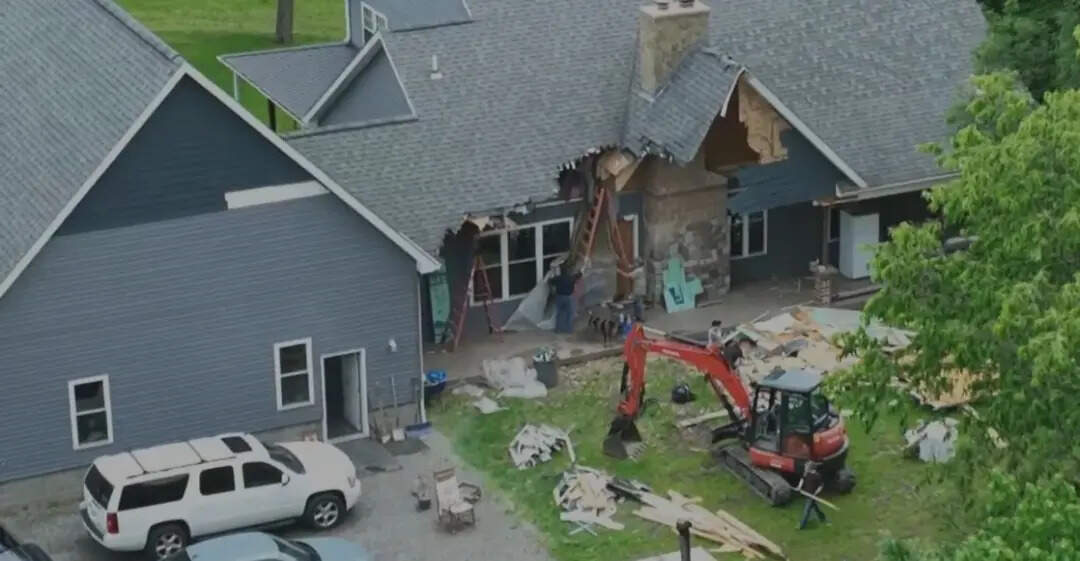
The utilization of heavy industrial machinery within domestic disputes represents a critical escalation in operational risk, altering the mechanics of domestic violence from interpersonal assault to structural sabotage. When Erik A. Pierwsza, 48, allegedly deployed a Kubota excavator against his family's Martin Road residence in Buffalo Township, Pennsylvania, the incident breached standard criminological boundaries. By converting a high-mass mechanical asset into a weapon while his wife and two daughters occupied the structure, the event demonstrated how industrial mechanics can instantly compromise structural engineering, local emergency response timelines, and legal frameworks governing domestic catastrophes.
Evaluating this incident requires moving past the sensationalism of local reporting to analyze the specific physical, operational, and legal mechanics at play.
The Mechanical Cost Function: Structural Degradation via Kinetic Force
Standard domestic disputes typically involve low-mass, localized kinetic energy transfers. The introduction of a hydraulic excavator introduces industrial-scale mechanical forces that decouple structural elements from their load-bearing designs.
The Vector of Structural Failure
Residential wood-frame or light-masonry construction is engineered to withstand vertical gravity loads and predictable lateral forces like wind or seismic activity. It is completely unequipped to absorb the concentrated, high-torque hydraulic force of a multi-ton excavator bucket. The criminal complaint notes that the rear portion of the Buffalo Township home sustained major damage.
In structural engineering, the destruction of an exterior rear envelope triggers a cascade of compounding vulnerabilities:
- Load Path Disruption: Removing exterior studs or foundation tie-ins instantly shifts the tributary load to adjacent, non-reinforced spans.
- Diaphragm Shear: Residential floors and roofs act as horizontal diaphragms that transfer lateral loads to shear walls. Breaching the rear wall destabilizes the entire diaphragm, threatening a progressive collapse.
- Utility Line Rupture: Tearing into a residential envelope introduces an immediate risk of secondary hazards, including high-pressure natural gas ruptures and electrical arcing, which exponentially increases the probability of a fire.
Occupant Vulnerability and Spatial Bottlenecks
The presence of three occupants inside the dwelling during mechanical demolition alters the risk profile from property crime to active endangerment. Unlike localized physical violence, where occupants can leverage internal geometry to create distance or barricade themselves, mechanical structural breaches compromise the entire perimeter. Internal walls offer zero ballistic or structural protection against a hydraulic arm. The auditory feedback captured on the 911 dispatch tape—where operators recorded simultaneous yelling and mechanical engine noise—highlights an extreme sensory barrier, reducing the occupants' situational awareness and blocking clear paths to an exit.
Operational Logistics and Law Enforcement Interventions
The timeline of the Buffalo Township intervention reveals the strategic challenges emergency services face when high-capacity machinery is used as a weapon.
[911 Call Initiated / Audio Logs Mechanical Noise]
                       │
                       ▼
[Mechanical Demolition of Rear Envelope Occurs]
                       │
                       ▼
[Suspect Packs Gym Bag & Abandons Asset] ───► [Exits Jurisdiction to Fawn Township]
                       │
                       ▼
[First Responders Arrive / Establish Perimeter]
                       │
                       ▼
[Apprehension by Inter-Jurisdictional Authorities]
This sequence illustrates a distinct operational window where the suspect held a significant tactical advantage over arriving units.
Tactical Resource Allocation Challenges
When a standard domestic violence dispatch report includes the active operation of heavy machinery, responding officers must alter their tactical approach. Normal patrol vehicles offer no protection against an operator inside an enclosed, armored steel cab of an excavator. This mismatch limits direct intervention strategies until the operator dismounts.
Inter-Jurisdictional Flight Mechanics
The suspect ceased operations, re-entered the damaged structure to secure personal items (a gym bag), and fled southeast across the township line into Fawn Township, Allegheny County. This multi-jurisdictional movement requires instant coordination across county lines (Butler County to Allegheny County). This shift divides police focus between securing a unstable crime scene and executing a secondary manhunt.
The Legal and Financial Matrix of Civil Catastrophes
The Pennsylvania criminal justice system responded to this incident by bypassing standard domestic assault charges in favor of high-level statutory offenses. This shift reflects the scale of the mechanical threat.
                ┌──► Felony Causing Catastrophe (18 Pa. C.S. § 3302)
                │
CRIMINAL CHARGES ├──► Reckless Endangerment (3 Counts - 18 Pa. C.S. § 2705)
                │
                └──► Disorderly Conduct (Misdemeanor)
Deconstructing 18 Pa. C.S. § 3302
The most severe charge filed against Pierwsza is causing or risking a catastrophe. Under Pennsylvania law, a person is guilty of a felony of the first degree if they knowingly cause a catastrophe by explosion, fire, flood, collapse of a building, or other harmful breakdown.
Proving this charge relies on two distinct elements:
- The Mechanism of Breakdown: Utilizing a Kubota excavator to systematically dismantle a home while it is occupied fits the definition of a "harmful breakdown" or forced structural collapse.
- The Risk Factor: The prosecution does not need to show that the building fully collapsed, only that the structural integrity was compromised enough to place the occupants at immediate risk of death or severe injury.
The filing of three misdemeanor counts of Recklessly Endangering Another Person (REAP) mirrors the exact number of occupants inside the home. This establishes a clear link between the mechanical damage and the direct threat to human life.
The Bail and Financial Leverage Function
District Judge Jack Ripper set Pierwsza's bail at $10,000, and he was remanded to the Butler County Prison. In a corporate or financial framework, this bail amount represents a very low liquidity barrier relative to the total value of the destroyed asset. However, the true financial impact lies in how the civil and insurance systems handle the loss.
Standard homeowners insurance policies contain explicit exclusions that prevent payouts for these exact scenarios:
- Intentional Acts Exclusion: Insurance companies universally deny coverage for property damage directly caused by a named insured party. Because Pierwsza is a co-owner or resident, the insurance provider will likely deny any claims for property restoration.
- Asset Liquidation Strain: The family faces a severe cash flow problem: the primary asset is unlivable and its equity is trapped, while they must simultaneously fund temporary relocation, legal representation, and structural stabilization out of pocket.
This financial vulnerability is further complicated by a temporary Protection From Abuse (PFA) order granted to the wife on the day of the incident. This order legally cuts off the suspect's access to the property, freezing the domestic asset structure during ongoing criminal proceedings.
Structural Risk Mitigation Protocol
When a residential asset suffers localized mechanical demolition, immediate stabilization is required to prevent a total structural collapse. The following sequence establishes the necessary tactical response for property management and civil engineering teams handling a compromised structural envelope.
Phase 1: Immediate Stabilization and Hazardous Isolation
- Utility Shutoff: Turn off the main gas valve and cut electrical feeds at the street transformer to eliminate fire hazards from compromised wiring and fractured lines.
- Shoring Installation: Erect temporary hydraulic or timber shore towers beneath the remaining first-floor joists and header systems adjacent to the destroyed rear wall to arrest any downward structural movement.
- Environmental Sealing: Install heavy-duty polyethylene tarping over the exposed interior framing to prevent moisture from degrading the remaining structural elements.
Phase 2: Forensic Engineering Assessment
- Laser Scanning: Deploy terrestrial LiDAR scanning to map deviations in the building’s vertical alignment and identify structural warping.
- Load-Bearing Analysis: Calculate the remaining load capacity of the shifted structural frame to determine if the building can be repaired or if it requires a controlled demolition.
The upcoming preliminary hearing on June 9 will determine if there is sufficient prima facie evidence to advance these charges to the Court of Common Pleas. Given the physical evidence of the damaged rear envelope and the 911 audio records, the legal strategy will likely center on the structural definitions of a catastrophe. The defense will face a difficult challenge decoupling the suspect's intentional operation of the excavator from the immediate, life-threatening compromise of the residential structure.


