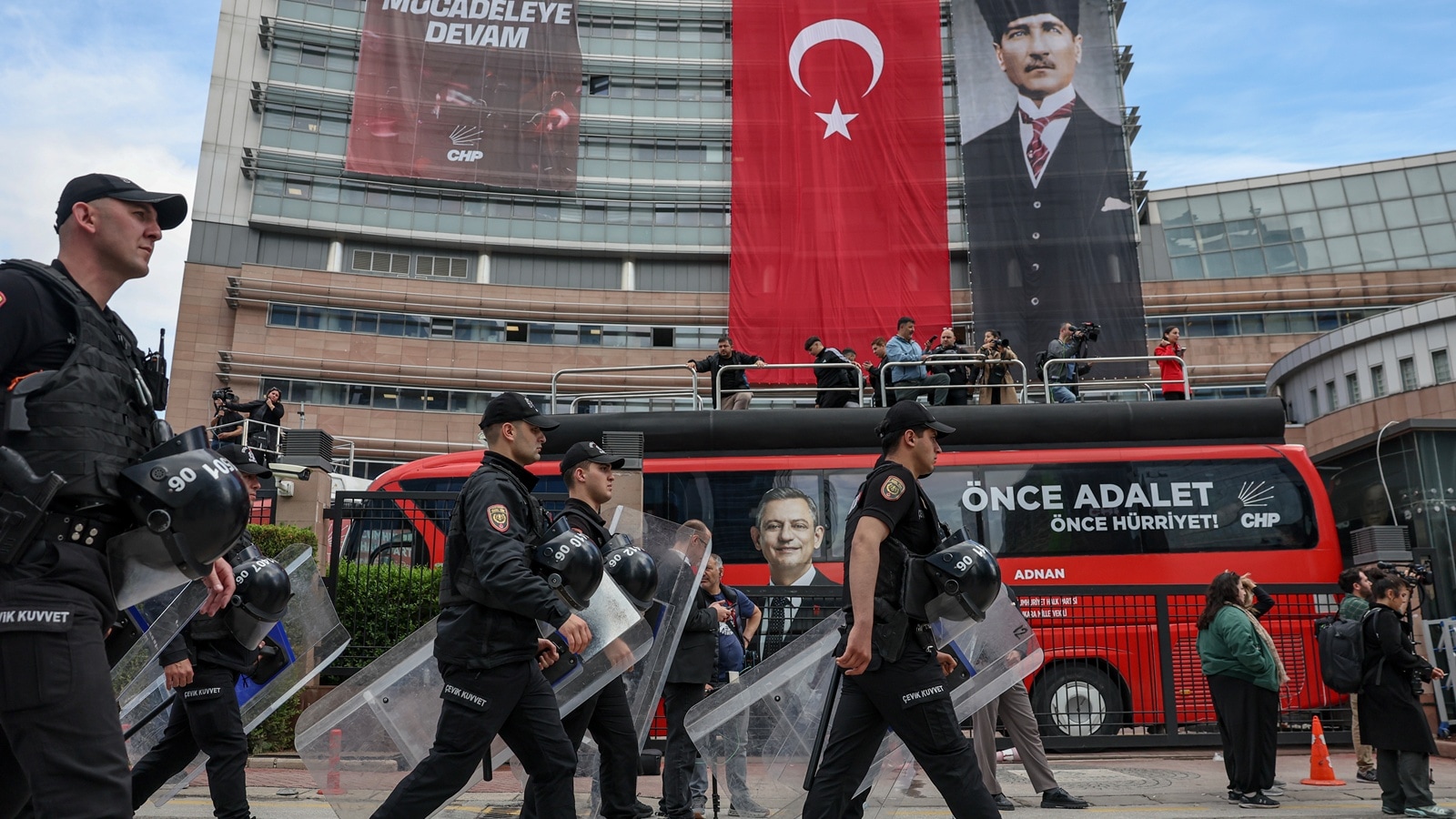
The forceful eviction of the Republican People’s Party (CHP) leadership from its Ankara headquarters on May 24, 2026, marks the transition of Turkish political competition from electoral rivalry to institutional liquidation. While mainstream accounts focus on the visceral imagery of riot police, tear gas, and barricades, the event cannot be understood merely as an isolated law-enforcement operation. It represents the precise execution of a strategy known as autocratic legalism: the use of judicial mechanisms to manufacture internal leadership crises and structurally incapacitate opposition forces.
By analyzing the mechanics of this operation, the operational constraints placed on the political opposition, and the structural incentives governing the ruling Justice and Development Party (AKP), we can map out the actual systemic impact of this standoff.
The Strategic Triad of Opposition Neutralization
The removal of elected CHP Chairperson Özgür Özel and the forced reinstatement of his predecessor, Kemal Kılıçdaroğlu, follows an appeals court ruling that nullified the November 2023 party congress. This intervention operates along three distinct axes of political disruption, which collectively form a framework for neutralizing viable political alternatives ahead of potential early elections before 2028.
Axis 1: The Judicial Disruption Matrix
The primary mechanism deployed by the state apparatus is the exploitation of intra-party grievances to trigger a cascade of legal interventions. In this instance, a lawsuit initiated by a disgruntled former member—expelled Antakya Mayor Lütfü Savaş—was utilized by an appeals court to overturn a previous lower court ruling that had validated Özel’s leadership. By executing this judicial reversal, the state achieves multiple strategic objectives simultaneously:
- The Annulment of Democratic Mandates: It invalidates the internal democratic processes of a party that represents millions of voters.
- The Erasure of Electoral Momentum: It systematically unseats a leadership team that delivered a historical defeat to the AKP in the 2024 municipal elections.
- The Forced Reversal of Generational Change: It legally compels the party to return to a 77-year-old former leader who presided over 13 years of consecutive national electoral losses.
Axis 2: Leadership Decapitation and Asset Freezing
The legal maneuver effectively paralyzes the party's executive decision-making. By suspending Özel and his executive board, the court creates an immediate administrative vacuum. The sudden replacement of CHP’s legal representation by Kılıçdaroğlu’s faction—evidenced by the swift dismissal of the party's sitting lawyers—effectively blocks the party's ability to mount an integrated legal defense before the Supreme Court. The timing of the police raid, synchronized with the onset of the nine-day Eid al-Adha holiday, minimizes the opposition's window for rapid judicial appeal or mass urban mobilization, as municipal centers clear out for the festive period.
Axis 3: The Disruption of the Succession Pipeline
To understand the full scope of this institutional degradation, it must be viewed in tandem with the ongoing judicial suppression of Istanbul Mayor Ekrem İmamoğlu. İmamoğlu, who has been imprisoned since March 2025 and remains entangled in corruption trials, represented the CHP’s primary presidential asset for the next electoral cycle. By simultaneously locking İmamoğlu into the judicial system and retroactively removing Özel, the ruling party systematically targets every viable leadership node within the main opposition bloc.
The Cost Function of Civil Resistance Under Authoritarianism
The three-day standoff at the CHP headquarters illustrates the physical and operational limitations of conventional political resistance when confronted with an unconstrained state security apparatus. The decision by Özel and his core supporters to barricade themselves inside the building reflects an attempt to raise the political cost of enforcement for the state. However, the operational reality of the clearing operation demonstrates how asymmetric state power can easily absorb these costs.
[Court Order Nullifying Election]
               │
               ▼
[Intra-Party Leadership Split] ──► [Ankara Governor Authorizes Police Action]
               │
               ▼
[Tactical Asymmetry: Tear Gas vs. Fire Extinguishers]
               │
               ▼
[Forced Eviction & Physical Disruption of HQ]
               │
               ▼
[Transition to Extralegal / Assembly Politics (Marching to Parliament)]
When the Ankara Governor’s office approved the request from Kılıçdaroğlu’s legal team to vacate the premises, the police utilized standard counter-protest tactical packages—including tear gas, rubber bullets, and physical breeches—to quickly overwhelm the barricades composed of buses and office furniture. The use of fire extinguishers by defenders functioned only as a temporary visual deterrent, completely lacking the capability to alter the tactical outcome.
The structural limitation of this defensive posture is clear: physical occupation of a building cannot sustain political authority if the state controls the legal definitions of ownership, banking access, and official institutional standing. When Özel tore up the court order served to him in his office, the act carried significant symbolic value, but it could not alter the legal reality that the state no longer recognized his signature as binding on the party's financial or regulatory accounts.
Strategic Implications and the Electoral Forecast
The displacement of the CHP leadership from their physical infrastructure forces the opposition into a decentralized, extra-legal operational environment. Özel's subsequent five-kilometer march to the national parliament in heavy rain, accompanied by hundreds of supporters, marks a necessary shift from institutional governance to assembly politics.
By declaring the CHP "de facto shuttered" and floating the proposition of rebuilding the party for a "third time"—referencing its historical lineage from Mustafa Kemal Atatürk in 1923, its closure during the 1980 military coup, and its 1992 revival—Özel is attempting to frame this judicial ouster as a foundational crisis. This narrative strategy aims to convert institutional displacement into a powerful organizing myth capable of driving mass mobilization.
However, this strategy faces severe friction from engineered structural vulnerabilities:
- The Legitimacy Trap: By acting on a formal request from Kılıçdaroğlu’s camp, the government can frame the entire crisis as an internal property and administrative dispute between rival party factions, rather than a direct assault on democracy by the state.
- Resource Depletion: A party fractured by dueling executive boards cannot effectively deploy its municipal budgets, organize synchronized national campaigns, or guarantee ballot-box security in upcoming cycles.
- The Early Election Trigger: President Erdoğan retains the constitutional authority to call for an early presidential vote. By launching these sweeping legal actions against both the administrative leadership (Özel) and the electoral frontrunners (İmamoğlu) well ahead of the scheduled 2028 elections, the ruling coalition ensures that if an early vote is triggered, the opposition will be forced to compete while deeply fractured, financially restricted, and structurally decapitated.
The primary strategic recommendation for the ousting faction of the opposition is to abandon the legal fiction that internal party mechanics can be resolved through an aligned judiciary. Political survival under these conditions requires the immediate formation of a parallel shadow executive structure that derives its legitimacy from elected local municipalities and parliamentary blocks, rather than state-regulated party registries. Failure to decouple the opposition's operational command from state-controlled physical and legal infrastructure will result in the complete neutralization of the CHP as a competitive electoral vehicle long before the first ballot is cast.


