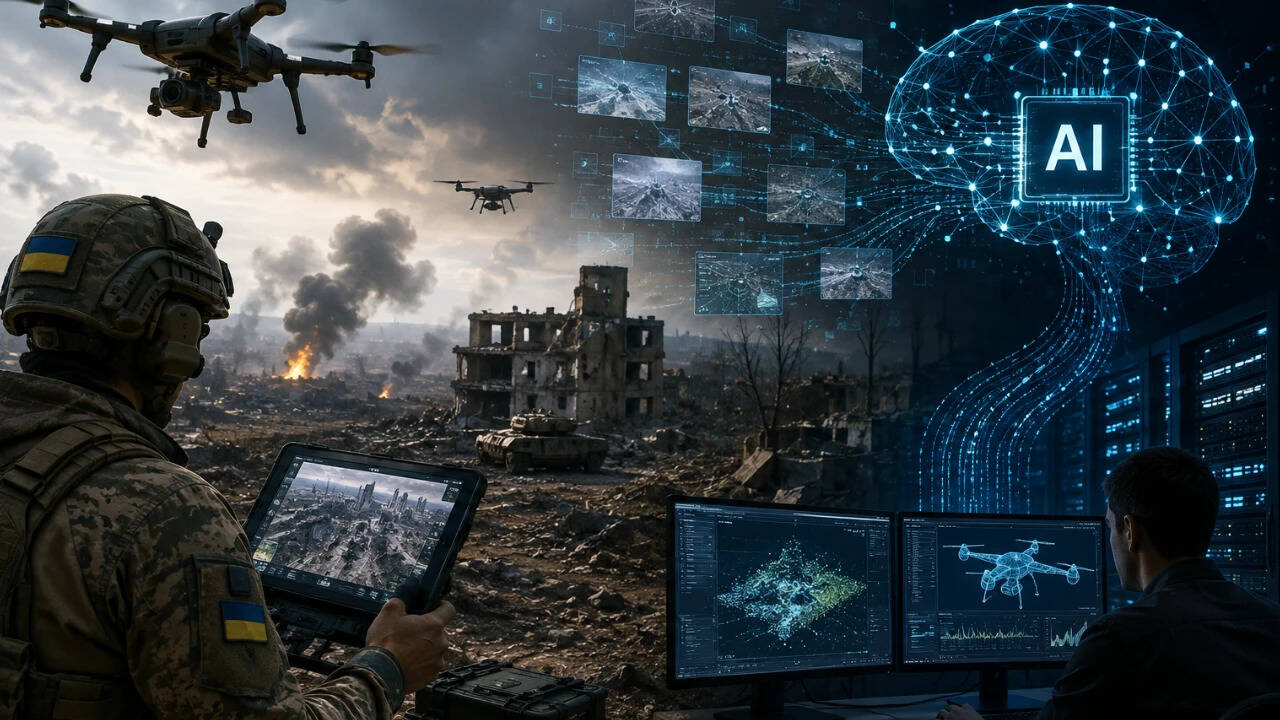
The convergence of prolonged high-intensity conflict and computer vision engineering has precipitated an unprecedented structural shift in military technology development. Millions of hours of full-motion video, thermal imagery, and telemetry harvested from unmanned aerial systems operating across the Ukrainian frontlines are systematically bypassing traditional laboratory testing environments. This operational feed functions as an engine for machine learning optimization, transforming raw combat telemetry into a globally traded training asset. Understanding the mechanics of this market requires deconstructing the data pipeline, the operational realities of electronic warfare inference, and the systemic economic implications for global defense contractors.
The Mechanics of Combat Data Extraction
Traditional computer vision models suffer from synthetic validation bottlenecks. Simulators fail to replicate the complex degradation patterns inherent to active warzones, including heavy electronic countermeasures, dynamic atmospheric interference, particulate smoke, and structural destruction. Battlefield data resolves this failure mode by supplying high-entropy inputs straight from operational deployments.
The ingestion pipeline relies on distinct operational stages:
- Raw sensor capture from electro-optical and infrared payloads during active flight missions.
- Telemetry aggregation, coupling positional and directional data with pilot input logs to establish ground truth.
- Edge conditioning and structural classification, isolating target engagement profiles, vehicle types, and pedestrian movement.
- Centralized curation through institutional and private repositories, such as Ukraine's AI Avengers Labs and external aggregators like Enabled Intelligence.
When entities aggregate half a million hours of pre-labeled combat footage, the value proposition rests on annotation density. Training a neural network to execute terminal autonomous guidance—where an aerial platform completes the final one thousand meters of flight without a human operator—requires exposure to edge cases that peacetime ranges cannot generate. Signal degradation caused by front-line radio frequency jamming forces networks to learn localized pixel tracking rather than relying on constant remote telemetry.
The Inference Bottleneck and Autonomous Convergence
The operational efficacy of unmanned systems is governed by the latency-bandwidth trade-off. Standard first-person view platforms rely on continuous operator feedback, creating a critical vulnerability under dense electronic warfare conditions. When signal jamming severs the link, manual guidance collapses. Machine learning models trained on frontline visual streams mitigate this failure mode by shifting inference to the edge.
Integrating pre-trained computer vision models with localized tactical datasets yields exponential jumps in target acquisition success rates. Systems dependent entirely on human-in-the-loop pilot control experience high attrition rates due to operator fatigue, environmental obfuscation, and signal loss. Autonomous terminal navigation architectures—trained on the high-volume data streams emerging from eastern Europe—re-engineer this curve. The model assumes control strictly during the terminal phase, utilizing onboard processing to identify, track, and strike designated signatures independently.
This operational shift redefines the economics of munitions expenditure. Historical engagement ratios often required multiple conventional munitions per target due to guidance drift or interception. Edge-optimized visual tracking reduces resource waste by sharpening terminal accuracy, effectively lowering the cost-per-effect ratio for asymmetric forces.
The Regulatory Void and Commercial Feedback Loops
The commercialization of frontline telemetry creates an unregulated marketplace. Unlike controlled defense exports or traditional international arms transfers, raw digital data lacks standardized classification frameworks. When state-backed repositories distribute millions of frames to international defense contractors and allied governments, the jurisdictional boundaries governing derivative intellectual property dissolve.
This environment establishes a closed-loop feedback mechanism between commercial innovation and military application:
- Commercial hardware enters the theater of operations as off-the-shelf consumer or industrial components.
- Extreme operational stressors force rapid software adaptations and generate unique behavioral telemetry.
- Aggregators harvest and clean this data to train foundational models for commercial remote sensing, logistics, and precision agriculture.
- Advanced models return to the defense sector to power the next generation of autonomous targeting engines.
This circular flow commodifies conflict experience. Civilians and soldiers captured within multi-spectral sensor sweeps become unwitting contributors to proprietary model weights owned by foreign corporate entities. The absence of retroactive consent frameworks or data sovereignty controls means that operational experiences harvested today translate directly into commercial product lines years downstream.
Strategic Resource Allocation for Defense Implementers
Organizations attempting to capture value from modern tactical environments must shift focus from raw collection capacity to annotation velocity and data provenance tracking. Accumulating petabytes of unformatted full-motion video introduces storage bloat without enhancing model performance.
Defense technology developers must implement rigorous data filtering protocols that isolate high-entropy scenarios—specifically signal degradation events, clutter-heavy tracking sequences, and evasive target maneuvers. Treat raw battlefield feeds as controlled munitions: mandate strict origin verification, cryptographic licensing of training subsets, and lifecycle tracking on downstream model deployments to prevent capability proliferation outside authorized allied frameworks.