The air inside the White House during a state dinner is thick with a specific kind of silence. It is not the silence of an empty room, but the pressurized quiet of history being made. Silverware clinks against fine china with the precision of a metronome. The scent of expensive jasmine and roasted meat hangs heavy under the glint of crystal chandeliers. In this space, every movement is choreographed, every guest vetted, and every exit guarded. It is the most secure bubble on the planet.
Outside that bubble, reality is messier.
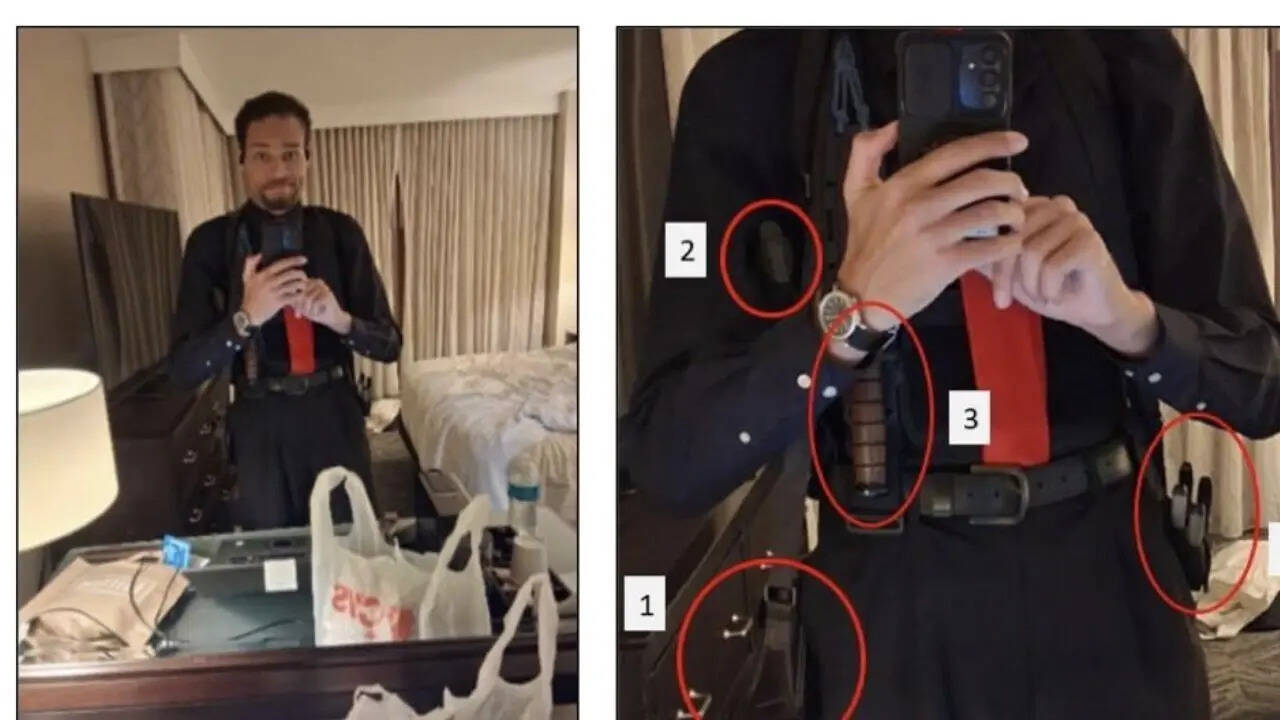
Consider a man standing in the gray light of a nondescript room, holding a knife. He isn’t a phantom from a thriller; he is a person of flesh and bone, gripped by a singular, jagged purpose. Before he ever stepped toward the gates of 1600 Pennsylvania Avenue, he took a photograph. He didn't capture a sunset or a family meal. He captured the edge of his weapon.
This is the moment where the mundane meets the monstrous. We often think of security breaches as high-tech maneuvers involving encrypted codes and silent rappelling. The truth is usually more visceral. It is a man, a blade, and a photograph.
The Mirror of the Lens
When a person documents their intent, the act of photography transforms from a hobby into a ritual. Federal investigators now point to that digital image—a man posing with a knife—as the prologue to an assassination attempt on Donald Trump. It was a digital "selfie" of a dark ambition.
Why take the picture?
Psychologically, it acts as a bridge. It moves the thought from the chaotic interior of the mind into the physical world. Once the shutter clicks, the plan feels real. It becomes a commitment. For the Secret Service, these digital breadcrumbs are the modern equivalent of a smoking gun, found not in a holster, but in the cloud.
The suspect didn't just carry a weapon; he carried a vision of himself as a protagonist in a violent drama. This wasn't a spontaneous outburst of rage. It was a curated sequence of events. He traveled. He prepared. He documented. He arrived.
The Fragility of the Gala
Imagine being a server at that dinner. You’ve spent hours polishing glasses until they gleam like diamonds. Your biggest worry is a spilled sauce or a mispronounced name. You are surrounded by the most powerful people in the world, protected by men with earpieces and stony expressions. You feel safe. You have to.
But security is an illusion of layers.
The suspect's approach to the White House dinner wasn't just an attack on a person; it was an assault on the sanctuary of the office itself. When a man with a knife tries to penetrate the perimeter of a state event, the "invisible stakes" become blindingly clear. We aren't just talking about the safety of a former president. We are talking about the integrity of the peaceful transition of power and the sanctity of our national symbols.
The steel of a knife is cold. The heat of political fervor is unpredictable. When they meet, the friction threatens to ignite something much larger than a single news cycle.
The Invisible Perimeter
We like to believe that we live in a world where logic prevails. We assume that the sheer scale of the White House security apparatus—the snipers on the roof, the thermal sensors, the canine units—would be enough to deter any rational person.
But the man with the knife wasn't operating on a frequency of logic.
Security professionals often speak about "the gap." It’s the space between a known threat and a new one. The Secret Service is trained to look for patterns, but how do you prepare for the person who is willing to walk into the mouth of the lion with nothing but a pocket-sized blade?
It is a terrifying thought. Vulnerability exists in the most protected spaces because humanity itself is vulnerable. You can build a wall, but you cannot build a shield against the human will to do harm.
The suspect’s journey from a private room with a camera to the gates of the White House reveals a chilling truth: the greatest threats often start in the most quiet, unremarkable places. A laptop. A kitchen drawer. A digital photo gallery.
Beyond the Metal
This isn't just a story about a crime. It is a story about the era we inhabit. We live in a time where the line between the digital and the physical has blurred to the point of disappearing. A man can radicalize himself in a basement, document his descent on a smartphone, and then attempt to change the course of history before the sun sets.
The court documents tell us he was charged. They tell us the knife was recovered. They tell us the photo exists.
But they don't tell us how to fix the broken sense of peace that lingers after the sirens fade. We are left looking at the images ourselves—not of the knife, but of our own reflection in the screen. We wonder how many other photos are being taken right now, in other quiet rooms, by other people who believe that a blade is a solution to a grievance.
The dinner went on. The guests eventually left. The china was washed and stored away. But the image of that knife, captured by the man who intended to use it, remains. It sits in a digital file, a sharp reminder that the most dangerous things in our world aren't always the ones we see coming. They are the ones that have been hiding in plain sight, waiting for their close-up.
Blood doesn't have to be spilled for a wound to be felt.