The intersection of Chinese manufacturing capacity and Gulf Cooperation Council hydrocarbon reserves constitutes one of the most significant realignments in contemporary global commodity markets. Historically, this bilateral corridor functioned through a simple, transactional mechanism: the transfer of crude oil in exchange for foreign currency reserves. Today, the underlying economic parameters are undergoing a structural shift. Both entities face distinct macro-level risks. China confronts acute supply chain vulnerabilities across its maritime import routes, while Gulf economies face the long-term depreciation of fossil-fuel assets due to the global energy transition. To mitigate these risks, both regions are pivoting toward deep industrial integration, combining Chinese green technology manufacturing capabilities with Gulf sovereign wealth capital. This analytical breakdown deconstructs the economic mechanisms, strategic dependencies, and operational frameworks driving this transformation.
The Dual Vulnerability Model and Supply Chokepoints
To understand the necessity of this integration, one must examine the baseline economic vulnerability of both China and the GCC. China imports more than 70% of its crude oil, with over 50% passing through the Strait of Hormuz and the Strait of Malacca. This reliance creates a strategic chokepoint that could disrupt supply chains during geopolitical conflicts. The risk is quantified through the Energy Security Index, which measures the vulnerability of a nation's energy supply to external disruptions. This index reveals a high degree of exposure to maritime interdiction and price volatility in global oil markets.
Meanwhile, GCC states, specifically Saudi Arabia, the United Arab Emirates, and Kuwait, face a different economic bottleneck: sovereign asset devaluation. The global transition away from fossil fuels threatens the long-term viability of their primary export revenues. The rentier state model, which relies on state-directed capital redistribution from oil revenues, cannot sustain itself if global demand for hydrocarbons declines. Therefore, both parties possess a complementary incentive to alter the supply-demand equation.
The vulnerability of the Gulf's economic model is reflected in its fiscal breakeven oil prices. To maintain current public expenditures, these states require crude prices to remain well above the marginal cost of extraction. When global demand softens, the fiscal deficit widens. By diversifying into downstream assets and green technologies, these states can lock in long-term demand and generate alternative revenue streams.
Upstream and Downstream Integration Mechanics
The initial phase of this integration involves direct equity investments in refining and petrochemical assets, linking Gulf crude supply directly to Chinese processing capacity. Chinese national oil companies and private refining conglomerates have established joint ventures with Saudi Aramco and Abu Dhabi National Oil Company (ADNOC). These operations are not merely financial investments; they represent integrated supply chain agreements designed to guarantee baseline demand for Gulf crude and secure feedstock for Chinese petrochemical facilities.
Consider the operational dynamics of the downstream integration. When a Chinese enterprise acquires an equity stake in a Saudi downstream facility, the transaction reduces the cost of transaction for crude sales. The supply chain is locked in through long-term off-take agreements. The economic mechanism at play is the reduction of price volatility through equity hedging. The marginal cost of refining decreases when the refinery is physically and contractually linked to the extraction source.
Furthermore, the integration of petrochemical operations allows Gulf states to capture higher margins. Instead of merely exporting raw crude, the GCC economies are moving down the value chain, exporting refined products and advanced polymers. This operational shift insulates the economies from the raw price volatility of crude oil.
Capital Allocation and the Green Transition
Why is the Gulf shifting its sovereign capital toward Chinese green technologies? The answer lies in the diversification of the rentier economy. GCC sovereign wealth funds, including the Public Investment Fund, Mubadala Investment Company, and the Abu Dhabi Investment Authority, are shifting capital away from traditional Western asset classes into high-growth, technology-driven sectors in China.
The capital allocation function operates through several distinct phases:
- Direct equity participation in Chinese electric vehicle manufacturers and battery producers.
- The creation of joint-venture manufacturing facilities within the Gulf region to capture domestic value.
- The deployment of capital into Chinese clean-energy infrastructure projects.
This transfer of capital allows China to bypass the high capital costs associated with expanding green energy manufacturing capacity. In return, the GCC acquires the technical expertise and intellectual property necessary to build domestic renewable energy infrastructure. The cost of capital for green projects in China is significantly lower than in the Gulf due to state subsidies and economies of scale. By combining Gulf capital with Chinese manufacturing efficiency, the cost function of the energy transition decreases.
The economics of the energy transition require substantial upfront capital investment (CAPEX) followed by low operational expenditure (OPEX). Chinese firms hold a competitive advantage in manufacturing solar modules and lithium-ion battery cells due to economies of scale and an established supply chain ecosystem. By deploying Gulf capital into these Chinese firms, GCC states secure a reliable supply chain for their own domestic renewable energy deployment, which is necessary to power desalination plants, cooling systems, and industrial hubs.
The Economics of Solar Photovoltaics
The manufacturing of solar photovoltaic modules consists of four primary stages: polysilicon production, ingot and wafer manufacturing, cell production, and module assembly. Each stage possesses different capital expenditure requirements and energy consumption profiles. Polysilicon production is energy-intensive, requiring high electricity inputs, while module assembly is labor-intensive.
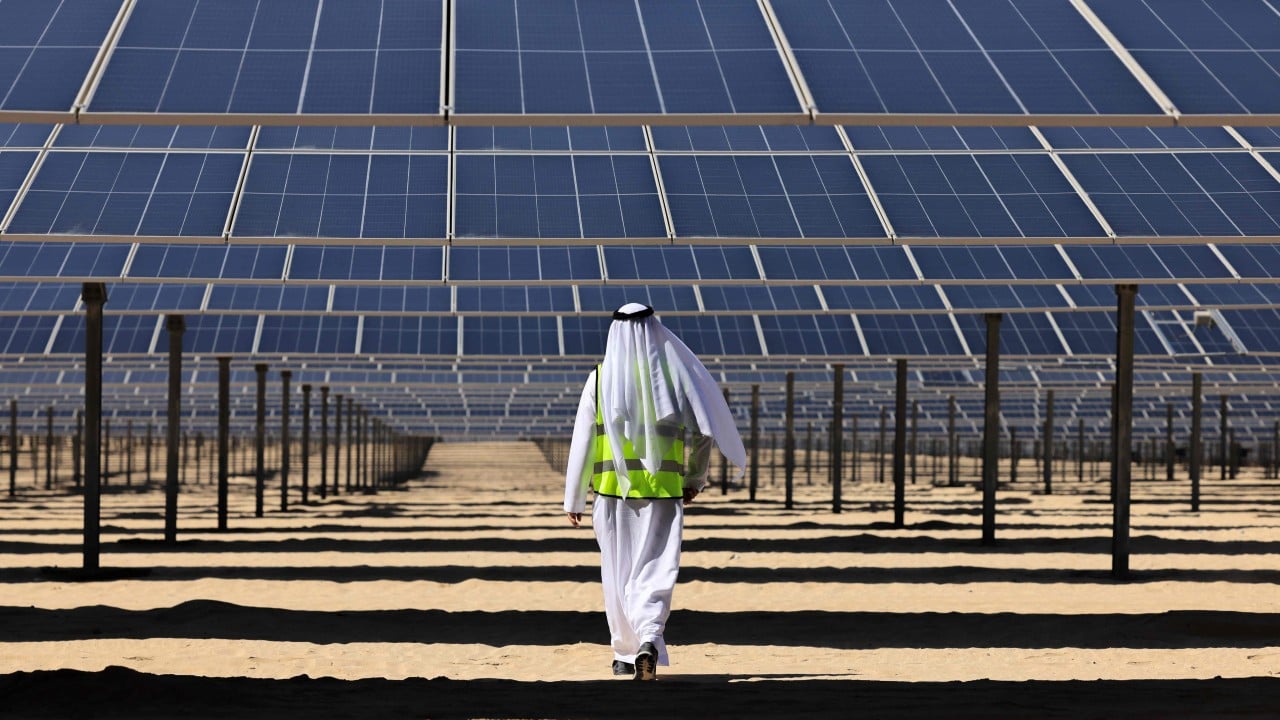
Currently, China controls more than 80% of the global manufacturing capacity across all four stages. This concentration creates a supply chain risk for countries attempting to deploy renewable energy at scale. The GCC, with its vast reserves of natural gas and low-cost solar electricity, can capture the early, energy-intensive stages of the manufacturing process.
By forming joint ventures with Chinese producers, Gulf energy firms can build polysilicon processing plants powered by local natural gas or solar arrays. This configuration lowers the cost of production by integrating the energy supply directly into the manufacturing facility. The economic output is an optimized supply chain that lowers the overall cost of solar deployment in the Gulf.
The Hydrogen and Battery Manufacturing Equations
The transition from fossil fuels to renewable energy systems relies on storage and transport infrastructure. China dominates the global supply chain for lithium-ion batteries and electrolyzers. The Gulf possesses abundant land and low solar irradiance costs, making it an ideal location for the production of green hydrogen.
The cost equation for green hydrogen production depends heavily on the capacity factor of renewable energy and the capital expenditure of electrolyzers. China’s supply chains reduce the CAPEX of electrolyzers by up to 30% compared to Western manufacturers. By importing Chinese equipment, GCC energy firms can lower the levelized cost of hydrogen, making their green hydrogen production globally competitive.
Let's examine the mathematical relationship governing this production function:
$$\text{LCOH} = \frac{(\text{CAPEX} \times \text{CRF}) + \text{OPEX}}{\text{Annual Hydrogen Production}}$$
where the Capital Recovery Factor (CRF) is a function of the discount rate and the project lifespan.
By utilizing Chinese equipment, the CAPEX component decreases, leading to a direct reduction in the levelized cost of hydrogen. This integration of supply chains allows the Gulf to transform from a simple oil exporter into an energy exporter in the post-hydrocarbon era.
Structural Limitations and Geopolitical Bottlenecks
Despite the economic rationale, the integration faces significant structural and geopolitical limitations. The United States remains the primary security guarantor in the Gulf, and its strategic competition with China creates a geopolitical bottleneck for GCC states.
The limitation is not merely theoretical; it affects the choice of technology in critical infrastructure, such as telecommunications and power grids. GCC states must balance their economic dependence on Chinese manufacturing with their security dependence on the United States. This situation creates an asymmetric security-economic trade-off.
Furthermore, the regulatory environment in China regarding foreign direct investment remains highly controlled. Sovereign wealth funds from the Gulf face restrictions on the acquisition of majority stakes in strategic Chinese sectors. These regulatory hurdles create friction in the deployment of capital, slowing down the pace of integration.
The technological mismatch also presents a limitation. Chinese green technologies are optimized for domestic conditions, which may differ significantly from the high temperatures and high salinity environments found in the Gulf. Adapting these technologies requires additional research and development expenditures, which increases the total cost of deployment.
Strategic Action
To move from energy vulnerability to sustainability, the GCC must transition from passive capital deployment to active technology licensing and joint-venture manufacturing on its own soil. The optimal strategy is to use current hydrocarbon revenues to build a domestic supply chain for green energy, utilizing Chinese technology and expertise while maintaining diversified diplomatic ties.
By establishing localized manufacturing of solar panels, battery storage, and electrolyzers, the GCC can transform its economic base from a consumer of imported green technology to a producer for the wider Middle East and North Africa region. The strategic play is to link the supply of raw materials directly to Chinese processing facilities while retaining intellectual property rights and operational control over the downstream green infrastructure.