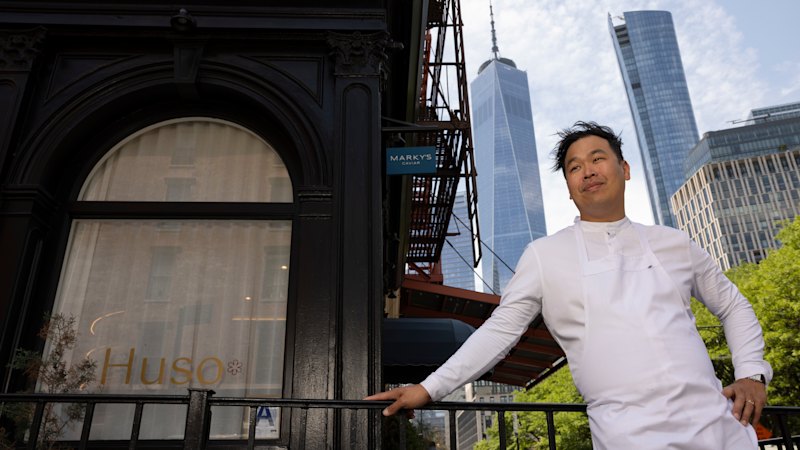
The convergence of media capital and operational mastery creates an asymmetrical advantage in hyper-competitive regional markets. In the Manhattan hospitality landscape—a sector defined by compressed margins, extreme real estate premiums, and high consumer churn—traditional growth models rely on slow, capital-intensive reputation building. The trajectory of culinary figure Buddha Lo demonstrates an alternative framework: geographic and tactical arbitrage. By systematically converting elite European and Australian technical training into American media equity, and subsequently leveraging that equity into institutional restaurant backing, Lo has established a repeatable blueprint for rapid market penetration.
Understanding this trajectory requires moving past the standard narratives of talent and luck. Instead, the model can be deconstructed into a precise three-part operational engine: resource extraction, media value compounding, and the commercial stabilization of premium hospitality assets.
The Three Pillars of Geographic Arbitrage
The foundation of high-value culinary positioning rests on the strategic acquisition of technical credentials in low-yield, high-rigor environments, followed by the deployment of those credentials in high-capital markets.
1. Technical Resource Extraction
Elite culinary training functions as an investment in human capital with delayed realization. Spending formative operational periods within three-Michelin-starred institutions—such as Gordon Ramsay’s flagship in London—serves a dual purpose. First, it establishes rigorous systems optimization, training the operator to manage tight labor efficiency and precise waste-mitigation protocols. Second, it secures institutional validation. The margins in these high-end European systems are notoriously thin, compressed by intense labor costs and high ingredient specifications. However, the intellectual property and prestige acquired are highly portable.
2. Media Capital Conversion
The primary bottleneck for skilled operators entering the New York market is the cost of customer acquisition. Traditional marketing yields linear growth. Media competition, specifically back-to-back victories on specialized platforms like Bravo’s Top Chef, fundamentally alters this dynamic.
This exposure functions as a capital injection of non-dilutive marketing assets. Rather than purchasing audience attention through traditional advertising spend, the operator exchanges performance labor for institutional validation and prime-time visibility. This shifts the consumer demand curve outward before a physical location even opens its doors. The economic value of this visibility can be quantified as the total saved marketing acquisition cost required to achieve equivalent baseline brand awareness in a major metropolitan statistical area.
3. Institutional Capital Pairing
Media visibility possesses a rapid decay function; it must be crystallized into physical cash-flowing assets quickly. The final pillar of the framework pairs this fleeting consumer attention with established hospitality groups or real estate developers. In Lo's case, anchoring operations within premium environments—such as Huso on the Upper East Side or multi-tiered collaborations with corporate hospitality platforms—de-risks the expansion. The developer provides capital expenditures and prime real estate, while the operator provides the immediate customer volume driven by media equity.
The Cost Function of Elite Hospitality Execution
To understand why this model succeeds where traditional luxury restaurants fail, one must analyze the underlying operational mechanics. The traditional fine-dining blueprint is structurally flawed, plagued by high fixed overheads and variable food costs that fluctuate wildly based on supply chain disruptions.
To achieve sustainability, successful operators implement a precise structural formula designed to maximize revenue per square foot while capping operational downside:
Net Margin = (Average Check Size × Table Turnover Velocity) - (Fixed Real Estate Premium + Compressed Labor Cost + Optimized Food Cost)
To optimize this equation, the operational framework relies on three distinct levers:
- Fixed-Menu Monotony as a Waste Mitigation Strategy: By limiting consumer choice through hyper-curated tasting menus, the kitchen minimizes inventory holding costs. Predictable ingredient usage eliminates the standard $8%$ to $12%$ ingredient spoilage rate observed in traditional à la carte formats, driving raw food costs down toward a highly optimized $22%$ baseline.
- Labor Compressing Through Systematization: High-intensity technical training allows the operator to design a kitchen layout that requires fewer, higher-skilled components. Cross-training staff to execute highly repeatable, modular tasks reduces total head-count dependencies during peak service hours.
- The Luxury Premium Multiplier: Brand equity derived from media validation allows for an artificial inflation of price points well above the baseline cost of goods sold. The consumer is not merely purchasing caloric volume or raw ingredients; they are paying a premium for proximity to verified cultural capital.
The Velocity of Media Equity Decay
While the arbitrage model offers immense short-term scaling advantages, it introduces unique structural vulnerabilities. Media-driven demand behaves similarly to a venture-backed tech product: it experiences an initial hyper-growth phase followed by a sharp stabilization or decline.
       Demand Curve (Media vs. Structural Quality)
       ^
Volume |     /\  <- Initial Media Spike (Top Chef Victory)
       |    /  \
       |   /    \_________________  <- Sustainable Structural Run-Rate
       |  /                       \
       | /                         \ <- Pure Media Play (No Operational Rigor)
       +----------------------------------> Time
As illustrated, the long-term viability of the asset depends entirely on the transition from the initial media spike to a sustainable structural run-rate. If the operational foundation is weak, the brand experiences a rapid decline once the novelty fades. If the system is optimized, the media spike settles into a highly profitable, consistent baseline.
The primary risk factor is the decoupling of brand expectation from execution reality. A consumer acquired through television expects an flawless, narrative-driven experience. If the operational systems fail to deliver that exact standard at scale—due to labor shortages or supply chain friction—the negative feedback loop is accelerated by the operator’s high visibility. The larger the media footprint, the faster a reputational deficit spreads.
Strategic Recommendations for High-Velocity Hospitality Brands
For operators and investors attempting to replicate this geographic and market arbitrage model, execution must follow a rigid sequence:
First, prioritize institutional pedigree over immediate monetization. The early phases of a career must focus entirely on acquiring technical systems knowledge and prestigious brand associations in high-standard, low-wage environments. This forms the unassailable baseline of the product's quality.
Second, treat media opportunities as high-leverage customer acquisition campaigns, not validation of artistic merit. The objective of entering the media ecosystem is to compress a decade-long customer acquisition cycle into a multi-month sprint. Every action taken on screen must align with the target commercial demographic of the planned physical assets.
Third, institutionalize the operator's IP immediately upon market entry. The business model must transition away from a single individual's physical labor toward a scalable system of standards, training manuals, and brand architecture. Long-term profitability is achieved only when the asset can generate premium margins independent of the founder's daily presence in the kitchen.