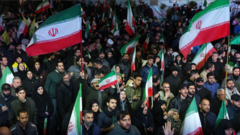
The two-week provisional ceasefire between the United States and the Islamic Republic of Iran, effective April 8, 2026, represents a tactical pivot rather than a resolution of underlying geopolitical frictions. While public gatherings in Tehran’s Enqelab Square are framed by the state as a "victory of national patience," the agreement’s mechanics reveal a rigid exchange of economic and maritime concessions designed to avert immediate systemic collapse. This de-escalation is governed by a fragile cost-benefit equation: the restoration of global energy flows through the Strait of Hormuz in exchange for a temporary suspension of U.S.-Israeli kinetic operations against Iranian infrastructure.
The Triad of Strategic Constraints
The cessation of hostilities is not a product of diplomatic breakthrough but of reached thresholds in three critical domains:
- The Energy Supply Bottleneck: By obstructing the Strait of Hormuz, Tehran successfully leveraged a global inflationary crisis. With nearly 20% of the world’s oil and liquefied natural gas (LNG) transit halted, the economic pressure on the United States and its allies reached a point where the cost of military escalation began to exceed the strategic value of regime degradation.
- Intercept Exhaustion: Six weeks of continuous missile and drone exchanges have depleted regional interceptor stockpiles. The defense saturation point—where the volume of incoming projectiles exceeds the capacity of systems like the Iron Dome or Aegis-equipped vessels—forced a reassessment of the "race between missiles and interceptors."
- Governance Resilience: Despite sustained strikes on the South Pars gas field and the assassination of high-ranking officials on February 28, the Iranian administrative structure remained functional. The failure of "decapitation strikes" to trigger an internal collapse necessitated a shift toward the Pakistani-mediated 10-point framework.
The 10-Point Framework: Sovereignty vs. Access
The upcoming negotiations in Islamabad on April 10 are centered on a "workable" 10-point plan. This document formalizes the transition from active warfare to a supervised stalemate. The core of the negotiation rests on two primary variables:
- Conditional Maritime Transit: Iran and Oman are poised to implement a transit fee system for vessels passing through the Strait of Hormuz. This transforms a military blockade into a fiscal instrument, granting Tehran a degree of de facto control over international waters that the U.S. has historically rejected.
- The 15-Day Consolidation Window: The ceasefire is explicitly defined as a 14-day "pause." This duration is calibrated to allow for the restoration of domestic Iranian power grids—targeted by U.S. threats—while providing the U.S. administration a window to measure Iranian compliance without committing to permanent sanctions relief.
Divergent Definitions of Victory
The "victory" narratives presented by both Washington and Tehran are mutually exclusive, serving domestic political stabilization rather than factual reporting.
- The U.S. "Full Victory" Model: The Trump administration frames the ceasefire as a successful application of "maximum pressure," citing the reopening of the Strait of Hormuz as the primary objective achieved. From this perspective, the ceasefire is a capitulation by Tehran under the threat of "total decimation" of its bridge and power infrastructure.
- The Iranian "Field Victory" Model: Tehran’s Supreme National Security Council views the Islamabad talks as a "continuation of the battlefield." By forcing a two-week pause and securing a seat at a negotiation table that includes demands for a non-aggression pact and withdrawal of U.S. forces, Iran claims it has successfully shifted the conflict from a defensive military posture to an offensive diplomatic one.
The Lebanese Disconnect
A critical failure in the current de-escalation logic is the status of Lebanon. While the U.S.-Iran ceasefire theoretically includes "elsewhere," Israeli leadership has explicitly stated that strikes against Hezbollah assets will continue. This creates a geographic asymmetry:
- Proximal Escalation: If Israel continues kinetic operations in southern Lebanon, the "Axis of Resistance" may view the Tehran ceasefire as a localized truce rather than a regional one.
- Proxy Feedback Loops: Should Hezbollah launch retaliatory strikes from Lebanese territory, the U.S. commitment to the pause in Iran becomes untenable, as the military intelligence frameworks of the two theaters are inextricably linked.
Strategic Action and Forecast
The next 14 days will function as a high-stakes stress test for the "Islamabad Process." For the ceasefire to transition into a durable settlement, negotiators must solve the "Verification-Sanction Gap"—the delay between Iranian maritime concessions and the actual mechanical lifting of U.S. secondary sanctions.
The most probable outcome is a series of "rolling extensions" of the two-week pause. Neither side possesses the current logistical depth to sustain a high-intensity conflict through the summer of 2026 without risking total economic or systemic failure. Therefore, the strategic play for global observers is to monitor the transit volume through the Strait of Hormuz as a lead indicator of diplomatic health. If vessel insurance premiums do not drop significantly within the first 72 hours of the Islamabad talks, the ceasefire should be viewed as a re-arming period rather than a peace process.