Reporting that a relative of Kenya's first Ebola patient tested positive misses the operational hinge of an outbreak: secondary transmission inside a known contact cohort tests containment speed, whereas an unlinked case signals community blind spots. Standard breaking news treats each new confirmation as a fresh escalation. Epidemiological operations treat it as an audit of quarantine execution, exposure timing, and diagnostic lag.
In October 2026, Kenya confirmed its first Ebola case—caused by the Bundibugyo virus—after a 40-year-old man who had been living in the Democratic Republic of the Congo traveled through Uganda to Nairobi, was taken to a hospital by a relative, tested positive on October 5, and died the same day (announced October 6). Subsequent secondary infections among relatives and healthcare workers were traced to that initial chain, with cases identified among individuals already under quarantine or contact monitoring. By early November, official reporting counted nine cumulative confirmed cases in Kenya (the index patient plus eight secondary cases across relatives and healthcare workers) and two deaths, with contact monitoring winding down as no community spread outside the traced cluster was detected.
Deconstructing Thin Headline Reporting
Headline-driven coverage of a second case—or a relative testing positive—typically compresses complex transmission dynamics into a single emotional hook: kinship. Kinship explains social proximity, not biological mechanism. Relatives share household spaces, transport vehicles, caregiving duties, and grief rituals. When a relative becomes the second confirmed case, the analytical question is not merely "who is infected," but whether exposure occurred before isolation, during transport to care, or during early symptom onset when viral shedding rises.
Standard news summaries often blur four distinct analytical variables:
- Index versus secondary classification: Separating imported introductions from domestic secondary transmission determines whether border screening failed, domestic contact tracing succeeded, or both occurred simultaneously.
- Quarantine status at diagnosis: A positive test in an already-quarantined contact indicates that surveillance captured the exposure window; a positive test outside quarantine indicates an escaped transmission link.
- Household versus nosocomial exposure: Relatives face prolonged, repeated contact during pre-hospital care and transit, while healthcare workers face acute exposure during clinical assessment, intubation, fluid handling, or triage before isolation precautions lock in.
- Incidence versus lethality: Case counts measure transmission reach; case fatality reflects viral virulence, host risk, and time from symptom onset to supportive clinical care.
Missing these distinctions leads readers to equate a second case inside a traced family with an uncontrolled regional surge. Conversely, treating a single-chain household cluster as "nothing to worry about" ignores the real operational risk in a dense transit hub like Nairobi.
The Containment Cost Function
Every imported filovirus case imposes a steep containment cost function. Unlike respiratory pathogens that spread across casual crowd encounters, Ebola virus spreads primarily through direct contact with blood or body fluids of symptomatic or deceased patients, as well as contaminated surfaces. That transmission mode creates a narrow operational window: patients are generally not infectious during the asymptomatic incubation period, and infectiousness escalates as illness progresses and fluid volume loss increases.
Containment costs scale non-linearly across three operational levers:
- Contact identification and quarantine load: Each confirmed case generates dozens of contacts requiring daily symptom checks and movement restrictions over a 21-day monitoring horizon. In the October 2026 Kenya cluster, authorities identified 135 contacts and placed 118 in quarantine, illustrating how a single imported case ties up substantial public health workforce capacity.
- Isolation bed and PPE burn rate: Suspected and confirmed patients require dedicated isolation capacity, trained clinical teams, and strict personal protective equipment protocols to prevent secondary healthcare worker infections.
- Cross-border and economic friction: Neighboring outbreaks in the region and cross-border movement trigger heightened airport screening, health declarations, and external travel or visa restrictions that hit workers, trade, and aviation regardless of whether local community spread exists.
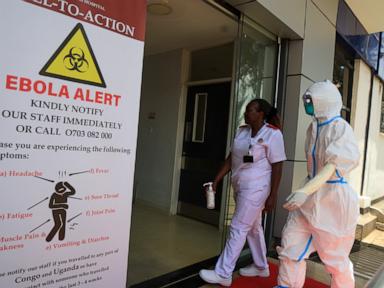
Here is a concrete operational example of how the cause-and-effect chain plays out. Suppose an ill traveler enters a major city by road or air and is driven to a hospital by a family member before Ebola is suspected. During that trip and initial triage, household members and clinical staff may experience unprotected fluid exposure. Even if rapid testing confirms the virus quickly and isolates the patient, the response team must immediately reconstruct every stop, trace every passenger and caregiver, test symptomatic contacts, and hold asymptomatic contacts under observation for three weeks. A delay of 48 hours at any link widens the contact tree and multiplies quarantine demand.
Cause-and-Effect Blind Spots in Outbreak Coverage
Basic reporting rarely maps the feedback loops that govern whether a cluster stays contained or sparks wider chains. Four structural mechanisms drive those outcomes.
Care-Seeking Pathways and Pre-Hospital Exposure
Families naturally move sick relatives toward care quickly. When a patient is driven to a hospital by a relative prior to diagnosis, that vehicle and household environment become high-yield focal points for contact tracing. Rapid clinical suspicion at the front door—paired with immediate isolation—cuts off downstream hospital amplification, whereas late recognition increases exposure among both family caregivers and frontline staff.
Quarantine Compliance and Cross-Border Mobility
Quarantine only interrupts onward transmission if contacts remain reachable, supported with essentials, and monitored consistently for the full incubation period. When contacts travel across borders or leave a jurisdiction during monitoring, containment depends on rapid notification between national health authorities so follow-up does not lapse mid-cycle. Regional mobility across East and Central Africa means an outbreak in one country is never purely domestic.
Diagnostic Turnaround and Symptom Onset Lag
Ebola symptoms—fever, fatigue, vomiting, diarrhea, and later bleeding—overlap with common tropical illnesses early on. Every hour between symptom onset, sample collection, laboratory confirmation, and isolation represents potential exposure time if the individual is not already quarantined. When secondary cases arise among individuals already placed under quarantine, diagnostic confirmation still matters for clinical management and bed allocation, yet the transmission chain is already boxed in.
Data Interpretation Pitfalls: Known Facts vs. Educated Hypotheses
Rigorous analysis separates verified surveillance facts from analytical inferences.
- Known epidemiological facts in the 2026 Kenya cluster: Officials confirmed an imported Bundibugyo virus case in Nairobi in early October 2026 following travel from the Democratic Republic of the Congo via Uganda, identified secondary cases among relatives and healthcare workers linked to that cluster, placed contacts under monitoring and quarantine, and reported no evidence of wider community spread.
- Educated hypotheses: Secondary cases among relatives most likely reflect close caregiving, shared transport, or household contact around symptom onset or hospitalization rather than casual public exposure. Likewise, declining new detections once all known contacts complete their 21-day observation window supports—but does not by itself guarantee—cluster containment unless active syndromic surveillance continues to catch any missed chain.
Operational Playbook for Outbreak Containment
Managing a high-consequence pathogen cluster requires disciplined sequencing rather than ad hoc announcements.
- Lock the transmission tree within 24 hours of confirmation: Interview household members, drivers, and admitting staff to map every person with direct physical or fluid contact since symptom onset, ranking contacts by exposure intensity.
- Enforce tiered quarantine and daily active tracing: Separate high-risk contacts with direct fluid or caregiving exposure from lower-risk contacts, assign dedicated case-trace teams with daily check-ins over 21 days, and log cross-border movements immediately with neighboring focal points.
- Harden triage and PPE workflows at receiving facilities: Isolate febrile patients with relevant travel or exposure histories immediately, standardize donning and doffing supervision to protect healthcare workers, and audit near-misses after every admission.
- Pair transparent risk communication with targeted border screening: Publish clear counts distinguishing imported cases, quarantined contacts, and unlinked community cases so public messaging and travel policies match actual transmission risk rather than panic.
Real-World Limits and Failure Modes
No containment protocol eliminates risk completely. Thermal screening at airports and border posts misses travelers who are still in the asymptomatic incubation window or who suppress fever with antipyretics, which is why post-arrival health declarations, rapid clinic triage, and domestic contact tracing carry the heavier burden. Contact lists are also only as complete as patient recall and willingness to disclose contacts under stigma or fear of isolation.
Resource constraints create another hard boundary. Sustained contact tracing, safe and dignified burial coordination, and intensive supportive care demand trained personnel and steady supply chains. Even in well-resourced urban centers, a single unquarantined secondary case that triggers a second generation of household or hospital exposures can strain isolation units and force broader restrictions.
Strategic Play for Health Authorities and Risk Planners
Treat a second case inside a known family cluster as an operational stress test of quarantine integrity and clinical protection rather than proof of runaway national spread. Direct immediate surge resources into three concrete actions: verify 100% completion of 21-day monitoring across every traced contact (including cross-border notifications), audit triage and PPE compliance at every hospital that touched the index or secondary cases, and maintain heightened hospital-based fever surveillance past the initial cluster window so any unlinked transmission link surfaces while still small.