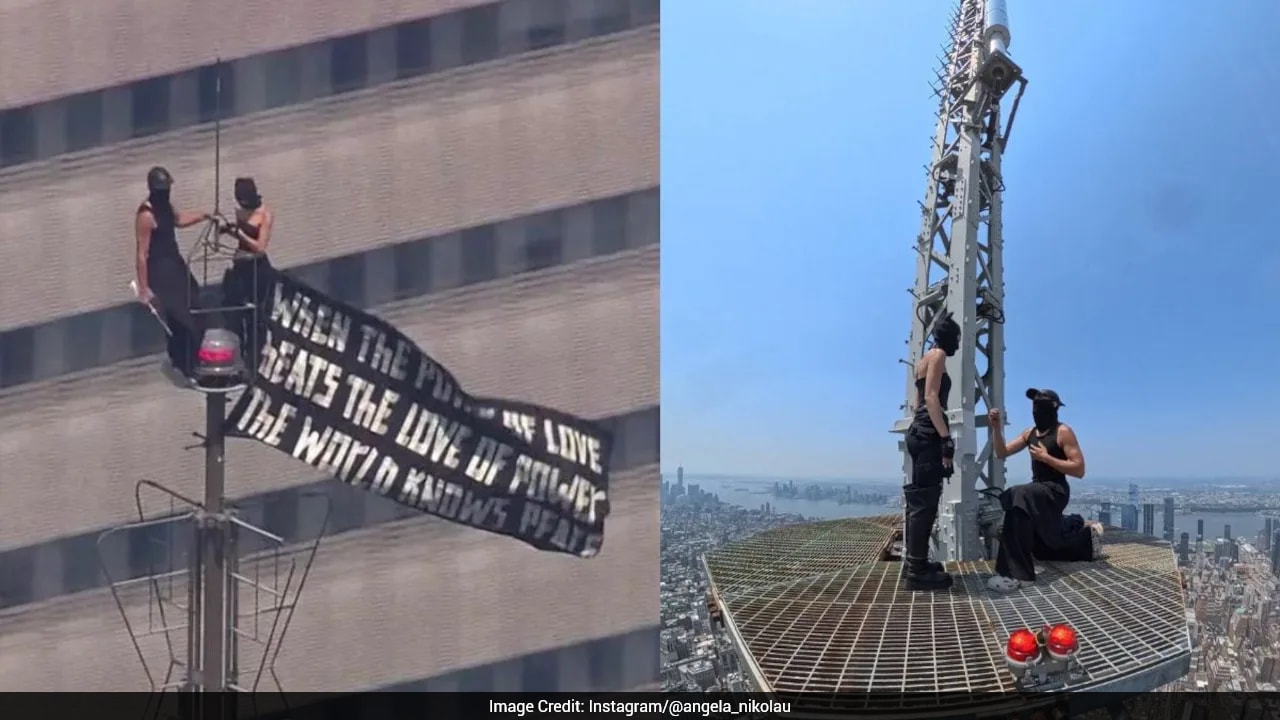
The scaling of the Empire State Building’s transmission tower by Russian rooftoppers Angela Nikolau and Ivan Beerkus represents more than a dramatic marriage proposal. It serves as a stark case study in the optimization of attention architecture. When the pair summited the 1,454-foot (443-meter) pinnacle of the midtown Manhattan landmark without tethers, unfurled a political banner, and staged an engagement, they executed a highly calculated media operation.
Media attention operates under strict mechanical rules. For independent creators, the monetization of physical risk requires a continuous escalation of variables to bypass institutional noise and algorithm fatigue. Analyzing this event through structural frameworks reveals the exact intersection of risk calculation, corporate security vulnerabilities, and the asymmetric economics of viral content.
The Attention Mechanics of High-Risk Ingress
The primary bottleneck for any unauthorized live stunt is the physical security architecture of the target asset. The Empire State Building utilizes a multi-layered defense system designed to screen, track, and restrict visitor movement. For a non-employee to transition from a public observation platform to the external latticework of a 102-story antenna requires exploiting specific systemic vulnerabilities.
[Public Deck] ──> [Mesh Gate Breach] ──> [Restricted Spire Ladder] ──> [Antenna Apex]
                         │
                         └── Security Void: Assumption of Personnel Status
The progression path follows a distinct four-stage operational sequence:
- Infiltration (Public to Restricted Transition): Witness accounts indicate the climbers bypassed physical barriers by moving through structural mesh gates adjacent to the observation deck. The breakdown occurred not at the mechanical layer, but at the human verification layer; onlookers and nearby personnel assumed the unmasked individuals possessed operational clearance based entirely on their deliberate, non-evasive movement patterns.
- Ascent Mechanics: The transition tower requires vertical progression up a exposed ladder system. By operating at midday (approximately 12:00 PM), the climbers leveraged high ambient tourist volume to mask their initial exit point, utilizing the density of the crowd to delay immediate security detection.
- Asset Deployment: Once at the apex, the pair deployed a high-contrast black banner featuring white text quoting a modified version of William Gladstone's peace thesis. The selection of a 1,454-foot elevation maximizes the optical line of sight for ground-level pedestrians and local news helicopters, creating an un-ignorable visual anomaly in the Manhattan skyline.
- The Conversion Event: The progression from a geopolitical statement (the peace banner) to a highly personal consumer event (the marriage proposal) represents a strategic narrative shift designed to diversify media coverage. Pure political stunts invite immediate institutional censorship or polarized public blowback. Intertwining the stunt with a romantic milestone captures mainstream lifestyle distribution networks, effectively insulating the creators from uniform public condemnation.
The Cost Function of Asymmetric Content Generation
The economics of extreme urban exploration depend on a highly skewed risk-to-reward ratio. Traditional marketing models require substantial capital expenditure to achieve global reach. In contrast, the high-altitude attention model trades personal liberty and physical safety for zero-cost syndication.
The cost function of this operation can be mathematically defined by the relationship between legal penalties, physical risk, and asset monetization:
$$C_{total} = P(Injury) \cdot V_{life} + P(Arrest) \cdot (L_{legal} + T_{incarceration})$$
Where $P(Injury)$ represents the probability of a fatal fall—elevated by the absence of safety tethers—and $P(Arrest)$ approaches a statistical certainty ($1.0$) in a heavily monitored urban environment like New York City. The legal liabilities incurred by Nikolau and Kuznetsov (Beerkus) include three core charges:
- Burglary: Entering a restricted building or structure with the intent to commit a crime (unauthorized commercial filming and asset manipulation).
- Criminal Trespass: Knowingly entering and remaining in an area where explicit physical barriers and signage prohibit public access.
- Reckless Endangerment: Creating a substantial risk of serious physical injury to third parties below, including pedestrians and emergency response personnel, through potential dropped objects or a secondary rescue deployment.
The creators accept these liabilities because the returns on the alternative side of the equation are asymmetric. The distribution of the resulting media assets operates on a global syndication loop:
[Stunt Execution] ──> [Local Broadcast Media Capture] ──> [Global News Syndication] ──> [Social Platform Conversion]
The immediate capture by local news helicopters, New York Police Department (NYPD) drones, and civilian smartphones creates a decentralized distribution network. The creators do not pay for ad placements; instead, global networks like Reuters, the Associated Press, and major digital publishers syndicate the footage for free. This media footprint acts as a direct funnel to the creators' primary digital storefronts and streaming assets, such as their 2024 Netflix feature film, Skywalkers: A Love Story. The long-term subscriber lifetime value (LTV) and brand equity generated by a top-tier global stunt consistently outweigh the predictable operational costs of standard legal defense fees and short-term detentions.
Institutional Vulnerabilities and Asset Protection
The event exposes critical structural gaps in landmark property management. The Empire State Realty Trust issued a statement confirming that the incident was entirely unauthorized and did not present an immediate physical threat to internal occupants. The trust explicitly highlighted their legitimate "$1,000 Happily Ever Empire Proposal Package" as the sanctioned alternative for consumers seeking high-altitude engagements.
This corporate response underscores a fundamental disconnect between institutional asset monetization and creator economic realities. A $1,000 luxury package yields localized, private value. Conversely, an unauthorized spire ascent yields global attention capital. The institutional framework fails to deter elite urban explorers because standard financial penalties and perimeter fencing are designed to manage general public liability, not to repel motivated, professional climbers who treat architectural barriers as terrain features.
The structural breakdown occurred inside the asset's internal access control loop. The fact that two individuals could transport a large commercial banner and specialized photographic equipment past standard tourist screening checkpoints indicates a failure in asset classification. Security protocols treated the climbers as standard consumers until they crossed the physical threshold of the spire gate, missing the pre-breach indicators of non-standard attire, concealed faces, and atypical equipment profiles.
Strategic Outlook for High-Value Assets
Urban infrastructure will face an increasing frequency of these asymmetric media operations. As algorithmic distribution channels continue to commoditize standard digital video content, the valuation of real-world, high-stakes physical spectacles will increase proportionally.
To mitigate these unauthorized exploitations, landmark operators must shift from passive physical barriers to active, predictive security frameworks. This requires integrating computer vision systems capable of detecting anomalous movement vectors near perimeter gates and establishing immediate, automated lockouts on all structural access points leading to building spires. Until asset managers treat their external facades with the same security density as their internal financial vaults, high-profile architecture will remain vulnerable to exploitation by sophisticated attention entrepreneurs.
The tactical resolution of the July 1 event by the NYPD Emergency Services Unit—resulting in a controlled, non-violent arrest on the lower antenna ladder—demonstrates that law enforcement can contain the physical disruption effectively. The legal system will now process the climbers through standard punitive channels. However, the media assets generated during the 30 minutes of peak exposure have already entered global distribution networks, completing the value extraction process before the first police camera footage was officially archived.
The technical mechanics of this high-altitude intervention are visually documented in detailed video analyses tracking the couple's route from the public observation platform up the structural latticework of the tower. For a complete tactical breakdown of the ascent path, equipment deployment, and subsequent interception by the NYPD Emergency Services Unit, view the Empire State Building Spire Structural Analysis. This footage illustrates the exact structural transition points used by the climbers to bypass the landmark's physical security layers.