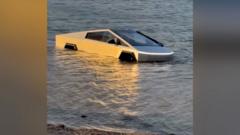
The physical failure of an $80,000 electric vehicle in a body of deep water is not a failure of marketing; it is a predictable violation of boundary conditions. When a driver intentionally steered a Tesla Cybertruck into Grapevine Lake, Texas, to test its engineering limits, the vehicle immediately transitioned from an off-road transit asset to a disabled, flooded hull. This incident exposes the critical decoupling between consumer perception of mechanical utility and the strict thermodynamic and legal limits governing consumer-grade engineering.
To understand why this vehicle failed, we must dissect the intersection of fluid dynamics, electrical insulation thresholds, human risk miscalculation, and the administrative frameworks of public safety. For an alternative look, read: this related article.
The Mechanics of Wade Mode and Hydrostatic Limits
Consumer understanding of a vehicle's aquatic capacity often relies on anthropomorphic assumptions rather than fluid mechanics. The engineering configuration of the Cybertruck features a dedicated "Wade Mode" sub-routine designed to mitigate risk during shallow water crossings. However, this system operates under rigid boundary conditions that do not scale linearly with depth.
The Mechanical Pressurization Loop
The core function of Wade Mode relies on active pneumatic engineering rather than passive physical sealing. When activated, the vehicle initiates two primary defensive protocols: Further insight on this matter has been provided by TechCrunch.
- Pneumatic Battery Pressurization: The system utilizes the air suspension’s compressor to pump air directly into the structural battery pack housing. This raises the internal air pressure of the enclosure above atmospheric levels, creating a positive pressure differential ($\Delta P > 0$). This positive internal pressure actively repels external water ingress through the seals.
- Ride Height Maximization: The air suspension shifts to its maximum clearance setting, raising the chassis to maximize the vertical distance between the water surface and sensitive electronic control units (ECUs).
[Wade Mode Activation]
       │
       ├─► Air Suspension Compressor ──► Positive Internal Battery Pressurization (ΔP > 0)
       └─► Ride Height Maximization  ──► Vertical Clearance of ECUs (Max 32 inches)
The fundamental bottleneck of this system is its maximum operational rating: 32 inches (815 mm) of static, slow-moving freshwater, measured from the base of the tire.
The Transition to Hydrostatic Failure
When a vehicle breaches the 32-inch boundary layer and enters deep water, the hydrostatic pressure ($P = \rho g h$, where $\rho$ is water density, $g$ is gravitational acceleration, and $h$ is depth) increases linearly.
Once the external hydrostatic pressure exceeds the internal pneumatic pressure generated by the battery compressor, the protective barrier collapses. At Grapevine Lake, the vehicle progressed past a standard boat ramp into deeper waters. This introduced three distinct failure vectors:
- The Charging Port Vulnerability: Unlike specialized marine hulls, consumer electric vehicles feature external charging interfaces sealed against directional precipitation, not submersion. Deep water exposure allows liquid to breach the charging port door, entering the high-voltage or low-voltage signal lines.
- Steering System Short-Circuiting: The vehicle utilizes a steer-by-wire system, which replaces mechanical steering columns with electronic actuators and digital signaling. Water ingress into these low-voltage control loops creates an immediate electrical short, grounding out signal wires and triggering a hard system shutdown.
- Loss of Traction via Buoyancy: Large-volume vehicular bodies displace a significant mass of water. As the vehicle deeper submerses, the buoyant force matches or exceeds a portion of the vehicle's mass, reducing the normal force between the tires and the lake bed. Without sufficient friction ($\mu N$), the tires lose all tractive capacity on soft, muddy underwater surfaces.
The Human Error Matrix: Miscalculating System Reliability
The driver’s decision-making process highlights a classic cognitive bias in consumer technology adoption: the false equivalence of past success under varying baseline conditions. The vehicle operator noted prior successful aquatic operations, including an alleged traversal of shallow ocean water, as validation for entering a deep freshwater lake. This logic contains a fatal structural error.
Environmental Volatility Variables
Operating a vehicle in shallow, predictable environments differs fundamentally from entering unmapped lake beds. The Grapevine Lake failure point was accelerated by two environmental constraints:
- Topographical Sub-Surface Hazards: Boat ramps are engineered for linear marine deployment, but the surrounding lake beds feature unmapped rock formations, drop-offs, and soft sediment. The vehicle encountered large shoreline rocks that physically altered its trajectory and altered its suspension equilibrium.
- The Warranty Exclusions: The manufacturing documentation clearly dictates that any damage sustained during water immersion is entirely excluded from warranty coverage. The financial risk is born entirely by the operator, making the test a zero-upside, high-downside economic wager.
Legal and Administrative Multipliers
The incident escalated from a mechanical failure to a criminal offense because the operator failed to recognize that entering a public body of water transforms a vehicle's legal definition under state jurisdiction. The state of Texas enforces strict boundaries separating land transit from marine activity.
The Triad of Statutory Violations
Upon losing control of the asset, the operator faced immediate detention by the Grapevine Police Department based on three distinct legal failures:
- Unauthorized Area Operation: Operating a civilian motor vehicle within a closed section of a public park or lake bed constitutes a direct breach of municipal land management codes.
- The Marine Registration Contradiction: By deliberately driving a vehicle into a lake to navigate it, the asset functionally entered the operational space of a watercraft. Texas law requires any motorized vessel operating on public waters to possess a valid marine registration.
- Safety Equipment Deficiencies: Because the vehicle was operating as a de facto watercraft without meeting marine compliance standards, the operator was cited for lacking mandatory water safety equipment, specifically personal flotation devices (lifejackets) and marine-grade fire suppression tools.
This legal framework demonstrates that municipal authorities treat the intentional immersion of consumer vehicles not as eccentric testing, but as an immediate threat to public safety and shoreline ecosystems, particularly given the proximity of families and children to recreational beach zones.
Strategic Play for Fleet and Asset Operators
For operators managing high-capital electronic assets or evaluating off-road fleet capabilities, this incident provides a definitive operational protocol.
Never rely on active software subsystems (such as automated air-pressurization routines) to override the hard boundaries of physical fluid dynamics. If an asset must operate near water boundaries, establish an absolute physical threshold at 50% of the manufacturer’s stated maximum depth to account for dynamic wave action and soft substrate displacement. Treat any amphibious deployment as a high-voltage threat vector, requiring immediate isolation of the asset the moment steering feedback or traction coefficients deviate from baseline land parameters.
Tesla Cybertruck Sinks in Texas Lake Testing Wade Mode This video documentation details the extraction process by emergency services and provides direct footage of the vehicle's final submerged position relative to the shoreline.