Hyperscale infrastructure developers are encountering a hard structural ceiling in the American Southeast, demonstrated by local authorities in Georgia rejecting a 700-acre data-centre campus twice within a seven-month window. Rather than representing an isolated zoning dispute, this repeated denial exposes a fundamental breakdown in how digital infrastructure operators price localized externalities, manage municipal political capital, and sequence utility interconnection agreements. Developers attempting to deploy gigawatt-scale compute campuses on agricultural or greenfield parcels can no longer rely on traditional industrial development playbooks that trade tax abatements for passive municipal approval.
The Structural Friction of Mega-Campus Siting
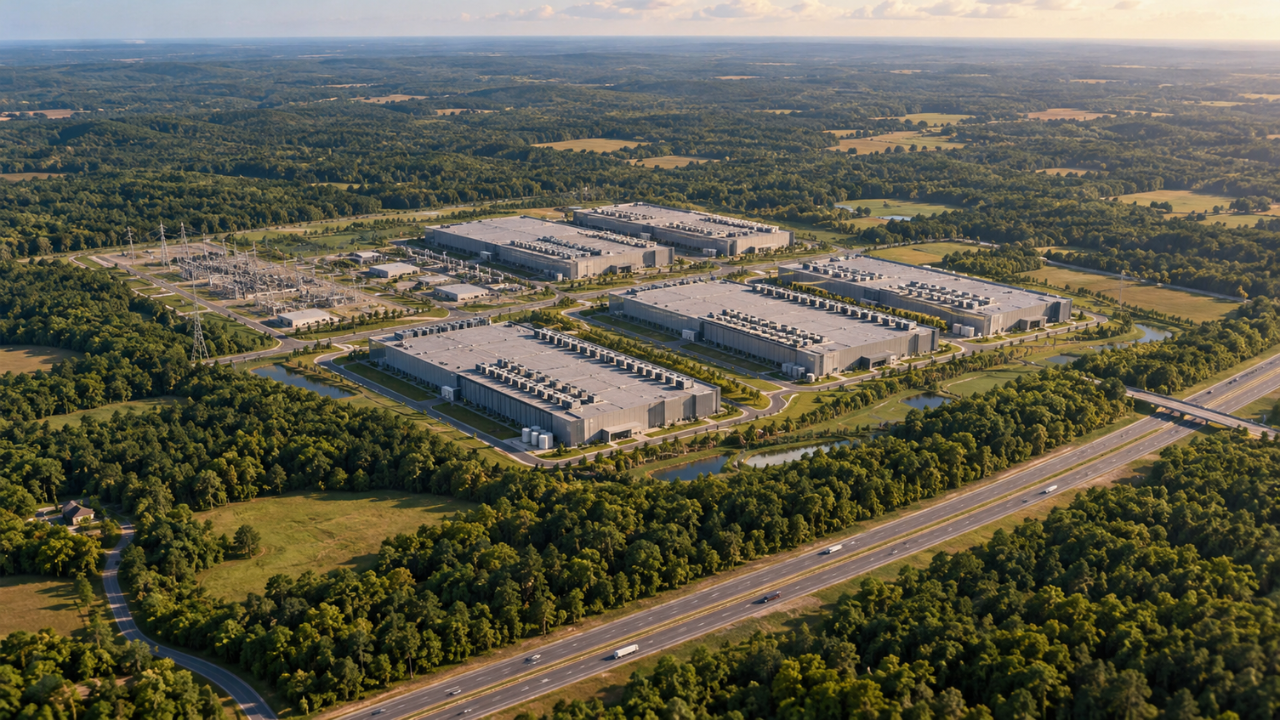
A 700-acre footprint places a proposed facility squarely in the mega-campus tier, typically engineered to support between 300 megawatts and over one gigawatt of critical IT load. At this physical scale, the industrial mechanics of a data center cease to resemble a standard commercial warehouse and begin operating like heavy utility infrastructure. When developers submit rezoning applications for parcels of this magnitude twice inside seven months without fundamentally altering the physical load profile of the site, they trigger an inevitable collision between corporate deployment timelines and municipal risk tolerance.
The core failure in a rapid seven-month resubmission cycle lies in misdiagnosing the root cause of the initial rejection. Standard real estate development treats municipal pushback as a negotiation over cosmetic concessions—such as increased vegetative buffers, architectural facade upgrades, or minor road-widening commitments. In the context of high-density compute campuses, local opposition is rarely driven by aesthetics. It is driven by structural anxieties regarding irreversible resource allocation, specifically electrical grid capacity, watershed depletion, and permanent land-use transformation. Submitting a revised site plan within half a year leaves insufficient time to execute the deep engineering redesigns—such as transitioning from evaporative cooling to closed-loop liquid systems or securing dedicated behind-the-meter generation—required to neutralize the underlying objections.
The Four Resource Bottlenecks Driving Municipal Pushback
To understand why a 700-acre proposal fails repeatedly at the county or municipal level, the project must be evaluated through the four primary physical constraints that govern hyperscale operations. Local planning commissions and residents increasingly evaluate these projects not by their projected capital expenditure, but by their localized resource burn rates.
Grid Interconnection and Substation Sprawl
A campus occupying 700 acres requires multiple high-voltage transmission feeds and dedicated on-site substations stepping down power from 230kV or 500kV lines. In Georgia, where rapid industrial growth—spanning electric vehicle manufacturing, battery plants, and logistics hubs—has already tightened reserve margins, adding a single-point load equivalent to a mid-sized city forces utilities to accelerate transmission upgrades. Municipal leaders recognize that while the data center operator pays for direct interconnection, the broader regional grid reinforcement costs are frequently socialized across the local rate base, creating political backlash among residential voters.Consumptive Water Use Versus Closed-Loop Economics
Traditional hyperscale cooling relies on evaporative cooling towers to maintain optimal Power Usage Effectiveness (PUE). A facility operating at several hundred megawatts can consume millions of gallons of potable or surface water daily during peak summer wet-bulb temperatures in the Southeast. For a county managing finite municipal water treatment capacity or agricultural aquifer drawdowns, approving a 700-acre campus introduces severe drought-resilience liabilities. While closed-loop air-cooled chillers or direct-to-chip liquid cooling eliminate consumptive water loss, they impose a capital expenditure penalty and slightly degrade thermal efficiency, increasing peak electrical draw. Developers who attempt to preserve evaporative cooling designs during a seven-month resubmission cycle almost always fail to overcome watershed protection mandates.Acoustic Footprints and Low-Frequency Propagation
Unlike manufacturing facilities that operate on predictable shift schedules, a hyperscale campus runs at continuous base load 8,760 hours per year. The primary acoustic threat comes not from server racks, which remain heavily insulated, but from hundreds of rooftop or yard-mounted chillers, dry coolers, and backup diesel generator banks. Low-frequency hums generated by large fans and transformers travel significantly farther than high-frequency noise, penetrating residential structures miles beyond the property line. On a 700-acre greenfield site—typically carved out of quiet rural or exurban land—even strict adherence to standard decibel limits at the property boundary often fails to prevent community nuisance complaints, forcing planning boards to reject proposals on quality-of-life grounds.The Fiscal Asymmetry of Job Creation
Economic development authorities historically justify zoning variances based on employment density. A 700-acre manufacturing plant might employ 2,000 to 4,000 workers on-site. A completed hyperscale data center of identical acreage typically employs between 50 and 150 permanent operational staff once construction concludes. While the facility generates substantial property tax revenue on high-value server hardware and real estate improvements, local municipalities often grant aggressive tax abatement packages to attract the project. When voters compare massive land consumption and permanent infrastructure strain against minimal permanent job creation and heavily abated initial tax receipts, the political math collapses.💡 You might also like: Inside the High-Stakes Fight Over California’s Billionaire Tax Proposal
The Fallacy of the Rapid Resubmission Cycle
Re-engaging a municipal zoning board within seven months of an initial defeat demonstrates a critical miscalculation of local political mechanics. County commissioners and city council members operate under direct electoral accountability; once they expend political capital to vote down a high-profile, controversial project, reversing that vote within the same election cycle without a transformative change in the proposal amounts to political self-sabotage.
During a compressed seven-month window, developers typically focus on public relations campaigns, minor site-plan adjustments—such as shifting building footprints 200 feet inward—and legal pressure regarding property rights. This approach ignores the operational reality of infrastructure entitlement. Meaningful risk mitigation requires restructuring the physical engineering of the campus:
- Transitioning Power Architecture: Moving from standard diesel backup generators—which require massive on-site fuel storage and frequent air-quality permitting for testing—to hydrotreated vegetable oil (HVO) fuels, fuel cells, or battery energy storage systems (BESS) to eliminate localized emissions concerns.
- Decoupling from Municipal Water: Engineering zero-water-use (ZWU) cooling architectures from the outset, completely removing the facility from the local water utility's demand projections.
- Land-Use Buffering via Mixed-Use Conservation: Dedicating a substantial percentage of the 700 acres—often 30% to 40%—to permanent conservation easements, public greenways, or solar microgrids rather than maximizing impervious surface coverage.
None of these engineering pivots can be fully modeled, priced, permitted with state environmental agencies, and socialized with local stakeholders within seven months. Resubmitting prematurely locks the developer into an adversarial posture, hardening local opposition groups and giving skeptical commissioners concrete procedural grounds—such as incomplete environmental impact assessments—to issue a second, often fatal, denial.
Strategic Recalibration for Greenfield Deployment
The double rejection in Georgia signals that the era of frictionless greenfield accumulation for hyperscale compute in primary and secondary utility markets has ended. Infrastructure operators must fundamentally alter their site-selection and entitlement sequencing before committing capital to land acquisition or zoning applications.
First, developers must invert their engineering sequence. Rather than securing zoning for a generic shell building and finalizing cooling and power specifications later, operators must lock in zero-water cooling designs and low-emission backup power architectures prior to the initial public filing. Presenting a fully engineered, resource-neutral specification eliminates the primary technical ammunition used by opposition groups.
Second, site selection must pivot away from raw agricultural greenfields toward brownfield industrial sites, retired coal power plants, or established industrial corridors. Retired thermal generation sites already possess high-voltage transmission interconnections, industrial zoning classifications, and community familiarity with heavy utility operations, bypassing the cultural and infrastructural shock of dropping a gigawatt-scale campus into a rural county.
Third, when greenfield entitlement is unavoidable, developers must abandon rapid resubmission tactics following an initial denial. A failed vote requires a minimum 12-to-18-month reset dedicated to substantive architectural redesign, binding community benefit agreements tied to infrastructure upgrades rather than vague charitable donations, and the decoupling of tax abatement requests from the initial zoning approval. Securing the entitlement first—and negotiating fiscal incentives only after the land use is legally vested—separates the technical merits of the project from political battles over corporate tax subsidies.