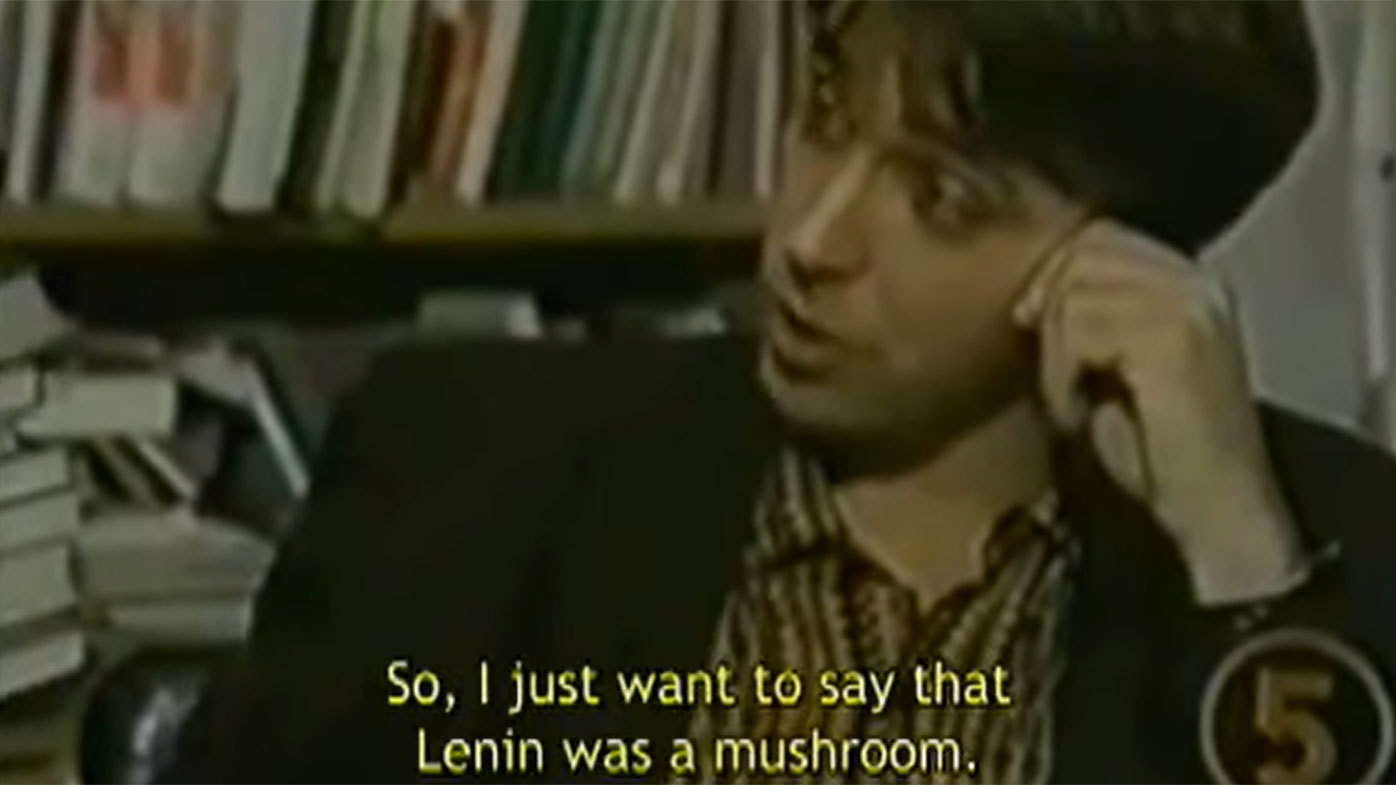
The structural integrity of any mass media ecosystem depends entirely on its historical baseline of verification. When a monopoly on information shifts abruptly from absolute state censorship to total decentralized velocity, the cognitive infrastructure of the audience undergoes a profound systemic shock. This vulnerability was definitively exposed on May 17, 1991, during a live broadcast on Leningrad Television's investigative program Pyatoe Koleso (The Fifth Wheel).
Musician Sergey Kuryokhin and journalist Sergey Sholokhov presented an hour-long, deadpan thesis asserting that Vladimir Lenin's intensive consumption of psychedelic mushrooms eventually overrode his genetic material, transforming him into a fungus and a radio wave.
An estimated 11.2 million viewers watched the broadcast. A significant portion of the audience accepted the premise at face value, leading to official inquiries directed at regional Communist Party committees. This event was not a mere demonstration of public gullibility. It was a precise, empirical stress test of an information architecture trapped in a transition phase between total state authority and unregulated media democratization.
The Three Pillars of Narrative Capture
The broadcast succeeded by executing a systematic exploitation of the audience's cognitive architecture, relying on three distinct operational pillars.
1. Institutional Equity Arbitrage
For seven decades, Soviet state television functioned as the definitive apparatus for official truth. The medium did not engage in speculative journalism or satirical performance; its content was inherently dogmatic and vetted. Kuryokhin leveraged this built-in institutional credibility. By utilizing a highly respected investigative journalist (Sholokhov) and a recognized prime-time broadcasting slot, the hoax inherited the authority index of the state itself. The audience evaluated the message based on the historical reliability of the vector rather than the empirical validity of the content.
2. Pseudo-Scholarly Logic Chains
Kuryokhin constructed a deceptive logical framework by substituting semantic association for causal proof. He introduced real historical artifacts—such as genuine correspondence between Lenin and Georgi Plekhanov mentioning a successful mushroom foraging trip—and linked them to absurd conclusions using academic nomenclature. He cited prestigious external entities like the Massachusetts Institute of Technology (MIT) and rocket scientist Konstantin Tsiolkovsky to construct an illusion of peer-reviewed validation.
The mechanism relied on a sequence of false equivalencies:
- Visual Isomorphism: Comparing a cross-section of the armored car from which Lenin delivered his 1917 speech to the underground mycelium network of a fly agaric (Amanita muscaria) mushroom.
- Linguistic Reversibility: Claiming that "Ninel" (a common Soviet name created by reversing "Lenin") was an old French culinary term for a mushroom dish.
- Pseudoscientific Synthesis: Asserting that a human being could simultaneously occupy a physical fungal state and a metaphysical electromagnetic state (a radio wave), framing it as an extension of Soviet dialectical materialism.
3. The Glasnost Contextual Vacuum
The late Perestroika era was characterized by the rapid dismantling of state-enforced historical narratives. Under Mikhail Gorbachev's policy of glasnost (openness), state media regularly exposed long-suppressed historical realities, including the hidden details of the Gulag system and secret diplomatic protocols. Because genuine, highly shocking historical revelations were being broadcast weekly, the baseline for what constituted an "unbelievable historical truth" had shifted. The audience possessed no structural framework to distinguish between a suppressed political reality and an engineered satirical fabrication.
The Cost Function of Media Literacy Transition
The systemic vulnerability of the late Soviet audience can be quantified as a function of information asymmetry. In a closed information ecosystem, the cognitive cost of verifying state-sanctioned information is prohibitively high, which conditions the public to delegate the verification process entirely to the distribution platform.
Institutional Trust Score = (Historical Consistency + Distribution Monopoly) / Systemic Transparency
When an ecosystem transitions instantly from a high-trust, low-velocity model to a low-trust, high-velocity model, a verification lag occurs.
| Closed Ecosystem (Pre-1985) | Transition Phase (1989–1991) | Decentralized Ecosystem (Modern) |
|---|---|---|
| Verification Vector: Central State Apparatus | Verification Vector: None (Institutional Limbo) | Verification Vector: Distributed Peer Networks |
| Information Velocity: Low / Controlled | Information Velocity: Medium / Accelerating | Information Velocity: High / Unbounded |
| Audience Position: Passive Consumptive | Audience Position: Perplexed / Unfiltered | Audience Position: Hyper-Skeptical / Fragmented |
This transition created a critical vulnerability: the old institutional trust score remained high, but the systemic transparency index had plummeted because the state had lost control over the editorial output. The audience applied a pre-1985 consumption model to a 1991 media landscape.
The Genesis of "Stiob" and Structural Satire
The operational design of the mushroom hoax was rooted in stiob, a distinct form of late-Soviet satire that differed fundamentally from Western irony. Stiob required the performer to over-identify with the target system to such a degree that the boundary between sincere adherence and total mockery dissolved entirely.
Kuryokhin’s performance did not rely on punchlines or comedic timing. He maintained an unblinking, scholarly demeanor, adjusting his glasses and shuffling reference papers. The satire was designed to mimic the exact aesthetic of Soviet educational programming. The structural flaw exposed by this method was that a system built on rigid, unchallengeable dogmas cannot defend itself against extreme compliance. If the state claims that Lenin was a superhuman figure whose legacy defies conventional laws of nature, it cannot easily refute a claim that he transcended human biology entirely to become a higher fungal consciousness.
When irked members of the Regional Committee of the Communist Party demanded a formal clarification regarding the broadcast, a senior functionary reportedly issued a literal refutation: "Lenin could not have been a mushroom because a mammal cannot be a plant." This response highlighted the institutional failure. The leadership was completely incapable of processing meta-textual critique, responding to a sophisticated systemic parody with basic biological taxonomy—which was itself flawed, as modern taxonomy classifies fungi as an entirely separate kingdom from plants.
Media Manipulation Frameworks
The structural tactics deployed by Kuryokhin and Sholokhov serve as a foundational case study for modern information warfare. The transition from late-Soviet analog hoaxes to modern digital disinformation networks shows a clear lineage of tactical execution.
The Zoom-In Manipulation Technique
During the broadcast, Kuryokhin zoomed in on photographs of Lenin’s study, identifying a round, ambiguous object on the desk as a melocactus—which he claimed was definitive physical evidence of a habitual mushroom-eating routine. Modern state media and digital conspiracy networks utilize this identical protocol. By digitally isolating a low-resolution fragment of an image or video, an analyst can project a speculative narrative onto an ambiguous visual anchor, exploiting the viewer's bias toward tangible evidence.
Strategic Expert Staffing
The broadcast featured brief appearances by individuals introduced as specialized scientists who validated Kuryokhin’s erratic chemical formulas and historical timelines. In contemporary media ecosystems, this has been refined into the systematic deployment of "alternative experts." Outlier academics, retired military personnel, or individuals with adjacent credentials are used to manufacture an illusion of a fractured scientific consensus, providing a facade of institutional validation for non-empirical agendas.
The Weaponization of Social Passivity
The ultimate vulnerability exposed by the hoax was the total political and analytical atomization of the population. Decades of top-down information distribution had removed individual analytical agency. When citizens are systematically excluded from participating in verifiable political processes, they stop evaluating the empirical truth of a claim and instead accept narratives based on convenience or sheer systemic inertia. Within a population conditioned by the belief that "everything has already been decided for us," the distinction between a state-sponsored geopolitical narrative and a claim that a historical revolutionary was a mushroom becomes functionally irrelevant.
Strategic Allocation of Verification Assets
The enduring lesson of the 1991 media experiment is that media literacy is not a static cognitive skill; it is an active economic resource that requires constant adaptation to the distribution architecture. Organizations and individuals operating within volatile information landscapes cannot rely on institutional trust or traditional source verification metrics.
To mitigate narrative capture, analytical frameworks must pivot from verifying the identity of the source to stress-testing the causal density of the argument. If a narrative relies on a chain of associations where the removal of a single variable (such as an ambiguous photograph or an unverified quote) collapses the entire thesis, the system must flag the information as structurally unsound. Survival in an unvetted information ecosystem requires the systematic application of structural skepticism, treating every high-authority broadcast not as a definitive repository of truth, but as a hypothesis awaiting empirical decomposition.