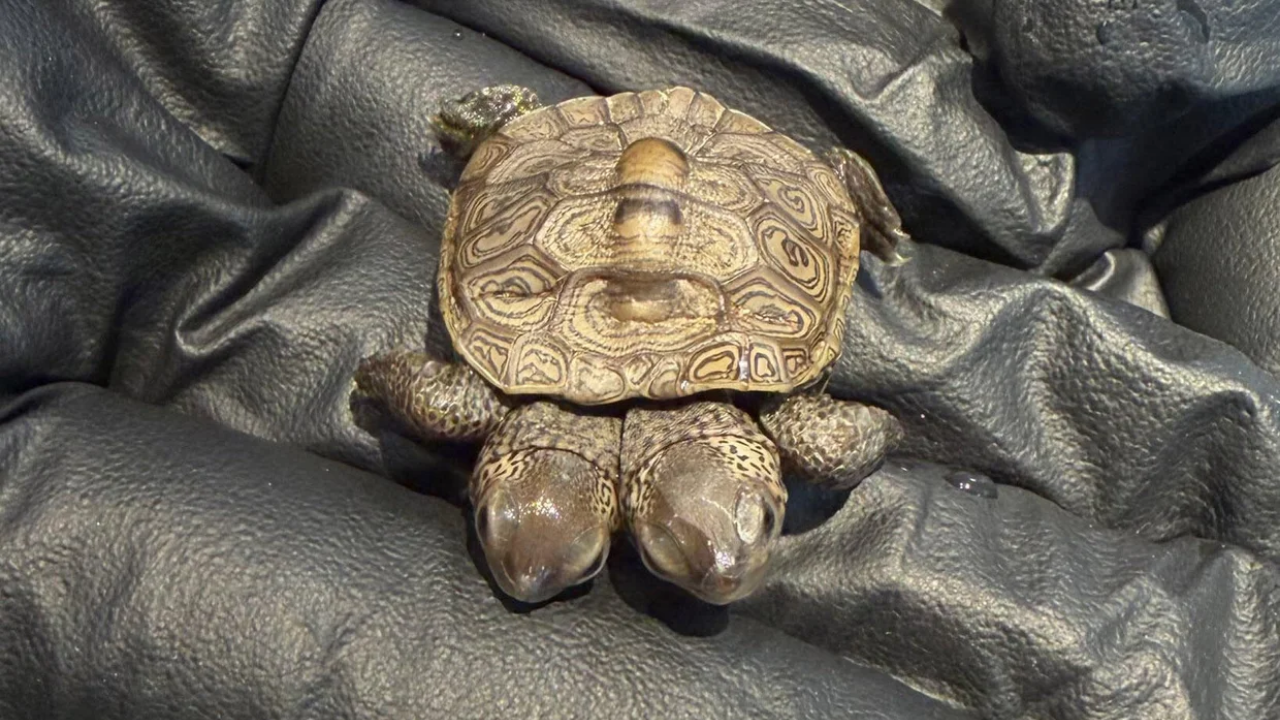
When a diamondback terrapin hatchling emerged from its nest on the sands of Wellfleet this autumn, it tipped the scale at a meager 5.2 grams—roughly the weight of a nickel or a teaspoon of sugar. But this tiny reptile carried something far heavier than its physical mass: a profound biological anomaly. Known scientifically as bicephaly, the newborn creature possessed two distinct, fully reactive heads protruding from a single shell. Transported to the Cape Wildlife Center by the Mass Audubon Wellfleet Bay Wildlife Sanctuary, the hatchling has ignited a quiet firestorm among marine biologists and veterinary specialists who are left grappling with the messy, unpredictable realities of developmental mutations in protected coastal wildlife.
Most casual observers see a social media curiosity. Veterans of wildlife rehabilitation see a complex clinical puzzle wrapped in a sobering ecological context.
The Mechanics of Bicephaly in Reptiles
To understand why a two-headed terrapin captures professional attention, one must look past the novelty and examine embryology. Bicephaly is rarely a product of genetic inheritance in the traditional Mendelian sense. Instead, it is almost invariably an accident of embryonic development—specifically, an incomplete splitting of a single fertilized egg during the early stages of monozygotic twinning.
Imagine a zipper that jams halfway down. The cells begin to divide into twins, but the process halts or stalls before physical separation completes. The result is a shared body cavity, a single digestive tract or a partially bifurcated one, and two independent neurological command centers vying for control of four limbs and a tail.
At the Cape Wildlife Center, veterinary technicians noted almost immediately that both heads are active, alert, and eager to feed. During initial assessments, the left head even demonstrated aggressive feeding behavior, snapping at air and attempting to secure sustenance independently of its counterpart. This creates an immediate husbandry crisis. In a shared coelomic cavity, organs must support double the neurological processing, increased metabolic demand, and conflicting motor inputs. If one head signals the body to turn left while the other dictates a rightward retreat, the animal experiences chronic physiological stress.
The Conservation Paradox on Cape Cod
This remarkable birth did not occur in a pristine, untouched wilderness. It was discovered within a fiercely managed ecosystem. During recent nesting seasons, conservation volunteers and sanctuary staff have patrolled the vulnerable barrier beaches of Wellfleet, Eastham, and Orleans, installing protective wire cages over diamondback terrapin nests to shield the eggs from voracious mammalian predators like raccoons, skunks, and foxes.
This intensive management creates an intriguing paradox for field biologists. Diamondback terrapins (Malaclemys terrapin) inhabit the brackish salt marshes and estuaries of the Atlantic coast. They are a threatened species in Massachusetts, squeezed relentlessly by coastal development, road mortality as females seek sandy nesting sites, and commercial fishing gear entanglements.
Because human intervention actively shields these nests to boost hatch rates—yielding thousands of successful releases annually—we are mathematically increasing the total volume of observed anomalies. When nesting output scales up through intense protection, rare developmental hiccups that might have gone entirely unnoticed in a wild, unmonitored population suddenly land on clinic tables. Are mutations like bicephaly ticking upward due to environmental micro-pollutants and rising coastal sand temperatures, or are we simply seeing them more often because we are looking closer? The honest answer from the field is that we are tracking the symptoms while the root environmental stressors continue to compound.
The Limits of Veterinary Medicine
For the veterinary team monitoring the 5.2-gram hatchling, the immediate future is defined by observation rather than intervention. Advanced diagnostic imaging, including high-resolution digital radiography and potential micro-CT scans, will eventually map how the skeletal and circulatory systems divide beneath the scutes.
Yet, imaging only reveals anatomy; it does not solve viability. Past cases of bicephaly in chelonians reveal a stark biological reality. Very few multi-headed reptiles reach full adult maturity in the wild. Even in captivity, where predators are eliminated and food is doled out with tweezers, internal organ conflicts frequently lead to premature mortality as the animal grows and metabolic strain increases.
If the terrapin proves robust enough to navigate its conflicting nervous systems, it will likely spend its life in an educational facility rather than returning to the salt marshes of Cape Cod. Releasing a bicephaly-afflicted animal into a tidal marsh where diamondback terrapins must battle swift currents, navigate deep mud, and evade avian predators is an ethical non-starter. Survival requires a degree of motor coordination that a two-headed animal rarely masters over the long term.
The tiny terrapin rests under a heat lamp in Barnstable, a living reminder of the fragility hidden inside an eggshell. It asks no questions about its own rarity, nor does it care about the headlines it generates. It simply tries to eat, breathe, and coordinate two minds inside a single, fragile world.


