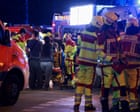
Public safety failures during large-scale urban gatherings expose systemic vulnerabilities in how municipal authorities manage kinetic risk and physical space. When a vehicle breaches a pedestrian zone during a high-profile demonstration like Berlin Pride, the resulting casualties represent the terminal point of multiple sequential safety breakdowns. Evaluating this event requires shifting away from emotional sensationalism and toward a rigorous framework of perimeter mechanics, crowd density dynamics, and traffic interception protocols.
The Triad of Perimeter Vulnerability
Urban crowd events rely on three distinct lines of defense to separate pedestrian zones from vehicular corridors. A failure in any single layer initiates a cascade that local security measures struggle to absorb.
Physical Barrier Integrity
The primary defensive layer consists of physical obstacles. Standard plastic or lightweight metal barricades serve as crowd-control boundaries for pedestrian flow, but they possess zero kinetic stopping power against a motorized vehicle. When planners substitute crowd-control devices for anti-ram infrastructure, they create a false sense of security. A vehicle operating at urban speeds transfers massive kinetic energy, instantly neutralizing superficial barriers. True physical mitigation requires hardened bollards, heavy transport vehicles parked transversely, or hydraulic wedge systems capable of absorbing momentum.
Spatial Buffer Zones
The secondary layer involves distance. Creating a buffer between moving traffic lanes and stationary pedestrian densities provides reaction time. Without an adequate clear zone, the velocity vector of an errant or hostile vehicle intersects with high-density human concentrations before any human operator can issue a warning or deploy secondary countermeasures.
Interception Protocols
The tertiary layer is human response. Law enforcement and event marshals stationed at critical junctures must possess clear authorization and capability to halt unauthorized vehicular access. Relying solely on passive observation without active traffic gating transforms the perimeter into a reactive environment rather than a proactive defense.
The Velocity and Density Equation
The severity of a crowd-impact incident is governed by a direct mathematical relationship between vehicle velocity, mass, and pedestrian packing density.
When a crowd gathers for a celebration or protest, pedestrian density often exceeds four to five individuals per square meter. In this compressed state, lateral movement becomes physically impossible. Individuals cannot flee because their neighbors block their paths. Consequently, a vehicle entering this space does not encounter a dispersed group that can scatter; it encounters a solid mass that acts as a physical medium, transmitting force through human bodies and compounding trauma.
Furthermore, emergency response metrics dictate that survival rates in mass-casualty incidents hinge on the golden hour of trauma care. However, high-density crowds physically trap emergency medical services on the periphery. First responders cannot maneuver vehicles or equipment through a dense assembly without specialized corridors, delaying triage and hemorrhage control.
Systemic Failure Modes in Urban Event Planning
Analyzing the systemic breakdowns in large-scale event management reveals recurring structural flaws.
Fragmented Jurisdiction
Urban events frequently cross municipal and federal jurisdictions. Police departments, private security firms, and city transit authorities often operate under separate command structures. This fragmentation creates communication latency. When a threat emerges or a vehicle bypasses a checkpoint, the delay in relaying actionable intelligence between traffic control and frontline units prevents timely intervention.
Risk Aversion Versus Operational Cost
Hardening an entire city district against vehicular incursions incurs substantial financial and logistical costs. Municipalities often balance the statistical probability of an incident against the disruption to commerce and transit. By treating security as a compliance checklist rather than a dynamic risk management problem, planners accept residual vulnerabilities that occasionally manifest as catastrophic failures.
The Threshold of Predictability
Large public demonstrations are inherently dynamic. Protest routes shift spontaneously, and crowd sizes frequently outpace initial permit estimates. Fixed security plans designed for a static headcount fail when actual attendance surges by fifty or one hundred percent, rendering pre-positioned barriers and staffing levels inadequate for the actual spatial load.
Strategic Operational Recommendations
Mitigating future incidents demands a fundamental overhaul of urban event engineering.
Municipalities must mandate dual-tier perimeter architectures for any event exceeding a designated attendance threshold. The outer tier must consist of heavy vehicle-exclusion zones enforced by certified anti-ram assets, entirely isolating the event footprint from active urban traffic arteries. The inner tier should remain dedicated to soft crowd control and wayfinding.
Event commands must integrate real-time spatial monitoring through aerial surveillance and density-mapping software. When crowd concentrations reach critical thresholds in proximity to open roadways, automated alerts must trigger immediate deployment of mobile traffic-blocking assets to reinforce vulnerable junctures.
Security planning must transition from static blueprint compliance to continuous red-teaming, testing perimeter resilience against unauthorized vehicular entry under live operational conditions. Only by treating public space security as an engineered system of redundant physical and procedural controls can authorities suppress the structural vulnerabilities that enable such tragedies.


/i.s3.glbimg.com/v1/AUTH_1f551ea7087a47f39ead75f64041559a/internal_photos/bs/2025/P/p/LLF10DRp2WoUISXryrUQ/whatsapp-image-2025-12-02-at-20.06.57.jpeg)