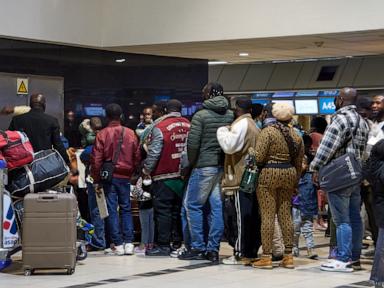
The voluntary repatriation of Ghanaian nationals from South Africa illuminates a structural breakdown in continental labor markets and pan-African immigration policy. When a sovereign state deploys state-funded capital to extract its workforce from a peer economy, the event cannot be evaluated merely as an isolated humanitarian response. It represents a costly, calculated intervention to mitigate systemic friction at the intersection of domestic fiscal stagnation and regional labor integration.
To evaluate the operational and economic realities of this evacuation, the situation must be broken down into its core drivers, financial mechanisms, and macroeconomic consequences.
The Triple Pressure Loop Behind South African Domestic Friction
The localized hostility driving more than 800 Ghanaian citizens to register for evacuation with the High Commission in Pretoria is the direct output of a multi-variable macroeconomic constraint model. Rather than viewing the civil unrest as spontaneous cultural friction, an economic assessment reveals three distinct systemic pressures.
- Labor Supply Imbalances: South Africa operates as a primary regional economic hub, yet it suffers from persistent structural unemployment. When low-skill and semi-skilled labor supplies swell via cross-border migration, local wage floors face downward pressure. This triggers immediate friction within high-density municipal economies.
- The Public Infrastructure Deficit: In urban centers across Johannesburg and Pretoria, the growth rate of the resident population outpaces municipal capital expenditure. The resulting strain on public healthcare, housing networks, and utility distribution models transforms basic public services into a zero-sum competition between domestic citizens and migrant populations.
- Asymmetric Regulatory Enforcement: A critical vulnerability in South Africa’s immigration framework is the sheer volume of undocumented workers. Initial data verified by immigration authorities at OR Tambo International Airport indicated that out of an early repatriation cohort of 300 individuals, only 10 possessed valid legal residency status. This 96.6% rate of non-compliance proves that the formal asylum and visa frameworks have experienced a systemic administrative breakdown, leaving thousands outside the formal legal tax and labor structures.
The Cost Function of Sovereign Extraction and Reintegration
Accra’s decision to fund the evacuation operations under the Mahama administration represents an acute reallocation of public capital. The state-led intervention operates on a two-tiered expenditure framework: immediate extraction costs and long-term reintegration liabilities.
Total State Expenditure = Flight Charter Capital + Immediate Relief Capital + Long-Term Capital Absorption
The first phase demands immediate liquid capital outlays. The Ministry of Foreign Affairs institutionalized fully state-funded chartered flights to bypass the financial constraints of vulnerable citizens. This stands in sharp contrast to parallel regional responses; for example, the Nigerian diplomatic apparatus mandated that its evacuees self-fund their return transit, shifting the financial burden entirely onto private household balance sheets.
The second phase introduces a compounding domestic fiscal liability. To prevent the repatriated population from instantly becoming a dependent underclass, Accra launched the "Welcome Home Financial Package." This multi-layered rehabilitation strategy includes:
- Immediate Liquidity Injections: Direct cash allowances distributed upon arrival to offset structural displacement shock and fund localized transport from the entry hub to regional destinations.
- Psychosocial Infrastructure: State-funded trauma counseling networks to manage the psychological fallout of sudden urban displacement.
- Human Capital Absorption: The creation of a dedicated state database designed to systematically funnel returnees into domestic employment channels and micro-enterprise startup programs.
Strategic Remittance Degradation and Macroeconomic Spillover
The contraction of the Ghanaian diaspora in South Africa carries measurable deflationary consequences for household economies inside Ghana. Diasporic labor functions as an informal social safety net through the mechanism of cross-border remittances.
When workers are removed from a high-yield economic market like South Africa and re-introduced into West Africa’s domestic labor market, two economic shifts occur. First, the immediate cessation of foreign currency inflows weakens household-level purchasing power in the returnees' home districts, directly impacting local retail and service sectors. Second, the domestic labor market experiences a sudden supply shock. Injecting hundreds of workers simultaneously into an economy already striving to generate sufficient formal employment creates localized wage compression and intensifies competition for micro-entrepreneurial market share.
The Geopolitical Friction Coefficients
The operational coordination between Ghana’s High Commissioner, Benjamin Anani Quashie, and South African immigration officials highlights a delicate balancing act designed to preserve bilateral trade relations. Both nations are highly incentivized to avoid formal diplomatic fractures; South African corporate entities hold significant market positions in Ghana’s telecommunications, retail, and mining supply chains, while Ghana remains a critical strategic partner in West Africa.
However, the necessity of the evacuation reveals the limits of the African Union’s institutional ideals. The Continental Free Trade and Free Movement principles state that labor mobility should act as an economic multiplier across borders. The reality on the ground exposes a structural paradox: pan-African economic integration cannot succeed when the macroeconomic foundations of host nations are under severe domestic strain. The use of state resources to execute defensive repatriations proves that when domestic resource constraints peak, national sovereignty and border protection will consistently supersede continental integration treaties.
The long-term resolution of this migration friction does not reside in recurring, state-funded evacuation flights, nor does it lie in blunt domestic security crackdowns. Host nations must reform their immigration tracking systems to significantly reduce the administrative backlogs that leave 96% of migrant cohorts undocumented. Concurrently, sending nations must build domestic economic systems capable of retaining human capital. Until these underlying structural asymmetries are corrected, regional labor migration will continue to generate cyclical fiscal shocks for both sending and receiving states across the continent.


