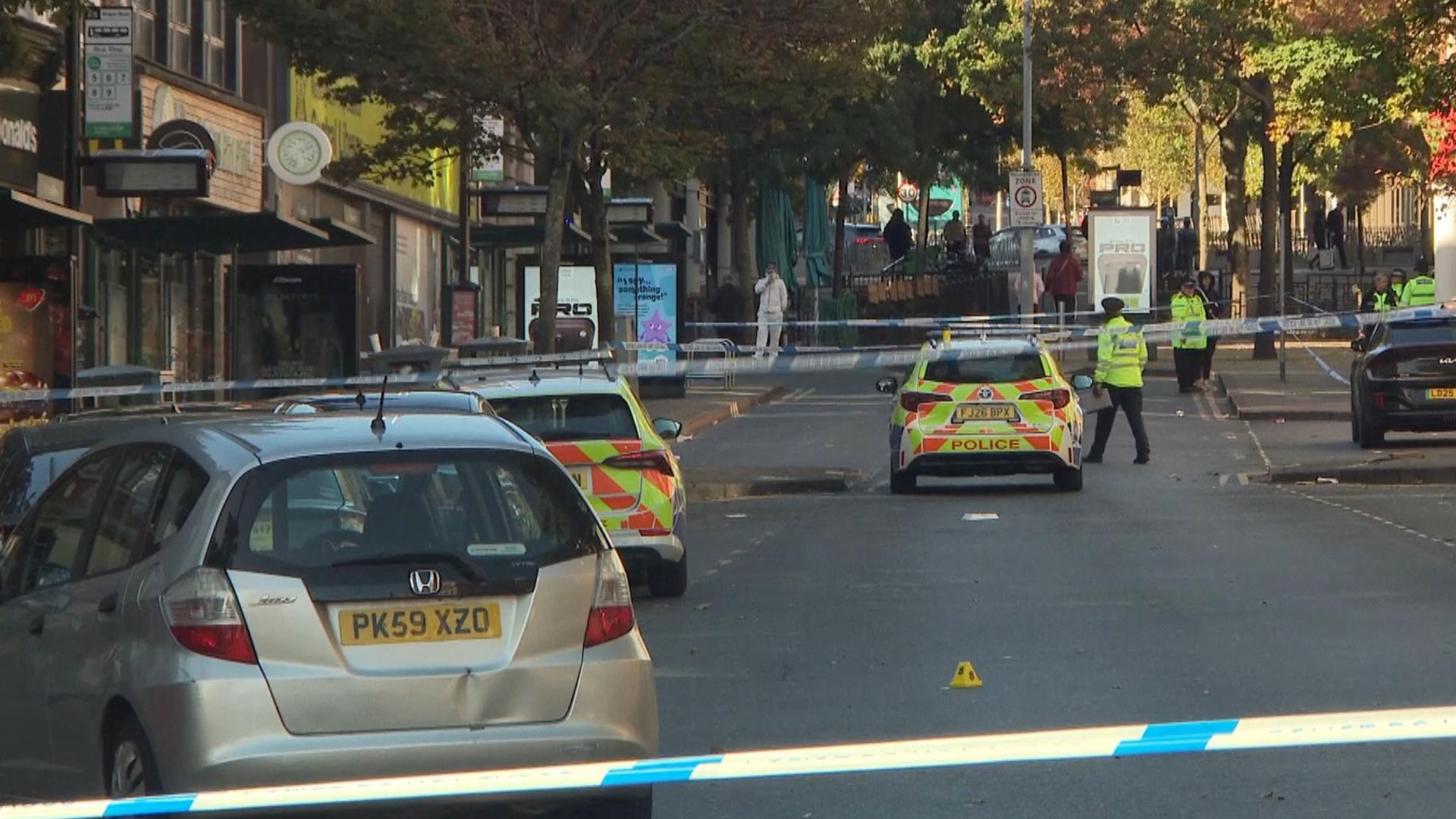
Standard breaking-news reports on the early-morning shooting of Nottinghamshire Police officer PC Lee Lane on Angel Row treat a complex operational event as a simple sequence of shock, hospital status, and arrests. That linear framing misses the structural mechanics of high-risk street encounters in a largely unarmed policing model. Around 4:50 a.m. on Sunday, October 18, 2026, an officer approaching two individuals near a bus stop by Old Market Square suffered a gunshot wound to the foot. Subsequent developments—including multiple arrests, vehicle stops outside the county, and charges involving prohibited firearm offences—show that a single street-level contact sits at the intersection of time-of-day dynamics, weapon concealment, and multi-stage investigative escalation.
To understand what actually happened and why standard incident summaries fall short, this analysis maps the event onto four operational frameworks: The Three Vectors of Late-Night Street Contact, The Escalation and Evidentiary Chain, The Asymmetric Threat Cost Function, and Known Facts Versus Analytical Hypotheses. Rather than relying on emotional reaction, each section examines how patrol decisions, urban geography, and criminal logistics interact when an illicit firearm appears in a city centre.
Deconstructing Conventional Incident Coverage
Conventional reporting on shootings involving officers typically follows a predictable template: time and location, injury severity, official statements from police leaders and elected representatives, and a running tally of arrests. In the Nottingham case, those building blocks are clear on the surface. An officer was shot in the foot on Angel Row at roughly 4:50 a.m., received medical treatment and hospital care in stable condition, and was assisted initially by members of the public before emergency backup and cordons were established. Over the weeks following October 18, 2026, investigators carried out multiple arrests and brought firearms-related charges against suspects.
The analytical weakness of that standard coverage lies in what it leaves unexamined. Treating an approach to two people at a bus stop as an isolated flashpoint obscures three causal links:
- Temporal and spatial friction: Pre-dawn hours in a major commercial and transit hub combine low ambient pedestrian volume, lingering night-time economy movement, and public transport nodes where individuals either wait for transit or attempt rapid egress.
- Information asymmetry at first contact: Routine proactive or reactive approaches in low-firearm-density jurisdictions operate under a baseline assumption that encountering a concealed lethal firearm is a low-probability tail event, even though high-consequence outcomes remain possible.
- Post-incident network unraveling: A street shooting rarely ends at the curb; forensic recovery at the scene, witness accounts, and mobile or vehicle tracking frequently expose wider networks of possession, movement, and assistance across jurisdictions.
When an article lists quotes about courage and concern without linking them to patrol posture, threat assessment, and investigative sequencing, the reader gets sympathy without systems insight.
The Three Vectors of Late-Night Street Contact
Any street-level encounter between a patrol officer and individuals acting suspiciously is governed by three interacting vectors: Environmental Geometry, Temporal Friction, and Threat Ambiguity.
Environmental Geometry
Angel Row sits adjacent to Nottingham's Old Market Square, a dense urban core defined by commercial frontages, pavements, transit stops, and multiple pedestrian and vehicular escape routes. Bus stops and central squares function as transition nodes—places where people pause, congregate, or pivot between walking routes and transport. For an officer approaching on foot or from a patrol vehicle, open sightlines and adjacent alleys or streets simultaneously create observation opportunities and rapid-flight avenues once an incident erupts.
Temporal Friction
At 4:50 a.m. on a Sunday, the city sits in a liminal operational window. Late-night venues have typically wound down or are clearing out, early morning shift workers and transit users are beginning to stir, and lighting conditions are artificial or low. In decision science, low ambient activity lowers the signal-to-noise ratio for spotting unusual behavior: two individuals at a bus stop stand out more sharply than they would at noon, yet fewer uninvolved witnesses are present to provide early context before contact is made.
Threat Ambiguity
Officers routinely make split-second judgments based on partial cues—body language, posture, positioning near a shelter, or refusal to disengage. A fundamental tension in policing is that suspicious behavior correlates far more often with minor disorder, intoxication, vulnerability, or property offenses than with armed violence. Approaching closely enough to communicate or conduct a standard check narrows physical distance and reaction time, while stepping back too early risks forfeiting situational awareness or allowing suspects to disperse before facts are established.
The Escalation and Evidentiary Chain
A shooting in a public space triggers two parallel tracks that run at different speeds: immediate tactical containment and multi-week criminal investigation.
In the first track, priorities compress into minutes. Bystanders who render initial aid affect early stabilization alongside arriving paramedics and firearms/response units. Establishing a scene cordon preserves ballistic, trace, and biological evidence on the street before foot traffic or weather degrades it. Simultaneously, police leadership must assess whether the incident represents a targeted or spontaneous confrontation involving fleeing suspects or an active ongoing danger to the wider public.
In the second track, detectives build a prosecutable chain from fragments. Arrests made hours or days later—including stops outside the immediate force area such as in Bedfordshire—illustrate how investigations expand from local street sightings to broader logistics, including potential assistance to offenders and possession of prohibited weapons. Crucial legal distinctions govern this phase:
- Arrest versus charge: Detention for questioning tests reasonable suspicion; formal charges require an evidentiary threshold linking specific individuals to specific statutory offences.
- Firearm possession versus firing: Being charged with possessing a prohibited firearm or related offences is legally distinct from proving who discharged a weapon at a specific moment.
- Presumption of innocence: Every arrested or charged individual remains presumed innocent unless and until proven guilty in court.
Conflating an arrest or a firearms charge with final attribution for the shot itself is one of the most common analytical errors in fast-moving crime reporting.
The Asymmetric Threat Cost Function
In economic and risk-modeling terms, unarmed or routinely unarmored street policing faces an asymmetric cost function. The operational cost of routine, proportionate engagement is low under normal conditions, and heavy tactical mobilization for every ambiguous street sighting would rapidly exhaust patrol capacity and erode community trust. Yet when an adversary introduces an illegal firearm into a routine approach, the marginal cost of a single second can jump from a minor stop to severe injury or fatality.
This asymmetry creates three structural pressures on a force:
- Resource strain: A single officer injured by gunfire requires immediate medical evacuation, welfare and family support via specially trained officers, backfill on patrol shifts, and a major detective and forensic investigation.
- Tactical trade-offs: Increasing distance or waiting for specialized support reduces immediate exposure for the approaching officer, but can lengthen response times or allow armed suspects to flee with a weapon through a city centre.
- Public confidence volatility: High-profile violence in a central civic space tests reassurance messaging—officials must acknowledge real danger without overstating ongoing public risk when intelligence indicates otherwise.
No single operational tweak eliminates this asymmetry. Armor, distance, backup protocols, and intelligence-led firearm disruption each reduce specific failure modes while introducing trade-offs in speed, visibility, or resource allocation.
Known Facts Versus Analytical Hypotheses
Rigorous analysis requires separating verified facts from working hypotheses so speculation never masquerades as evidence.
Known Facts
- The shooting occurred at approximately 4:50 a.m. on Sunday, October 18, 2026, near a bus stop on Angel Row in Nottingham city centre, close to Old Market Square.
- Nottinghamshire Police officer PC Lee Lane was shot in the foot after approaching two people and was hospitalized in a stable condition.
- Members of the public helped the injured officer prior to emergency responders arriving, and a scene cordon was set up for forensic examination.
- Police made multiple arrests following the incident—including an arrest following a vehicle stop in Bedfordshire—and subsequently brought charges including offences involving a prohibited firearm, while court proceedings progressed into November 2026.
Analytical Hypotheses
- Opportunistic versus pre-planned carry: Because suspects fled on foot after the shot rather than engaging in a prolonged standoff, the firearm may have been carried for personal protection, transit, or criminality rather than specifically to ambush a uniformed officer—though only investigative and court evidence can confirm intent.
- Cross-border mobility: The involvement of a stop in Bedfordshire suggests either pre-existing regional ties among associates or rapid post-incident movement away from Nottinghamshire to evade local containment.
- Bystander impact on early stabilization: Prompt assistance from passersby at 4:50 a.m. likely helped bridge the gap between injury and specialized medical care, highlighting how early civic intervention can influence immediate outcomes in urban incidents.
Operational Playbook for Urban Incident Response
For police commanders, municipal safety leads, and security analysts evaluating or preparing for similar high-risk street encounters, four practical steps translate these mechanics into discipline:
- Audit late-night transit nodes for blind spots and sightlines. Map bus stops, squares, and adjacent alleys around 3:00 a.m. to 6:00 a.m. to align CCTV coverage, street lighting, and patrol approach angles so officers are not funnelled into confined pockets.
- Calibrate approach geometry during low-visibility hours. Reinforce training on staged approaches, cover utilization, and early backup requests when encountering stationary or evasive pairs at odd hours, recognizing that low crowd density reduces natural observation.
- Separate public reassurance from ongoing investigative disclosures. Issue clear, bounded updates that distinguish immediate threat to the public from active suspect searches and forensic work, preventing rumor spikes while protecting evidential integrity.
- Track network linkages beyond the immediate postcode. Pair local street forensics immediately with regional vehicle, communications, and associate checks, because suspects and prohibited weapons frequently move across police force boundaries within hours.
Every one of these measures carries limits. Staged approaches can slow initial engagement; broader intelligence sweeps require strict legal oversight and analytical bandwidth; and public communications cannot control fast-moving social media narratives. Still, treating street shootings as structured system events—rather than mere headlines—gives decision-makers a sharper lens on prevention, response, and accountability.
For Nottinghamshire Police and urban policing leaders more broadly, the highest-value strategic move now is to conduct a rigorous post-incident operational review that maps exact decision timelines from initial sighting at Angel Row to cross-county arrests and court charges, using those empirical friction points to refine late-night patrol protocols and regional firearms intelligence sharing.



