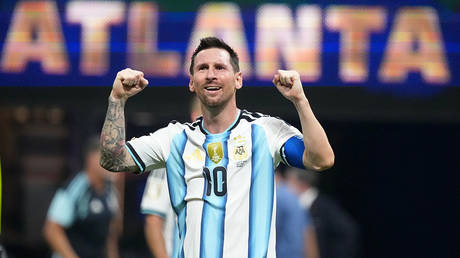
The scoreboard at the end of the night didn't flicker. It didn't need to. The two numbers, identical and unmoving, stared back at a crowd that didn't quite know whether to cheer or sigh. On April 9, 2026, the air in the stadium held a peculiar kind of static. We are conditioned to crave the definitive. We want the buzzer-beater, the walk-off home run, the clear-cut hero, and the devastated villain. But every so often, the universe hands us a draw.
A draw is not a void. It is a state of perfect, agonizing tension.
Think of a man named Elias. He’s been a season ticket holder for thirty years. He sits in Section 112, Row 4. He has seen championships that felt like religious experiences and losses that felt like funerals. But tonight, as he watches the players shake hands with a weary, mutual respect, he feels something else entirely. He feels the weight of the "almost."
The Physics of the Stalemate
In most competitive arenas, we treat a tie like a broken machine. We invent "Golden Goals," "Shootouts," and "Overtime" just to avoid the spiritual discomfort of an equal score. We demand a resolution. Yet, the tie on April 9 wasn't a failure of effort. It was a triumph of parity.
When two entities—be they chess grandmasters, football clubs, or political rivals—reach a dead heat, it reveals a terrifying level of preparation. It means that for every offensive thrust, there was a calculated parry. For every stroke of genius, there was a moment of disciplined resistance.
Imagine two high-speed trains hurtling toward each other on parallel tracks. If one is faster, the story is about speed. If they are exactly matched, the story becomes about the tracks, the wind resistance, and the very nature of the journey. That is what happened here. The mechanics of the game were pushed to their absolute limit until neither side had a single ounce of leverage left to exert.
One. Single. Point.
That was the margin that didn't exist. In a world obsessed with the binary of 1s and 0s, the draw is the messy, human 0.5.
The Invisible Stakes
We often mistake the "W" for the only source of value. But consider the locker room after a draw. It is a strange, quiet place. It lacks the champagne-soaked roar of a victory and the shattered silence of a defeat. Instead, there is a low hum of reflection.
The players aren't asking "How did we lose?" They are asking "Where was the inch?"
This is where the real growth happens. A loss can be dismissed as bad luck or a bad day. A win can be papered over by ego. But a draw? A draw is a mirror. It tells you exactly where you are equal to your adversary and challenges you to find the microscopic variable that will tip the scales next time.
For the coaching staff, a tie is a diagnostic tool. They look at the heat maps and the heart rates. They see that at the 72-minute mark, the defensive line sagged by three yards. They see that the striker took a breath when he should have taken a step. These are the "invisible stakes." They aren't reflected in the standings with the same weight as a win, but they are the seeds of the next season’s dominance.
The Fan’s Dilemma
Back in Section 112, Elias is walking toward the exit. He’s grumbling to his son about the lack of a "killer instinct." He feels cheated of the catharsis he paid for.
Is he right?
From a purely entertainment-focused perspective, perhaps. We pay for the climax. We want the narrative arc to resolve. A draw is a cliffhanger in a world that demands a series finale. But there is a hidden beauty in the lack of resolution. It keeps the conversation alive.
If one team had been crushed, the post-game analysis would be a post-mortem. Because it was a draw, the analysis is a debate. The fans in the bars down the street aren't mourning; they are litigating. They are replaying the missed header and the contested call. The draw ensures that the energy of the game doesn't dissipate the moment the lights go out. It lingers. It festers. It builds the mythos for the rematch.
The Mathematics of Equality
$P = \frac{1}{n}$
In a simple model, the probability of any specific outcome seems straightforward. But the statistical likelihood of a draw in high-level sports is a moving target. It fluctuates based on the "stiffness" of the defense and the "volatility" of the offense.
When we look at the data from April 9, we see a fascinating convergence. The Expected Goals (xG) for both sides hovered within a fraction of a point of each other. The possession stayed within a 4% margin. It was a statistical anomaly of balance.
Metaphorically, it’s like trying to balance two needles point-to-point in a windstorm. Everything has to go perfectly wrong for both sides simultaneously to end up exactly where they started.
The Evolution of the Grudge
A tie is the ultimate fertilizer for a rivalry.
Victories provide closure. If you beat your opponent 4-0, the argument is settled. You are better. You move on. But if you draw, the argument is merely paused. The "On the Draw" result of April 9 has created a vacuum that can only be filled by the next encounter.
The players know this. They felt the frustration of the final whistle. They felt the "what if" echoing in their cleats as they walked off the pitch. That frustration is fuel. It turns a standard seasonal match-up into a blood feud.
The next time these two meet, the ghost of this draw will be the third team on the field. Every move will be compared to the stalemate of April. Every goal will feel like a long-delayed answer to an unanswered question.
The Human Element
We live in an era of "optimization." We want our apps to be faster, our coffee to be more consistent, and our sports to be more decisive. We hate the "gray area."
But the gray area is where we actually live.
Life is rarely a series of clean victories and devastating losses. Most of our days are draws. We put in the work, we face the resistance, and we end the day more or less where we began, perhaps a little more tired, perhaps a little more experienced.
The match on April 9 was a reminder of that fundamental truth. It was a rejection of the easy narrative. It forced thirty thousand people to sit with the discomfort of the unresolved.
Elias reaches his car. He looks back at the stadium lights, which are finally starting to dim. He realizes that he isn't actually angry. He’s energized. He’s already checking his calendar for the rematch. He’s looking for the date when the tension will finally break.
He realizes that the draw didn't take anything away from him. It just gave him something to wait for.
The players have gone home. The grass is being watered by automated sprinklers. The scoreboard is dark. But in the minds of everyone who watched, the game is still going. It’s playing on a loop, a perpetual motion machine of effort and counter-effort.
A tie isn't a dead end. It’s a bridge.
The finality of a win is a sunset. The uncertainty of a draw is a dawn. It promises that there is more to come, that the story isn't over, and that the two sides—now inextricably linked by their inability to best each other—must return to the arena to find out who they really are.
Tonight, nobody won. Tonight, nobody lost.
Tonight, they just became permanent parts of each other’s history.