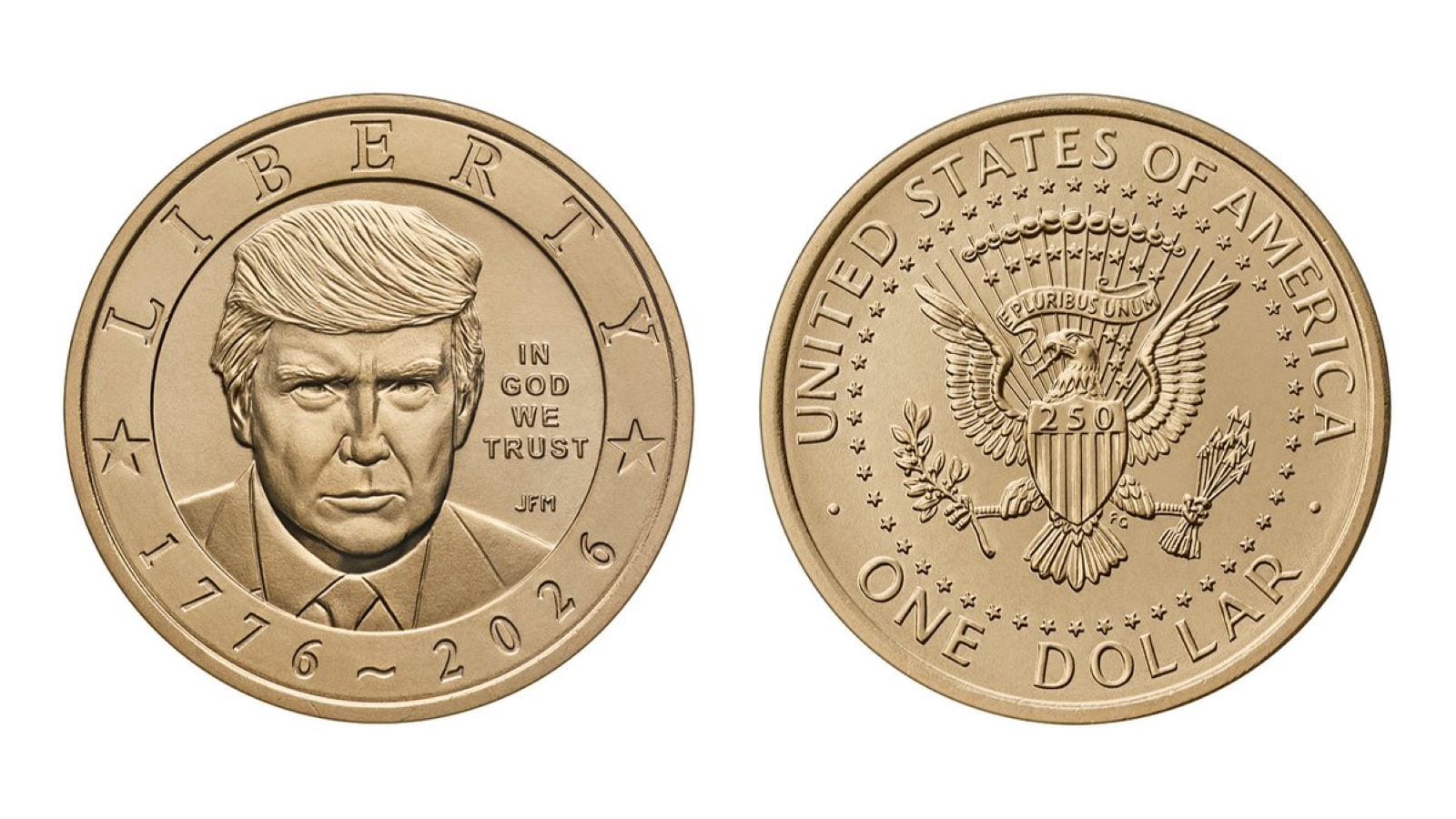
The United States Mint has commenced production on a newly designed $1 coin featuring the likeness of sitting President Donald J. Trump. Released by Treasury Secretary Scott Bessent to coincide with the nation’s 250th anniversary, the coin has quickly ignited rigorous debate spanning constitutional precedents, federal statutory boundaries, and the technical realities of modern minting.
To evaluate the validity and impact of this monetary release, one must bypass political rhetoric and examine the precise intersection of statutory law, bureaucratic executive power, and physical metallurgical composition.
The Legal Mechanism: Navigating the Living President Prohibition
The primary point of friction surrounding the new $1 coin centers on a long-standing tenet of American currency design: the statutory prohibition against depicting living individuals on legal tender. This restriction operates on a dual-track framework across paper and metallic currency.
                  U.S. CURRENCY PORTRAIT RESTRICTIONS
                                  │
         ┌────────────────────────┴────────────────────────┐
         ▼                                                 ▼
   Paper Currency                                   Metallic Coins
(1866 Codified Law)                             (2005 Presidential Act)
  Strict Prohibition                              Strict Prohibition
(No Living Persons)                             (Deceased 2+ Years Min)
         │                                                 │
         │                                                 ▼
         │                                      Semiquincentennial Loophole
         │                                      (2020 Redesign Act Exception)
         ▼                                                 │
   Current Status:                                         ▼
Trump Signature Approved                      Obverse Design Exemption
(No Portrait Allowed)                         (Trump Portrait Striking)
The 1866 Statutory Wall
Following the Civil War, Congress enacted legislation—now codified in 31 U.S.C. § 5114(b)—explicitly stating that only the portrait of a deceased individual may appear on United States currency and securities. The historical intent was structural: preventing sitting leaders from utilizing the state’s monetary infrastructure as a vehicle for personal monarchical branding or political campaigns. This law remains highly restrictive, particularly for paper notes. It is the primary reason the administration’s earlier proposal for a $250 Trump banknote stalled, as paper currency offers no administrative loopholes for living portraits.
The Presidential $1 Coin Act of 2005
For coinage, the restriction was reinforced by the Presidential $1 Coin Act of 2005 (codified at 31 U.S.C. § 5112(n)). This statute mandates that a President must be deceased for at least two years before being honored on a dollar coin. Under standard operating parameters, this rule would immediately disqualify President Trump from appearing on any circulating coinage.
The 2020 Statutory Exception
The Treasury Department’s legal justification rests on a specific legislative carve-out: the Circulating Collectible Coin Redesign Act of 2020. This bipartisan bill authorized the Treasury to issue a series of special $1 coins during the calendar year 2026 to mark the American Semiquincentennial.
The critical legal bottleneck is found in the drafting of the 2020 Act's design constraints:
- The statute specifies that "no head and shoulders portrait or bust of any person, living or dead, and no portrait of a living person may be included in the design on the reverse of specified coins."
- By explicitly banning the portrait of a living person on the reverse (tails side) of the coin, the statute left a conspicuous legal vacuum regarding the obverse (heads side).
- The Treasury’s legal counsel interpreted this omission as a permissive signal. Under the canon of statutory construction expressio unius est exclusio alterius (the explicit mention of one thing excludes all others), the prohibition of a living portrait on the reverse implies its legality on the obverse.
While critics point to the overarching 1866 and 2005 statutes to argue the spirit of the law has been bypassed, the Treasury Department has formally ruled that the 2020 Act provides the necessary legal authorization for this specific, time-limited issue.
Metallurgical Composition and Cost Architecture
Initial public and political debates were muddled by references to "gold coins," prompting concerns over the misallocation of federal bullion reserves and vulnerability to illicit supply chains. However, a precise physical and financial analysis reveals a vast difference between speculative bullion and the actual physical product.
The newly unveiled $1 coin contains no elemental gold. It is a base-metal alloy struck to mimic the visual aesthetic of gold.
| Physical Attribute | Specification | Operational Context |
|---|---|---|
| Primary Alloy | Manganese Brass | Standard U.S. Mint golden dollar alloy (copper, zinc, manganese, nickel). |
| Finish | Electroplated "Gold-like" Finish | High-luster non-precious metallic layer applied to optimize reflectivity. |
| Dimensions | "A little bit larger than a quarter" | Conforms to standard Sacagawea/Presidential dollar specifications (26.5 mm). |
| Distribution Channel | Direct-to-Collector (Rolls & Bags) | Sold at a premium over face value, bypassing everyday commercial circulation. |
This material selection dictates the cost function of the program. Because the U.S. Mint is not utilizing physical 24-karat gold reserves for this specific $1 issue, the direct material cost per unit remains under $0.15, yielding a massive seigniorage margin when sold directly to collectors at premium prices.
This structure isolates the program from the geopolitical and supply-chain vulnerabilities associated with physical bullion acquisitions, transferring the financial risk entirely to the consumer market, where demand will be driven by political collector premium rather than intrinsic commodity value.
Design Evolution: The Political and Aesthetic Variations
The coin’s journey from initial concepts to the physical dies in Philadelphia reveals a deliberate sanitization of its imagery. The final coin represents a significant compromise between overt political messaging and traditional numismatic standards.
       DRAFT DESIGN (2024–2025)                      FINAL APPROVED COIN (2026)
┌───────────────────────────────────────┐   ┌───────────────────────────────────────┐
│  - Face Profile (Traditional Look)    │   │  - Stern, Direct Forward-Facing gaze  │
│  - Active "Fist Pump" Pose            │   │  - Standard Suit and Tie Bust         │
│  - Aggressive "Fight Fight Fight" text│   │  - Traditional "Liberty" & "In God"   │
│  - Solid 24k Gold Proposals           │   │  - Manganese Brass (Gold-like finish) │
└───────────────────────────────────────┘   └───────────────────────────────────────┘
The removal of the active "fist pump" pose and the "Fight Fight Fight" text—which referenced the July 2024 assassination attempt—indicates a calculated effort by the Treasury and the U.S. Commission of Fine Arts to align the coin with historical, static portraits.
The choice of a direct, forward-facing gaze rather than the classic profile (recommended by the Commission of Fine Arts in January) breaks with standard U.S. coinage design paradigms. Forward-facing portraits are notoriously difficult to strike effectively on shallow dies without looking distorted, making the strike quality of the Philadelphia Mint a critical technical variable to watch.
The Broader Administrative Strategy
The Semiquincentennial $1 coin does not exist in an administrative vacuum. It is part of a coordinated, systemic effort by the administration to hardcode the President’s legacy into the physical and bureaucratic infrastructure of the United States.
To analyze the broader portfolio of legacy branding, one must track the parallel initiatives currently underway:
- Currency Signatures: In March 2026, the Treasury announced that President Trump’s signature would begin appearing on federal paper currency. This displaces the traditional Treasurer's signature for the first time since 1861, structurally altering the visual layout of federal reserve notes.
- Physical Infrastructure: Parallel executive actions have targeted high-profile infrastructure renamings, including the South Florida Palm Beach Airport and the U.S. Institute of Peace.
- The Passport Revision: Ongoing proposals to integrate the President's image directly into the internal pages of newly issued commemorative U.S. passports.
The critical limitation of this administrative strategy is its vulnerability to subsequent executive regimes. While coins struck and sold to collectors cannot be easily recalled from private hands, administrative policies regarding passport designs, paper currency signatures, and agency names can be swiftly reversed by a subsequent treasury secretary or executive order.
The $1 coin, therefore, represents the most permanent element of this branding portfolio. Once struck by the Philadelphia Mint and distributed to the public this autumn, these physical artifacts will remain permanent fixtures of the numismatic secondary market, regardless of future legislative or executive shifts.
For collectors and market participants, the primary risk is not legal invalidation, but market saturation. The premium value of these coins will be determined entirely by the Mint's final production caps. If the Treasury pursues an unlimited minting run, the secondary market value will rapidly decay to its face value of $1, converting a historic commemorative piece into a high-volume, low-margin novelty.