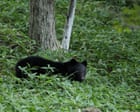
The wholesale suspension of 94 public primary and middle schools in Utsunomiya, a regional capital of 510,000 residents located 100 kilometers north of Tokyo, uncovers a systemic vulnerability in modern urban planning and wildlife management. This operational shutdown followed a series of ten distinct bear sightings spanning three days, where a single one-meter-long Asiatic black bear penetrated deep residential and commercial infrastructure, including a central shopping arcade and a wholesale market. The municipal response highlights a critical reality: modern cities are structurally unprepared for the rapid behavioral adaptations of apex predators driven by ecological and demographic shifts.
To evaluate this crisis accurately, the situation must be decoupled from sensationalism and analyzed through a cold, structural framework. The breakdown of urban boundaries is not a random occurrence, but rather the logical outcome of a shifting ecosystem meeting outdated municipal protocols.
The Tri-Phasic Incursion Mechanics
Wildlife infiltration into dense urban environments operates on a distinct three-phase trajectory. Municipalities consistently fail to contain these threats because their defensive playbooks treat every phase with a uniform, reactive approach.
[Phase 1: Peripheral Penetration]
      │ (Attracted by unmanaged municipal waste)
      ▼
[Phase 2: Commercial/Residential Traversal]
      │ (Guided by artificial structural corridors)
      ▼
[Phase 3: Critical Infrastructure Interaction]
        (Triggers total systemic lockdown)
Phase 1: Peripheral Penetration
The initial stage begins at the urban-rural fringe, where agricultural buffers have degraded. In Utsunomiya, the animal was first documented north of the city center on a Saturday morning near a residential park. Predators utilize these peripheral green spaces as staging areas, using unmanaged municipal waste and fruit-bearing vegetation to transition from natural foraging to urban scavenging.
Phase 2: Commercial and Residential Traversal
Once acclimated to the periphery, the animal moves along structural corridors like riverbeds, drainage channels, and railway lines. By Sunday, the Utsunomiya incursion escalated into a dense commercial zone, with verified sightings inside a shopping arcade. At this stage, standard animal control methods fail because high structural density disrupts visual tracking and limits the safe deployment of tranquilizer tools.
Phase 3: Critical Infrastructure Interaction
The final phase occurs when the animal enters zones with high human density. By Monday morning, verified sightings placed the bear within 500 meters of a junior high school and adjacent to a wholesale market. This proximity overrides standard risk tolerance thresholds, forcing municipal leadership to execute a total systemic lockdown to prevent mass casualties.
The Macro-Ecological Imbalance Function
The spike in urban bear encounters is the direct output of a mathematical imbalance between shifting rural demographics and exploding wildlife populations. The nationwide data released in June 2026 by the Japanese government presents a bleak reality: over 50,000 bear sightings were recorded in the year ending March 2026, a number that more than doubled the record set just two years prior. During this same window, bear attacks caused 238 injuries and fatalities.
The underlying cause of this crisis can be modeled through three distinct operational variables.
       [Satoyama Landscape Abandonment]
                      +
     [The Demographics of Hunter Attrition]   ===>  Urban Frontier Infiltration
                      +
    [Post-Hibernation Resource Depletion]
Satoyama Landscape Abandonment
Historically, Japanese rural communities maintained a well-managed buffer zone known as satoyama—a mix of secondary woodlands, rice paddies, and clearings that separated dense forests from human settlements. Japan's severe population decline has led to the abandonment of these rural agricultural lands. As human activity recedes, the forest boundary expands forward, replacing open fields with thick brushwood that brings wild animals directly to the edge of major urban centers like Utsunomiya.
The Demographics of Hunter Attrition
The primary mechanism for wildlife population control in Japan relies on local hunting associations (Ryuyukai). These organizations face an existential talent bottleneck. The average age of licensed hunters now exceeds 68 years, creating an unsustainable depletion of human capital. As older hunters retire or pass away, cities lose the tactical field expertise required to track, corner, and eliminate large predators in complex terrain.
Post-Hibernation Resource Depletion
The seasonal timing of these incursions correlates directly with the end of hibernation cycles. Bears emerge from winter dormancy facing a severe calorie deficit. When natural forest yields of acorns and beechnuts drop due to cyclical masting patterns, the animals are forced to expand their foraging range. This survival drive overrides their natural fear of human scents and artificial lighting.
Tactical Failures in Urban Containment
The three-day deployment of police, city officials, and local hunters in Utsunomiya exposed deep flaws in modern urban containment strategies. When a wild animal enters a high-density zone, standard wildlife management playbooks fall apart, creating a distinct series of operational bottlenecks.
- Acoustic Dispersal Inefficiency: Utsunomiya officials deployed public address vehicles across the city to broadcast warnings and sirens. While effective for alerting residents to stay indoors, this loud acoustic profiling often backfires when dealing with a panicked animal. Instead of driving the bear back toward the forest, loud sirens create disorientation, pushing the animal deeper into residential hiding spots like garages, alleys, and warehouses.
- Tranquilizer Dart Limitations: Standard chemical immobilization presents high operational risks in urban settings. A recent parallel incident in Fukushima’s Sasakino district illustrates this problem perfectly: a bear went on a rampage, injuring four people, and remained highly active and aggressive even after being struck by a tranquilizer dart. It eventually escaped into an electronics factory by unlatching a window. The physiological delay between dart impact and complete sedation—which can take anywhere from 5 to 15 minutes—leaves a dangerous window for a wounded, panicked predator to cause severe damage.
- Ballistic Restrictions in Public Spaces: Until recently, Japanese law heavily restricted the use of firearms in densely populated areas, prioritizing civilian safety from stray bullets over rapid predator elimination. While the Wildlife Protection, Control, and Hunting Management Act was revised to grant municipal mayors the authority to clear emergency context shootings, executing a clean shot remains incredibly difficult in a maze of concrete walls, glass storefronts, and asphalt.
The True Economic Cost of Systemic Closures
Media coverage consistently treats the closure of 94 schools as a simple safety precaution, completely ignoring the complex economic domino effect it triggers across a municipality. A citywide lockdown inflicts immediate, quantifiable strains on a region's productivity.
[School Operational Shutdown]
             │
             ▼
[Forced Sudden Parental Absenteeism]
             │
             ▼
[Immediate Local Productivity Losses]
             │
             ▼
[Supply Chain & Logistics Disruption]
When primary and junior high schools close with less than 24 hours of notice, the local workforce faces immediate disruption. Parents of young children are forced into sudden absenteeism, abruptly cutting into the productivity of local manufacturing, healthcare, and retail sectors. For industries that require an on-site presence, this disruption cannot be mitigated by remote work.
Furthermore, a roaming predator disrupts the movement of goods. The sighting of the Utsunomiya bear near a central wholesale market directly impacts food distribution networks, delaying shipments and spoiling perishable items. When logistics routes are altered or shut down to protect drivers, the financial losses quickly surpass the direct costs of the hunting operation itself.
Hard Hardening: A Blueprint for Resilient Municipalities
To survive this permanent ecological shift, cities must move past reactive containment and build proactive, multi-layered defensive systems. Managing urban wildlife requires treating animal incursions with the same tactical urgency as a severe natural disaster.
Predictive Drone Surveillance and Thermal Mapping
Municipalities must stop relying on random civilian phone reports to track animal movements. Cities need to deploy autonomous drone fleets equipped with forward-looking infrared (FLIR) sensors along known wildlife corridors. By running continuous thermal imaging scans of the urban-rural fringe, automated systems can detect large wildlife signatures well before they reach residential zones. This real-time data allows cities to set up targeted containment perimeters, shifting their strategy from citywide shutdowns to isolated, proactive blockades.
Automated Waste Isolation Systems
The primary driver for urban wildlife integration is accessible, high-calorie human food waste. Standard residential garbage collection protocols must be updated. Cities need to mandate reinforced, bear-proof containment systems for all commercial businesses and residential complexes along peripheral zones. Additionally, strict municipal ordinances must ban putting waste out overnight during peak post-hibernation months, removing the primary incentive for predators to enter city limits.
Urban Bio-Shield Construction
Cities must deliberately design physical barriers back into their geography. This involves clearing away dense undergrowth along abandoned agricultural plots and riverbeds near city lines to eliminate the blind spots predators use for cover. Replacing these overgrown areas with wide, clear utility corridors or well-lit public parks creates a natural psychological barrier, as large predators are highly reluctant to cross wide, exposed spaces without dense cover.
The ongoing crisis in Utsunomiya proves that the traditional boundaries dividing human cities from wild ecosystems have permanently eroded. Municipalities that continue to rely on manual tracking, loud sirens, and reactive school closures will face compounding economic damage and rising casualty rates. The only viable path forward is to accept this environmental shift and build hardened, tech-driven containment systems directly into the modern urban landscape.