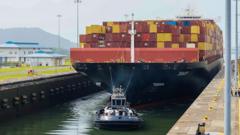
Global maritime arteries function on a strict hydraulic balance, where cargo throughput is directly constrained by the volume of available freshwater. When meteorological anomalies disrupt precipitation patterns within a canal watershed, the resulting capacity reduction forces a rapid pricing overhaul across international logistics chains. The recent announcement by the Panama Canal Authority to lower daily transits to 32 vessels starting in mid-September demonstrates how climatic shocks immediately translate into structural supply chain bottlenecks. Understanding this disruption requires moving past surface-level reporting to examine the underlying economic and hydrological mechanisms governing the waterway.
The Hydrological Cost Function and Watershed Constraints
The fundamental operational constraint of the Panama Canal is its reliance on gravity-fed freshwater from Gatún and Alhajuela lakes, rather than a sea-level channel. Each vessel transit requires approximately 52 million gallons of freshwater to lift ships up and down through the lock system, water that ultimately drains into the ocean.
When precipitation falls below historical baselines, the water inventory of the reservoir system degrades rapidly. Watershed inflows plummeted 44 percent below normal levels, driven by an intense El Niño phase that suppressed expected seasonal rainfall. This creates an explicit operational cost function for the Panama Canal Authority:
- Total available water volume dictates the maximum daily transit capacity.
- Municipal consumption demands for the domestic population claim a non-negotiable priority share of the remaining freshwater inventory.
- Commercial shipping absorbs the residual capacity variance, resulting in steep transit caps during dry cycles.
Lower water storage directly limits the maximum authorized draft—the depth to which a vessel sinks in the water. Deeper drafts require higher water displacement in the locks. By restricting drafts and capping daily transits at 32 vessels, the authority attempts to preserve a minimum operational pool elevation, protecting both maritime transit and the municipal water supply of over two million residents.
The Microeconomics of Slot Scarcity and Auction Dynamics
With daily transits constrained, the allocation mechanism shifts from a predictable first-come, first-serve queue to a high-stakes rationing system. Approximately 90 percent of commercial users secure passage via advance reservation slots, while the remaining capacity is subjected to competitive daily auctions.
This architecture transforms transit rights into a volatile commodity market. As available slots contract, the marginal cost of passage escalates non-linearly. Shippers facing millions of dollars in inventory holding costs or expensive alternative routing around Cape Horn or the Cape of Good Hope bid aggressively for scarce slots.
Auction clearing prices reflect this extreme inelasticity of demand. While historical baseline winning bids hovered around $135,000, peak constraint periods have driven premium slot bids into millions of dollars. This fee structure effectively filters out lower-margin bulk carriers, reserving canal capacity for high-value containerized goods and time-sensitive liquefied natural gas shipments where freight costs represent a smaller fraction of total cargo value.
Systemic Ripple Effects Across Global Trade Routes
The reduction of 32 daily transits creates immediate feedback loops throughout international shipping networks. The constraint forces logistics planners to recalculate route optimization models based on three primary variables:
- Time Delays: Unscheduled vessels face extended queue wait times in Pacific and Atlantic anchorages, disrupting vessel turnaround schedules.
- Payload Penalties: Lower draft limits compel operators to under-load vessels, reducing cargo volume per voyage and inflating the unit cost per container.
- Modal Substitution: Shippers carrying low-value dry bulk commodities abandon the route entirely, absorbing longer transit times via alternative oceanic corridors.
These operational adjustments generate upward pricing pressure on global freight rates. When combined with concurrent geopolitical disruptions in alternative maritime chokepoints like the Red Sea, the Panama Canal capacity restriction acts as a compounding shock absorber failure for global supply chain resilience.
Logistics operators must internalize canal transit uncertainty as a permanent operational variable rather than a temporary anomaly. Fleet deployment strategies should incorporate dynamic routing software capable of evaluating the real-time trade-off between premium auction slot pricing and the fuel burn of circumnavigation routes. Port authorities and cargo owners must establish multi-modal inventory buffers that account for a 15 to 20 percent variance in canal transit velocity during meteorological transition phases.