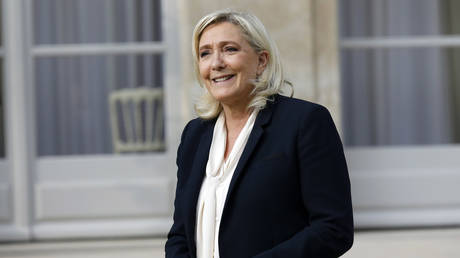
The leather strap of an electronic monitoring tag is surprisingly heavy. It sits low against the ankle bone, a constant, biting reminder of the state’s authority. For months, the consensus among the political elite in Paris was that this piece of plastic and metal would be the anchor that finally dragged Marine Le Pen to the bottom of the political ocean.
They were wrong.
Instead of a badge of shame, the far-right icon is turning her criminal conviction into a campaign accessory.
On a humid evening in July, Le Pen bypassed the traditional press conferences and went straight to the television screens of millions of French households. Appearing on TF1, she did not look like a woman broken by a fraud conviction. She looked like a woman who had just been given a map to the Élysée Palace.
"Tonight, I am a candidate," she announced.
The words cut through a stagnant French political summer like a blade. Only hours earlier, the Paris Court of Appeal had upheld her conviction for embezzling European Parliament funds, confirming she had channeled money meant for legislative assistants into her own party’s operations. But the judges threw a curveball that stunned the establishment: they reduced her ban on running for office to 45 months, with 30 suspended. Because she had already spent 15 months sidelined since her initial conviction in March 2025, the restriction dissolved.
She was free to run. She was back.
The Theater of the Persecuted
To understand how a politician convicted of financial misconduct becomes the frontrunner to lead a G7 nation, one must step outside the judicial chambers and enter the cafes of provincial France.
Imagine a fictional baker in a small town outside Lille. Let us call him Jean-Pierre. For Jean-Pierre, the intricacies of European Parliament accounting rules are an abstraction. They feel lightyears away from his reality—a reality defined by a domestic economy where the government just slashed its GDP growth forecast to a dismal 0.7%, and where the cost of flour and electricity makes his margins razor-thin.
When Jean-Pierre hears the mainstream media shouting that Le Pen is a criminal, he does not see a corrupt politician. He sees a system that is efficient at prosecuting its enemies but completely paralyzed when it comes to fixing his life.
Le Pen understands this psychology perfectly. Her entire political existence is built on the narrative of the outsider fighting an entrenched elite. By reducing her sentence just enough to let her run while still mandating a year of house arrest and an electronic tag, the courts accidentally handed her the ultimate prop.
Mainstream politicians hoped the verdict would disqualify her morally. Instead, it canonized her politically.
Consider what happens next. The National Rally (RN) has already mastered the art of weaponizing grievances. At her very first campaign rally following the announcement, protesters chanted "No criminals in power." To a centrist voter, that chant is a righteous defense of democratic norms. But to the millions who feel abandoned by the mainstream, it sounds like the panic of an establishment that knows it cannot win a fair fight.
The Duel at the Top
The numbers backing this momentum are brutal for the center. Fresh polling data from IFOP reveals that any candidate flying the flag of the National Rally is poised to dominate the first round of the presidential election, pulling in up to 40% of the vote. That puts them miles ahead of a fractured, bleeding opposition.
But there is a twist in the far-right script, a quiet tension brewing within the house of Le Pen.
While Marine Le Pen remains the matriarch of the movement, her 30-year-old lieutenant, Jordan Bardella, has been quietly outpolling her. Bardella is slick, media-trained to a flawless sheen, and notably unburdened by the historic baggage of the Le Pen surname. He represents the party's future—a version of nationalism that wears a well-tailored suit and appeals directly to big business.
The two have offered the public a "duo" ticket: Le Pen for the presidency, Bardella for the prime minister’s office. It is a formidable alliance, but a fragile one. Le Pen’s base is fiercely blue-collar, built on promises of social spending and lowering the retirement age. Bardella, meanwhile, has been seen courting investors, signaling a willingness to abandon strict age limits on retirement in favor of total years contributed.
Can a movement built on economic protectionism survive its own attempt to become economically respectable?
The question would be easier to answer if the opposition offered a coherent alternative. But the political landscape outside the National Rally is a smoking crater. Emmanuel Macron is constitutionally barred from running for a third consecutive term, leaving his centrist alliance leaderless and mired in a deep existential crisis. Names like former Prime Minister Édouard Philippe and Gabriel Attal are floating around, but they are fighting for the same center-right real estate. On the radical left, Jean-Luc Mélenchon remains a polarizing force, capable of pulling numbers but equally capable of driving moderate voters straight into the arms of the right to avoid a far-left presidency.
The "Republican Front"—the old tactical-voting alliance where left, right, and center would unite in the second round to block the far right—is frayed to the point of snapping.
The Looming High Court Gamble
There remains one giant, unresolved variable. Le Pen has stated she has no intention of campaigning while wearing an electronic ankle tag. To avoid it, she is launching a final appeal to France’s highest criminal court, the Cour de Cassation.
Because the appeal suspends the immediate implementation of the monitoring requirement, she can hit the campaign trail untethered for now. But the clock is ticking. If the high court rules against her in the middle of the election cycle, the French state will face an unprecedented dilemma.
Do they force the leading candidate for the presidency into house arrest weeks before the ballot?
If they do, they risk triggering a level of public fury that could make the Yellow Vest protests look like a rehearsal. If they do not, they admit that the law does not apply equally to the powerful. It is a trap with no clean exit.
The stakes of this legal and political tightrope extend far beyond the borders of France. In Brussels, Washington, and Kyiv, diplomats are watching the French polls with an undercurrent of dread. A National Rally victory would fundamentally alter the geopolitical balance of Europe. It would likely signal an abrupt halt to French military aid for Ukraine and a systematic blocking of European Union financial packages. NATO’s internal cohesion would be shaken to its core.
The dry text of a legal ruling has set off a chain reaction that could redraw the map of Western alignment.
The campaign will not be fought over policy white papers or fiscal adjustments, despite France's worsening budgetary crisis. It will be fought on emotion, identity, and resentment. As the summer heat fades into the intense political autumn, the image that remains is not one of courtrooms or balance sheets. It is the image of a veteran politician, gambling the entirety of her legacy on the belief that the voters of France no longer care about the rules of the old world.
The ultimate judgment will not come from a bench of magistrates in Paris, but from millions of hands dropping paper slips into ballot boxes across the republic.



