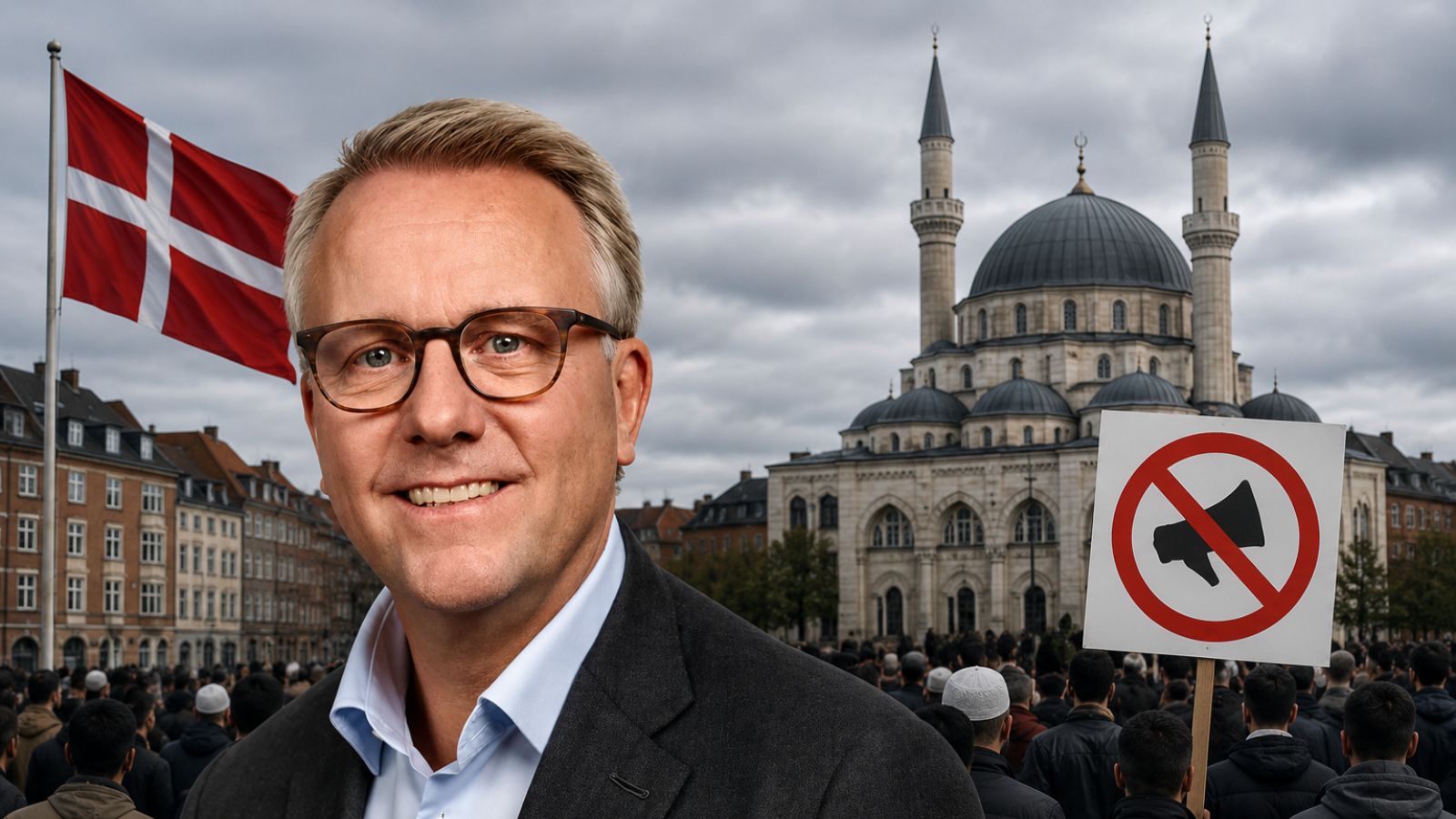
The Danish government’s renewed investigation into a nationwide ban on the public broadcast of the Islamic call to prayer (adhan) represents an optimization strategy within a larger political framework: the preservation of a homogenous public soundscape as a driver of civic integration. When Immigration Minister Morten Bødskov asserted that the acoustic space of Denmark should not resemble "a suburb of Islamabad," the rhetoric signaled a deliberate shift from local nuisance management to centralized cultural protectionism. The initiative, spearheaded by the center-left Social Democrats under Prime Minister Mette Frederiksen, challenges standard political binaries and highlights a specific model of governance: the low-immigration, high-assimilation left.
To evaluate the operational reality and long-term viability of this policy, the issue must be separated into its component mechanisms: local municipal zoning versus federal statutory bans, the technical obsolescence of acoustic broadcasting, and the constitutional friction points between public order and religious liberty.
The Dual-Track Regulation Architecture
Acoustic management in Denmark operates on two distinct tiers. Understanding the friction between these tiers explains why the federal government is attempting to establish a centralized legal framework.
1. The Municipal Noise Function
Currently, major urban centers like Copenhagen contain local bylaws that restrict or entirely prohibit the broadcast of the adhan from minaret loudspeakers. These regulations treat the broadcast as an issue of decibel optimization and urban planning rather than theological doctrine. Under municipal rules, any automated or high-volume acoustic projection in a public space must comply with strict environmental noise limits.
2. The Universal Statutory Ban
The federal initiative seeks to transition from localized, faith-neutral noise ordinances to a nationwide, identity-specific prohibition. The strategic objective is to eliminate the variance between municipal jurisdictions. Supporters argue that local bylaws create administrative inconsistencies, whereas a uniform national statute establishes a clear standard for the public square.
The scope of this issue reveals an asymmetrical relationship between political rhetoric and actual practice. Denmark contains roughly 270,000 Muslim residents out of a total population of six million, served by approximately 100 mosques. Within this infrastructure, only a minimal fraction of institutions attempt to broadcast the adhan externally. For instance, the Grand Mosque of Copenhagen operates under a voluntary agreement with local authorities to refrain from outdoor broadcasting. The proposed ban is therefore largely preventative and symbolic, designed to institutionalize a cultural boundary rather than to mitigate a widespread acoustic disruption.
The Digital Substitution Variable
The debate occurs during an era where the functional necessity of public acoustic broadcasting has been replaced by consumer technology. Historically, the adhan served as a critical synchronization mechanism for a localized community lacking distributed time-keeping devices. In a modern technological ecosystem, this infrastructure is redundant.
- Network-Synchronized Applications: Smartphone applications utilize localized GPS data to calculate exact prayer times based on astronomical coordinates, delivering pushed notifications directly to individual users.
- Targeted Delivery Systems: Cellular alarms, smart home integrations, and wearable technology allow for precise, zero-externality synchronization.
The availability of these decentralized alternatives alters the cost-benefit analysis of the public broadcast. Because the internal religious function (notifying the believer) can be achieved with zero public spillover, the insistence on external loudspeaker transmission shifts from a functional requirement to an assertive use of public space. This technological shift allows proponents of the ban to frame the restriction not as a suppression of religious practice, but as the removal of an obsolete, high-externality transmission method.
Constitutional and Structural Bottlenecks
The execution of a nationwide ban faces significant legal friction. The Danish Constitution (Grundloven) guarantees fundamental protections that complicate any identity-specific prohibition.
Section 67 of the Danish Constitution grants citizens the right to form communities for worshiping God in accordance with their convictions, provided that nothing is taught or done which is contrary to good morals or public order. A statutory ban targeted explicitly at the adhan must navigate two distinct legal challenges:
- The Neutrality Principle: To survive scrutiny by legal experts and human rights courts, a law must generally display religious neutrality. A statute that explicitly isolates the Islamic call to prayer while exempting other acoustic traditions, such as Christian church bells, faces vulnerability under international anti-discrimination frameworks.
- The Proportionality Test: Lawmakers must demonstrate that an outright ban is the minimum necessary measure to achieve the objective of public order. If municipal decibel caps or timed restrictions can solve the underlying disruption, a total prohibition may be ruled disproportionate.
To bypass these bottlenecks, the legislative strategy must decouple the ban from theological restriction, framing it instead as a defense of a secular public sphere or a uniform environmental soundscape regulation.
The Electoral Mechanics of Left-Wing Nationalism
The Social Democratic push for the adhan ban—marking the third major attempt following initiatives in 2020 and 2025—is an explicit execution of a defensive political strategy designed to neutralize populist challengers.
In traditional political modeling, strict immigration controls and assimilation mandates are associated with the right. The Danish Social Democratic model alters this paradigm by combining a robust welfare state with highly restrictive immigration policies. This framework operates on a clear economic calculation: a highly structured, taxpayer-funded social safety net requires high social cohesion and controlled demographic inputs to remain fiscally solvent.
By proactively absorbing the cultural and immigration platforms of the nationalist right, the center-left government has consistently protected its flank from right-wing electoral surges. The strategy reduces the salience of immigration as a wedge issue for opposition parties. However, this model introduces systemic trade-offs. While it maintains working-class support for the welfare state, it creates ongoing legal friction with international human rights standards and risks alienating minority populations by institutionalizing highly specific cultural criteria for civic belonging.
The Strategic Path Forward
The Danish government's investigation will likely yield one of two outcomes. The first is a broad, structurally neutral acoustic law limiting all recurring, non-emergency public broadcasts across all faiths—a move that would inevitably impact traditional European practices like church bells to preserve legal durability. The second, more probable path is the formulation of an integration-based statute that defines public broadcasts as a metric of civic assimilation, matching the logic of existing Danish policies like the "ghetto" relocation laws and the public face-covering bans.
As European states navigate demographic shifts and shifting political alignments, the Danish model demonstrates that cultural protectionism is no longer exclusive to conservative coalitions. It is increasingly utilized as a core structural policy by center-left administrations attempting to protect the socio-economic boundaries of the classic welfare state.