The Decentralization Mandate: Structural Limits of Legacy Air Defense
Modern peer conflict has exposed a severe structural vulnerability in expeditionary operations: the reliance on theater-level, centralized air defense assets to protect localized, distributed units. For decades, the U.S. Marine Corps deferred long- and medium-range air defense to the U.S. Army's MIM-104 Patriot batteries. This centralized architecture relies on a rigid, top-down command structure and massive logistical footprints that are incompatible with highly mobile, island-hopping campaigns in contested maritime environments.
When a force operates under a distributed doctrine, such as Expeditionary Advanced Base Operations (EABO), units are scattered across vast littoral zones. Relying on a distant, centralized air defense node introduces two distinct failure modes: For another look, check out: this related article.
- The Latency Bottleneck: The time required to pass tracking data through multi-echelon command chains exceeds the flight-time window of modern low-altitude cruise missiles.
- The Resource Allocation Dilemma: Strategic theater assets like Patriot systems prioritize high-value targets, leaving small, isolated combat teams exposed to low-altitude, multi-axis salvos.
To solve this vulnerability, the Marine Corps initiated the Medium-Range Intercept Capability (MRIC). The recent successful live-fire intercept during Exercise Valiant Shield 2026 on Guam demonstrates a shift from a dependent defense posture to an organic, decentralized architecture. The MRIC is not merely an addition of hardware; it represents a fundamental re-engineering of the expeditionary cost-to-kill equation.
The Three Pillars of Modern Intercept Architecture
The MRIC outclasses legacy systems by integrating pre-existing, mature technologies into a specialized, expeditionary framework. Rather than enduring the high development risks and scheduling delays typical of entirely new defense acquisitions, the program relies on an integration strategy built on three distinct pillars: Further insight on the subject has been shared by The Verge.
                  [ AN/TPS-80 G/ATOR Radar ]
                              │
                              ▼ (Target Track Data)
              [ Common Aviation Command & Control ]
                              │
                              ▼ (Fire Control Solution)
               [ SkyHunter / Tamir Interceptors ]
1. Sensor Integration: The AN/TPS-80 G/ATOR
The foundation of the platform is the AN/TPS-80 Ground/Air Task Oriented Radar (G/ATOR). By utilizing active electronically scanned array (AESA) technology, this single multi-mission radar handles low-altitude cruise missiles, unmanned aerial vehicles (UAVs), and rocket, artillery, and mortar (RAM) threats simultaneously. It eliminates the need for separate tracking and fire-control radars, reducing the physical footprint of the battery.
2. Battle Management: CAC2S Integration
Target tracking data from the G/ATOR flows directly into the Common Aviation Command and Control System (CAC2S). This software layer bypasses traditional theater-level command hierarchies, generating an organic fire-control solution at the tactical edge. By keeping the processing loop localized, the system minimizes data latency and preserves the autonomy of the distributed unit.
3. Kinetic Interception: The SkyHunter Missile
The kinetic execution relies on the SkyHunter missile, a U.S.-manufactured variant of the Israeli Tamir interceptor developed via a joint venture between Raytheon and Rafael. The SkyHunter features active radar homing and a proximity fuze designed to defeat highly maneuverable, low-altitude threats. The strategic value of this interceptor lies in its density; the launcher mechanism carries a significantly higher volume of ready-to-fire missiles than comparable platforms like the National Advanced Surface-to-Air Missile System (NASAMS) or Leidos Enduring Shield.
The Economic and Kinetic Calculus of Swarm Defense
Any viable air defense strategy must satisfy a critical economic condition: the cost of the interceptor must not disproportionately exceed the cost of the incoming threat. In modern asymmetric warfare, adversaries deploy waves of inexpensive, one-way attack drones and low-altitude cruise missiles to bleed high-cost defense inventories.
The economic and tactical math governing the MRIC architecture relies on three primary variables:
The Volumetric Capacity Function
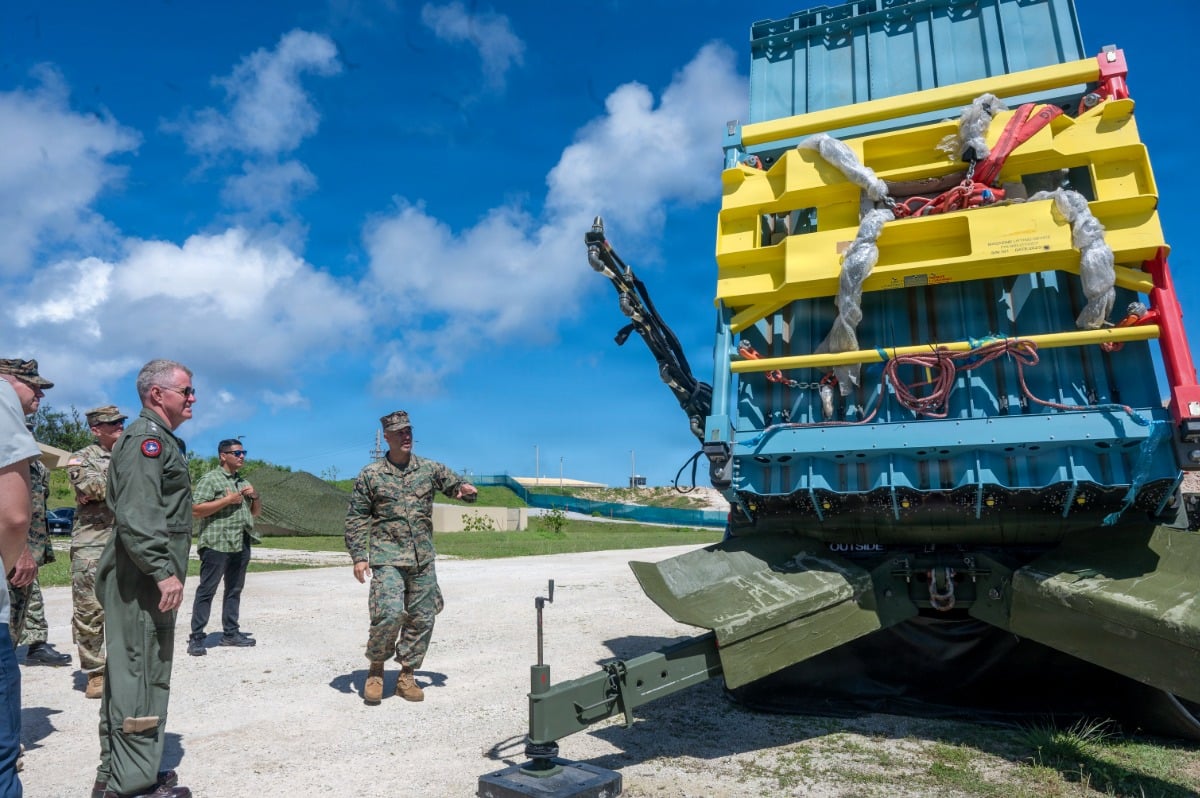
The physical capacity of a launcher dictates its saturation threshold. Legacy systems are constrained by low cell counts, making them vulnerable to saturation attacks. The MRIC addresses this by packing 20 Tamir-derived interceptors per containerized firing unit. This high cell density expands the unit's tactical ceiling, allowing it to engage concurrent, multi-axis salvos before facing a magazine-exhaustion bottleneck.
The Cost-Per-Kill Ratio
A standard Patriot interceptor costs between $3 million and $5 million, rendering it economically unviable against a $50,000 cruise missile or a $20,000 loitering munition. The SkyHunter interceptor operates at a fraction of that cost, stabilizing the attrition curve. This cost efficiency allows commanders to execute dual-shot doctrines (firing two interceptors at a single target to maximize probability of kill) without instantly bankrupting the theater ammunition supply.
Mobile Footprint and Logistics Exchange
The MRIC is designed around a containerized, palletized format compatible with standard medium tactical vehicles. This design reduces the logistics trail, allowing rapid relocation via organic amphibious transport or KC-130J aircraft. By shrinking the footprint from a massive convoy down to a few mobile platforms, the Marine Corps reduces the probability of detection by adversarial satellite and electronic intelligence arrays.
Architectural Limitations and System Vulnerabilities
While the MRIC provides a critical capability leap, it is not a flawless defense solution. An objective analysis of the system reveals distinct operational constraints and vulnerabilities that commanders must mitigate.
The most notable limitation is the system’s specialized engagement envelope. The SkyHunter missile is optimized for cruise missiles and unmanned aerial systems; it lacks the kinetic energy, thermal shielding, and guidance parameters required to intercept high-altitude ballistic missiles or hypersonic glide vehicles. If an adversary pairs a low-altitude drone swarm with a synchronized ballistic missile strike, the MRIC battery remains dependent on external, heavier air defense tiers to survive.
Furthermore, the system’s reliance on the active emissions of the AN/TPS-80 G/ATOR radar creates an electronic signature bottleneck. In a highly contested electromagnetic environment, any radar radiating high-power RF signals long enough to track a target becomes a beacon for enemy anti-radiation missiles and electronic warfare tracking systems. Without strict emission control (EMCON) protocols, a distributed MRIC site risks rapid localization and kinetic targeting.
Finally, supply chain dependencies present a near-term friction point. Though a dedicated domestic production facility opened in late 2025 to manufacture SkyHunter missiles in the United States, the initial component pipeline remains linked to international suppliers. During a protracted global conflict, maritime logistical chokepoints could restrict the flow of subcomponents, capping the maximum sustainment rate of ammunition replenishments.
Strategic Integration Blueprint
To maximize the utility of the Medium-Range Intercept Capability, the Marine Corps must avoid deploying it as a standalone defensive island. It must be systematically bound into a broader dynamic kill web.
The immediate priority requires the formal integration of the MRIC into the Joint All-Domain Command and Control (JADC2) network. By linking the localized CAC2S fire-control architecture with broader joint data feeds, an MRIC battery can receive early warning track data from Navy Aegis destroyers or forward-deployed Air Force assets. This passive data acquisition allows the G/ATOR radar to remain completely silent until the exact moment an interceptor launch is required, mitigating the electronic warfare vulnerabilities of active tracking.
Tactically, MRIC batteries should be deployed in a staggered, mutually supporting geometric layout across littoral nodes. Placing batteries within overlapping engagement ranges creates a redundant shield where the sensor data of one unit can guide the interceptors of another. This layout ensures that if an individual G/ATOR radar is targeted or jammed, the remaining launchers retain their full combat utility, preserving the integrity of the forward defensive perimeter.
U.S. Marines fire the Medium-Range Intercept Capability system in Guam
This video provides a direct, unvarnished look at the physical layout, mobility platforms, and live-fire deployment mechanics of the MRIC system during its validation phase in the Indo-Pacific theater.