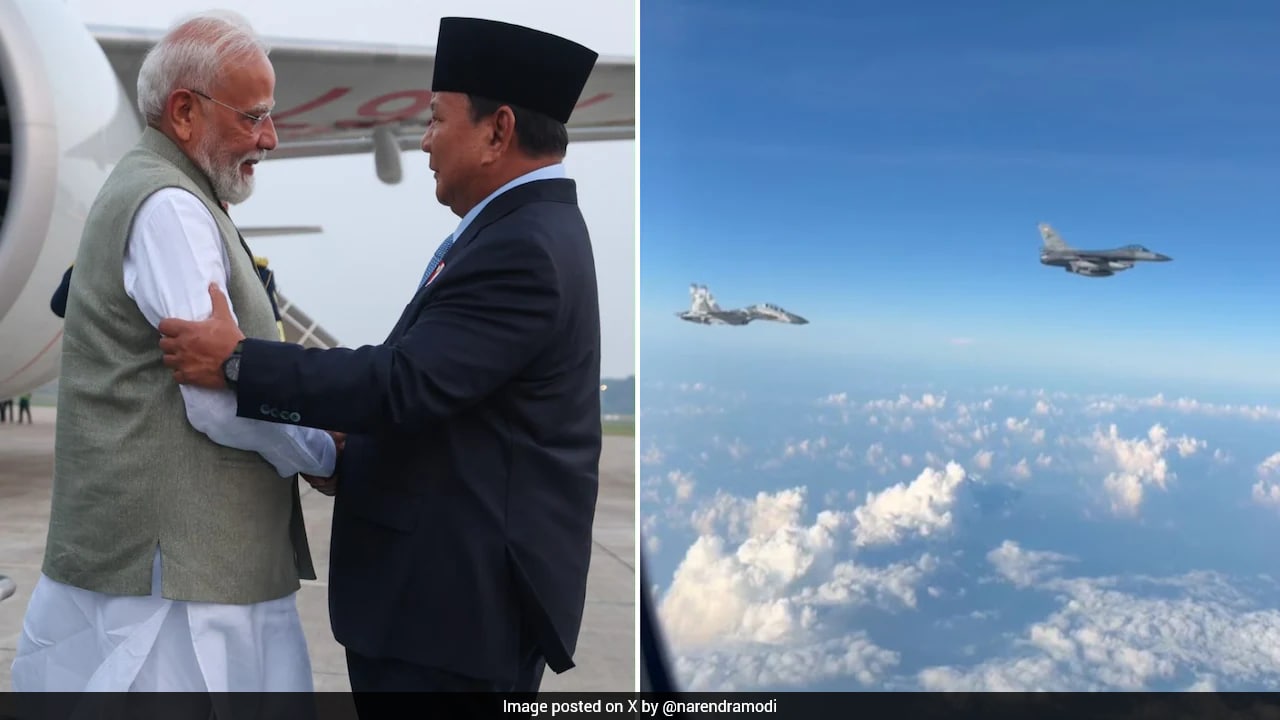
The operational utility of state ceremonial welcomes is routinely miscalculated as mere pageantry, yet in highly contested maritime corridors, these displays serve as quantifiable indicators of strategic alignment. The arrival of Indian Prime Minister Narendra Modi in Jakarta to meet Indonesian President Prabowo Subianto establishes a clear baseline for how bilateral defense and resource interdependency will operate under the expanded Act East Policy. By analyzing the mechanics of this diplomatic reception—ranging from airspace escort protocols to highly specific civilizational iconography—one can map the underlying economic and military realities defining the contemporary India-Indonesia Comprehensive Strategic Partnership.
The Airspace and Sovereign Security Vector
The deployment of Indonesian Air Force fighter jets to escort the Indian Prime Minister's aircraft upon entering local airspace is not merely decorative; it is a structural signaling mechanism. Within bilateral diplomacy, mid-air interception and escort protocols communicate an explicit security guarantee and designate the visiting state as a Tier-1 strategic partner. This operational choreography yields distinct geopolitical insights:
- Integrated Interoperability: Escort maneuvers require real-time synchronization between the military air traffic controllers and defense command centers of both nations. This demonstrates functional, high-level communication channels capable of managing shared airspace variables.
- Regional Maritime Deterrence: The physical presence of tactical aircraft in the Eastern Indian Ocean transit zones underscores a mutual commitment to maritime security, reinforcing India's MAHASAGAR (Mutual and Holistic Advancement for Security Across the Regions) framework.
- Defense Procurement Alignment: This high-visibility military integration coincides with an expanding defense-industrial pipeline, anchored by Indonesia’s acquisition of Indian-supplied BrahMos supersonic cruise missiles. The escort serves as an overt validation of this defense dependency.
Structural Metrics of the Economic Partnership
Beyond the symbolic framework of the airport tarmac lies a rigid economic equation. Media reporting frequently highlights diplomatic warmth while ignoring the raw fiscal infrastructure supporting the relationship. During the 2025–26 fiscal year, bilateral trade between India and Indonesia reached USD 24.78 billion, consolidating Indonesia’s position as India's second-largest trading partner within the ASEAN bloc.
This economic volume is concentrated across critical supply chains rather than consumer goods. The forward-looking trajectory of this financial architecture depends on a specific, dual-variable cost function: critical mineral access versus infrastructure capital investment.
The Critical Mineral Matrix
Indonesia controls approximately 21 percent of verified global nickel reserves, alongside massive production capacities in copper, bauxite, and tin. India’s domestic industrial strategy—specifically its semiconductor manufacturing push and electric vehicle (EV) transition goals—demands an uninhibited, non-monopolized supply of these exact inputs.
[Indonesia Critical Mineral Supply] ---> [Bilateral Trade Channels] ---> [India Industrial Tech/EV Scale]
The primary objective of the current institutional talks is to bypass third-party market disruptions by locking in direct bilateral institutional mechanisms. This reduces supply-chain friction for the more than 130 Indian enterprises currently operating inside the Indonesian economic ecosystem.
Geocultural Asset Utilization
The integration of specific cultural performances during the reception—including the Wayang Kulit (shadow puppetry) depiction of the Ramayana by the Ganesh troupe, the Bhara_tanatyam performance by the Samanvaya Group, and the Homage to the Triple Gem Buddhist choreography—is a calculated application of geocultural leverage.
In asymmetric diplomacy, shared civilizational history is used to de-escalate negotiation friction and build structural trust. This operates across two distinct vectors:
Civilizational Synchronization
By emphasizing the preservation of the Ramayana and Buddhist heritages within a modern, Muslim-majority state, Indonesia signals its pluralistic compatibility with India's democratic framework. This shared baseline reduces political risk for long-term bilateral treaties. The planned diplomatic itinerary to the UNESCO-listed Prambanan Temple Complex in Yogyakarta functions as a structural anchor, translating historical legacy into modern diplomatic capital.
Diaspora Mobilization
The Indian diaspora in Jakarta serves as a human capital bridge. By engaging directly with overseas nationals who are embedded within Indonesian mining, energy, and emerging technology sectors, the state apparatus optimizes its external economic influence. The diaspora acts as an informal regulatory buffer, accelerating project implementation and stabilizing foreign direct investment (FDI) channels.
Strategic Institutional Redirection
The structural limits of traditional diplomacy dictate that pageantry yields diminishing returns unless converted into binding institutional frameworks. The three-day state visit acts as a mechanism to transition from rhetorical alignment to legislative and military execution. The strategic roadmap requires immediate implementation across three critical axes:
- Maritime Chokepoint Joint Management: Establishing a permanent, institutionalized naval patrolling mechanism at the mouth of the Malacca Strait to operationalize the MAHASAGAR vision and counter unilateral assertions in the Indo-Pacific.
- Sovereign Mineral Standard Operating Procedures: Drafting bilateral investment treaties that grant Indian public and private entities preferential extraction and processing rights in Indonesian nickel and copper fields in exchange for technology transfers in infrastructure development.
- Bilateral Space and Nuclear Frameworks: Expanding the scope of the Comprehensive Strategic Partnership beyond traditional maritime parameters into satellite launch cooperation and civil nuclear research, as indicated by current diplomatic briefs.
This structural alignment shifts the relationship from a reactive, localized partnership to an active, institutionalized anchor of the Indo-Pacific security architecture.
PM Modi Witnesses Ramayana-Themed Welcome in Indonesia
This video document analyzes the specific cultural components used during the diplomatic welcome, illustrating how civilizational artifacts are leveraged to support modern geopolitical and economic strategies.