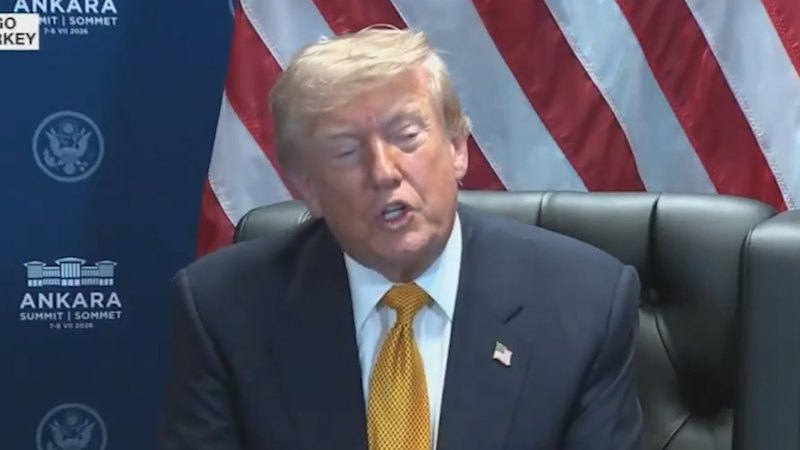
High-stakes executive communication operates under an unforgiving signal-to-noise ratio where a single semantic displacement can instantly overshadow substantive policy declarations. During the July 2026 NATO summit in Ankara, a verbal substitution occurred when the American executive referred to Iran as the "Islamic Republic of Japan" while detailing a missile strike against the USS Abraham Lincoln. Media analysis traditionally categorizes such events through a framework of partisan critique or hyper-fixation on physical or cognitive decline. A more systematic evaluation, however, isolating this occurrence within a broader structural model of executive stress, communicative bandwidth, and the compounding variables of regional conflict reveals a quantifiable pattern of semantic interference.
To evaluate the operational impact of this communication breakdown, the incident must be separated into its component mechanisms: linguistic interference vectors, geopolitical cognitive load, and the subsequent degradation of diplomatic signal clarity.
The Tri-Axe Framework of Semantic Displacement
The error of substituting "Japan" for "Iran" within the formal designation of an adversary state is not an isolated random variance. It represents a specific collision of three distinct cognitive and contextual pressures.
                       [ Geographic Salience ]
                                  |
                                  |
[ Phonetic Proximity ] -----------+----------- [ Historical Association ]
(Iran vs. Japan)                  |            (Pearl Harbor Precedent)
                                  |
                      [ SEMANTIC DISPLACEMENT ]
1. Phonetic and Morphological Proximity
The core structural vulnerability rests on phonological mechanics. The phonetic profiles of the target word (Iran) and the substituted word (Japan) share identical two-syllable structures ending in nasal consonants (/æn/ vs /æn/). When processing high-velocity speech under pressure, the neural retrieval pathways for state names with highly similar acoustic signatures experience an elevated error rate. This vulnerability increases when paired with fixed formulas like "The Islamic Republic of..." where the predictive text generation of human speech defaults to a familiar cadence.
2. Contiguous Geographic Salience
The executive’s immediate strategic focus involved a complex multi-theater portfolio. The administrative agenda for the 2026 bilateral sessions included intensive negotiations with Japanese Prime Minister Sanae Takaichi regarding maritime defense cooperation in the Middle East and funding allocations. When an executive simultaneously processes defensive logistics involving an East Asian ally and offensive strikes involving a Middle Eastern adversary, the mental taxonomy for both states enters the same active cognitive buffer. This proximity increases the statistical likelihood of cross-contamination during unscripted delivery.
3. Deep Historical Association
The substitution was further compounded by historical analogies already utilized by the executive. In prior administrative sessions, specifically during an Oval Office bilateral meeting in March 2026, the executive explicitly linked Japanese historical actions with the current Iranian theater, using the phrase "Why didn't you tell me about Pearl Harbor?" to justify the element of surprise in unilateral strikes against Iranian infrastructure. Because the two nations had already been explicitly paired in a highly publicized strategic analogy within the executive's rhetorical repertoire, the cognitive pathway between "Japan" and "military surprise strikes" was heavily reinforced, lowering the threshold for semantic displacement.
Quantifying the Bandwidth Bottleneck in Crisis Communication
The Ankara incident occurred during a critical policy announcement regarding the expiration of the 60-day US-Iran interim ceasefire following military exchanges in the Strait of Hormuz. The objective of the briefing was to project absolute strategic resolve, outline potential escalation pathways targeting Kharg Island, and demand multi-lateral compliance from NATO partners.
When an executive introduces an asymmetrical misnomer into a high-stakes strategic brief, the communication environment suffers immediate degradation across measurable metrics.
- Signal Distortion Index: The core policy signal—the termination of a critical maritime ceasefire—was immediately diluted. Quantitative media tracking post-briefing demonstrated that digital impressions and secondary reporting tilted heavily toward the verbal slip rather than the operational deployment warnings or the proposed $200 billion defense procurement expansion.
- Cognitive Load Allocation: Unscripted press conferences require the simultaneous management of real-time diplomatic positioning, domestic political posturing, and adversarial deterrence. When the cognitive load exceeds a critical threshold, the executive's focus shifts toward strategic positioning, leaving the mechanical execution of language vulnerable to automated processing errors.
- Allied Decoding Friction: For foreign ministries analyzing the text of an American executive address, semantic slips introduce analytical friction. Diplomatic teams must spend critical operational hours verifying whether a statement represents a structural shift in foreign policy, an intentional rhetorical provocation, or a simple mechanical error.
The Institutional Failure of Communication Safety Nets
The occurrence of high-profile verbal slips across successive administrations highlights an institutional bottleneck in executive preparation protocols. The traditional reliance on rigid teleprompter scripts fails during dynamic, unscripted Q&A environments where the executive must synthesize complex geopolitical realities in real time.
The primary vulnerability in current briefing design is the absence of real-time semantic correction mechanisms. Unlike corporate communications where statements are heavily vetted through layered release structures, executive press conferences prioritize raw authenticity and immediate media access. This layout ensures that any cognitive or linguistic variance is broadcast globally without a filtering latency.
A secondary limitation rests on the optimization of executive scheduling during major multinational summits. The compounding effects of timezone displacement, back-to-back bilateral negotiations, and fluid tactical updates create a compounding fatigue curve. Standard administrative operations do not factor this physiological cost function into speech parameters, assuming baseline executive performance regardless of operational duration.
Strategic Operational Imperatives
To insulate high-stakes geopolitical pronouncements from the destabilizing effects of semantic displacement, administrative communication teams must shift from traditional narrative preparation to structured cognitive mitigation.
First, briefing materials must actively decouple phonetically or conceptually linked states. If an active conflict zone shares a phonetic profile or recent diplomatic schedule space with a primary ally, the preparation team must deliberately use distinct, non-overlapping terminology in all preparation documentation to prevent cross-contamination in the executive's short-term memory buffer.
Second, the structural architecture of the unscripted brief must be modified. Rather than allowing long, open-ended monologues that increase the statistical probability of linguistic fatigue, strategic announcements must be isolated into high-density, modular statements bounded by immediate, structured hand-offs to technical experts or cabinet secretaries. This approach preserves executive authority while capping the maximum continuous cognitive expenditure per session.
The final strategic requirement demands that communication staff implement an immediate, objective correction protocol during the live broadcast itself. Allowing a misnomer to linger uncorrected creates an informational vacuum filled by adversary counter-narratives and domestic political friction. Immediate, low-friction clarification by the executive or an immediate official administrative clarification line remains the only viable method to restore the integrity of the primary strategic signal.