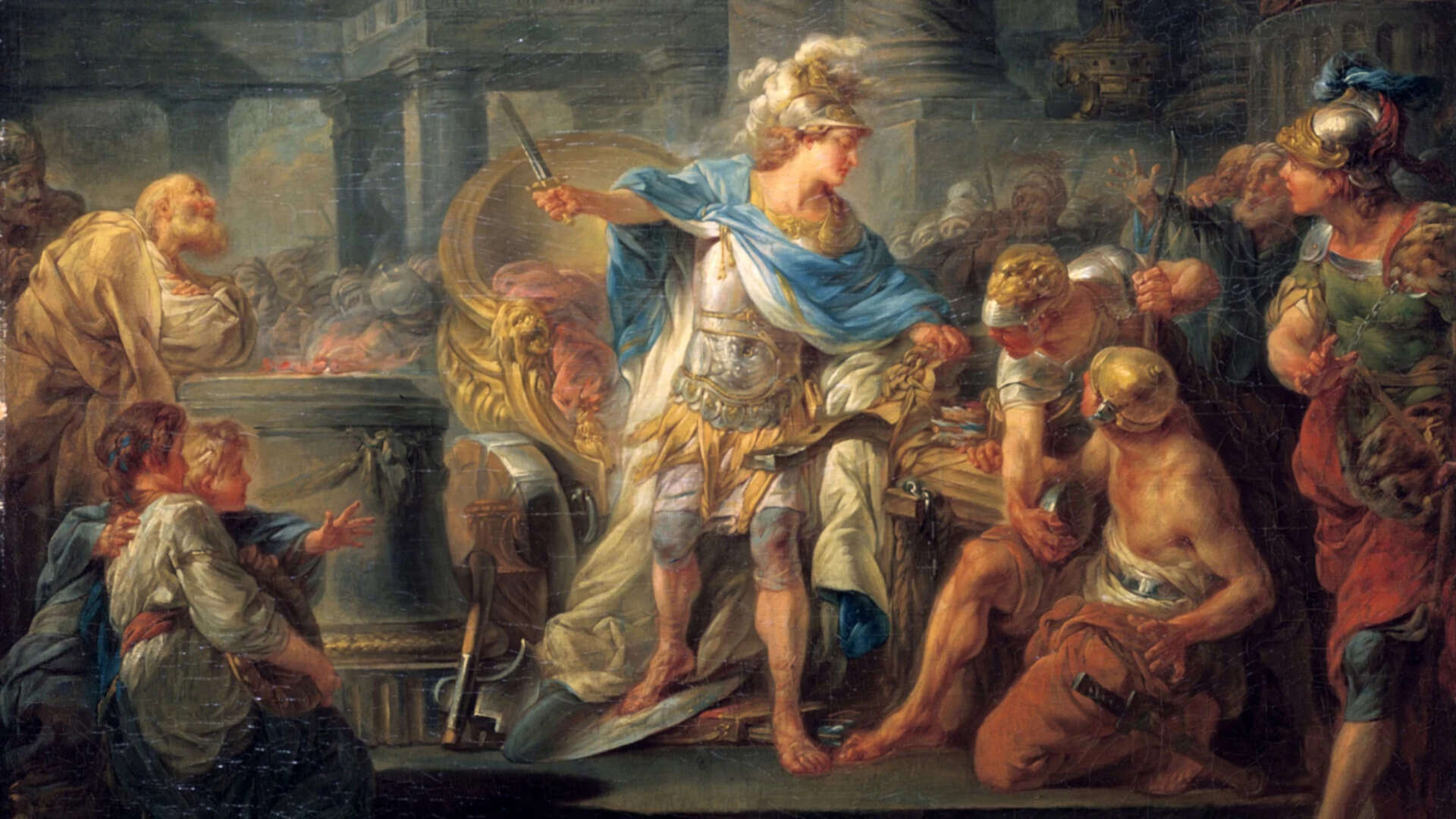
The aphorism traditionally attributed to Alexander the Great—that an army of sheep led by a lion outweighs an army of lions led by a sheep—is frequently dismissed as a cliché of management literature. This dismissal misses the structural mechanics of organizational output. When stripped of its martial romanticism, the statement posits a fundamental law of operational scaling: the competency of a centralized strategic node dictates total system performance far more than the aggregate capability of individual execution agents.
To understand why a highly competent workforce collapses under incompetent leadership, while a mediocre workforce can achieve hyper-efficiency under expert command, requires analyzing how strategic intent is converted into execution. Organizations do not fail because their individual contributors lack talent. They fail because the transmission mechanism connecting strategy to execution degrades under poor leadership, introducing systemic friction that neutralizes individual capability.
The Transmission Coefficient of Command
The operational output of any collective unit is not an additive sum of individual talent. Instead, it functions as a multiplicative product where leadership acts as the scaling coefficient. This dynamic can be modeled through the concept of the Transmission Coefficient: the efficiency with which strategic intent is translated into coordinated action across an organization.
In an organization composed of exceptionally talented individuals—the "lions"—the baseline capacity for localized execution is high. However, if the central node—the "sheep"—fails to provide clear vector alignment, these high-capability agents optimize for localized, disparate objectives. Without a unifying operational architecture, individual talent introduces variance rather than value.
The structural degradation occurs across three specific vectors:
- Vector Misalignment: Individual high-performers pursue conflicting micro-strategies based on their localized interpretations of market conditions. This creates internal friction, as different departments or teams work at cross-purposes, neutralising the organization's net forward momentum.
- Decisional Paralysis: A weak central node fails to establish definitive prioritization frameworks. In the absence of constraints, highly competent agents will debate strategy indefinitely, stalling execution velocity.
- Resource Dissipation: Capital and human assets are distributed thinly across too many initiatives because the leadership node cannot make the trade-offs required for concentrated execution.
Conversely, an organization of average performers guided by an exceptional strategist operates with a near-perfect transmission coefficient. The leader establishes absolute vector alignment, meaning that every unit of energy expended by the workforce moves the enterprise toward a singular, clearly defined objective. The mediocrity of individual talent is offset by the total elimination of systemic friction and structural waste.
The Cost Function of Misalignment
When individual capability exceeds leadership capability, the cost of coordination rises exponentially. High-performing employees possess strong cognitive frameworks and distinct opinions on operational direction. When led by an individual incapable of synthesizing these viewpoints or establishing structural authority, the organization enters a state of chronic strategic drift.
The financial and operational costs of this drift can be categorized into clear structural bottlenecks.
The Capability Autonomy Trap
High-performing individuals naturally demand autonomy. When autonomy is granted by a competent leader, it drives distributed execution. When autonomy is extracted by a workforce due to a vacuum of leadership, it results in structural fragmentation.
Each department begins to build its own isolated operational stack, develops its own metrics, and self-selects its priorities. The cost to integrate these fragmented units increases over time, requiring excessive layers of middle management just to arbitrate disputes between competing high-performers. The organization pays a premium for elite talent but realizes a negative return on that investment due to integration failures.
The Decisional Tax
In an environment with weak centralized command, decisions are rarely finalized. They are recycled through endless committees, re-examined via consensus-driven frameworks, and diluted to satisfy internal political factions. This creates a severe decisional tax.
The time-to-market for new initiatives stretches from weeks to quarters. By the time a strategy is approved, the market reality that prompted it has frequently shifted, rendering the execution obsolete before it begins.
Systematic Cognitive Drain
The most destructive element of the inverted leadership dynamic is the psychological toll on high-performers. Elite talent requires challenge, structural clarity, and the assurance that their output will yield meaningful market results. When trapped under leadership that cannot navigate complexity, high-performers experience rapid cognitive fatigue.
They redirect their analytical capabilities away from solving market problems and toward navigating internal dysfunction. This shift marks the inflection point where the "lions" either mentally disengage, reducing their output to baseline levels, or exit the organization entirely, leaving behind a depleted workforce that the weak leader is still unequipped to manage.
Structural Velocity vs. Individual Capability
The core error of modern management philosophy is the over-indexing on talent acquisition at the expense of organizational design and decisive command. High-talent individuals operating within a flawed system will invariably conform to the limitations of that system.
To visualize this, consider the organization as a fluid dynamics problem. Individual capability represents the volume of fluid, while leadership represents the structural integrity of the conduit.
| Variable | High-Capability Workforce / Low-Capability Leader | Average-Capability Workforce / High-Capability Leader |
|---|---|---|
| Strategic Direction | Highly fragmented; inconsistent prioritization | Absolute alignment; rigid focus on core objectives |
| Execution Velocity | Slow; weighed down by internal arbitration and debate | Rapid; driven by standardized processes and clear intent |
| Resource Efficiency | Low; capital scattered across competing initiatives | High; resources concentrated on highest-ROI vectors |
| Systemic Friction | Exponentially increasing due to political gridlock | Minimal; cleared by structural authority and clear metrics |
| Net Operational Output | Sub-optimal; characterized by missed market opportunities | Maximum possible relative to aggregate talent constraint |
Increasing the volume of fluid (hiring more elite talent) into a pipe filled with blockages and structural leaks (poor leadership) does not increase throughput; it merely increases internal pressure until the system ruptures. True organizational scaling requires optimizing the conduit first.
The Mechanics of Strategic Cohesion
A leader capable of transforming a mediocre workforce into a highly effective unit does so by applying three specific management mechanisms that eliminate variance and maximize output density.
1. Radical Scope Reduction
Average performers cannot manage high levels of ambiguity or balance complex, shifting priorities. A competent leader removes this burden entirely by ruthlessly narrowing the operational scope. The leader analyzes market dynamics, identifies the single highest-leverage point of intervention, and restricts the organization’s focus to that vector alone.
By reducing the number of variables the workforce must process, the leader ensures that even average execution yields outsized results due to the sheer concentration of effort.
2. Algorithmic Process Standardization
To decouple organizational performance from individual genius, a strong leader codifies execution into predictable, repeatable processes. If execution relies on individual brilliance, it cannot scale.
By designing highly structured operational playbooks, the leader elevates the floor of acceptable performance. The process itself becomes the intellectual property, ensuring that the departure of any single individual does not destabilize the broader enterprise.
3. Absolute Accountability Frameworks
A weak leader permits ambiguity in ownership to avoid internal conflict, which allows poor performance to hide behind shared responsibilities. A strong leader establishes unambiguous lines of accountability. Every metric, project, and operational outcome is mapped to a single individual.
This transparency creates a self-regulating environment. Average performers either elevate their execution to meet the explicit standards or are systematically exposed and replaced, continuously upgrading the baseline capability of the organization.
The Strategic Play
Building an organization around the assumption that elite talent can compensate for deficient leadership is a fundamental structural error. Individual capability is an asset, but it is an asset whose value is unlocked exclusively by the quality of the strategic architecture in which it operates.
Organizations must pivot away from the decentralized, consensus-driven models that neutralize the velocity of execution. The primary focus of enterprise optimization must be the absolute clarity and competence of the command node. To build a highly scalable, defensible market position, the strategic mandate is clear: design a rigorous operational architecture, standardize execution to mitigate individual variance, and ensure that strategic intent is dictated by a unified, decisive command structure. Talent without alignment is merely overhead; structure paired with execution is an insurmountable competitive advantage.