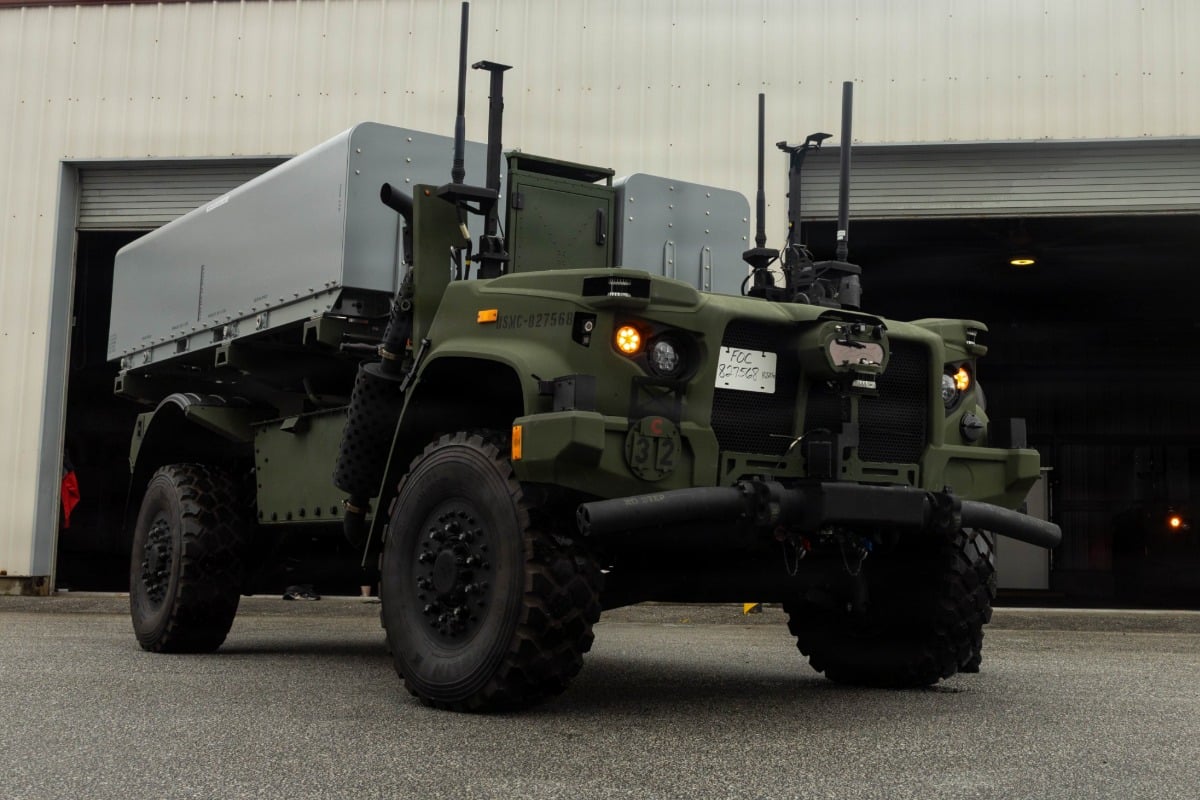
The delivery of the Navy-Marine Expeditionary Ship Interdiction System (NMESIS) and the Marine Air Defense Integrated System (MADIS) to the 12th Marine Littoral Regiment in Okinawa transitions the U.S. Marine Corps from a traditional amphibious assault force into a distributed, land-based maritime denial instrument. This shift, executed under the Force Design modernization framework, alters the tactical calculus within the First Island Chain by placing highly mobile, low-signature anti-ship and air defense assets directly inside an adversary's weapons engagement zone.
Rather than relying exclusively on multi-billion-dollar naval hulls to contest maritime choke points, the introduction of these ground-based systems establishes an asymmetrical attrition model. Ground forces can now project sea-denial capabilities over critical waterways from sovereign, hardened land mass.
The Two-Pillar Tactical Architecture
The operational utility of the reorganized 12th Marine Littoral Regiment relies on two distinct but deeply integrated hardware components designed to execute localized sea denial and force protection.
+------------------------------------------------------------+
|                12th Marine Littoral Regiment               |
|                     (Okinawa, Japan)                       |
+------------------------------+-----------------------------+
                               |
        +----------------------+----------------------+
        |                                             |
        v                                             v
+-------------------------------+             +-------------------------------+
|             NMESIS            |             |             MADIS             |
|   (Offensive Sea Denial)      |             |   (Defensive Air Protection)  |
|  - ROGUE Fires Unmanned JLTV  |             |  - Stinger Missiles           |
|  - 2x Naval Strike Missiles   |             |  - 30mm Cannon / Counter-UAS  |
|  - Range: ~115 miles (185km)  |             |  - Low-altitude air defense   |
+-------------------------------+             +-------------------------------+
1. Offensive Vector: NMESIS
The core offensive mechanism is the NMESIS, which pairs the Remotely Operated Ground Unit for Expeditionary Fires (ROGUE Fires) carrier—an uncrewed, semi-autonomous chassis derived from the Joint Light Tactical Vehicle framework—with a dual-pack launcher executing the Kongsberg Naval Strike Missile (NSM).
- Targeting and Subsonic Payload: The NSM is a sea-skimming, subsonic cruise missile carrying a 276-pound blast-fragmentation warhead over an operational range of approximately 115 miles (185 kilometers).
- Passive Terminal Guidance: The payload relies on an imaging infrared seeker coupled with an onboard target database rather than active radar homing. This eliminates radio-frequency emissions during the terminal phase, neutralizing shipboard electronic warfare countermeasures and standard radar warning receivers.
- Digital Integration: The transition to Block I variants replaces manual data relay protocols with a fully digitized fire-control architecture, reducing the time elapsed between target acquisition and missile ignition.
2. Defensive Vector: MADIS
Distributed anti-ship launchers operating inside contested territory are fundamentally vulnerable to detection and subsequent airborne counter-battery strikes. The MADIS mitigates this operational vulnerability by providing low-altitude, short-range surface-to-air defense for the regiment's units.
- Kinetic Interception: The platform integrates Stinger missiles, a 30mm automatic cannon, and dedicated counter-unmanned aircraft system (c-UAS) technologies onto crewed tactical vehicles.
- Sensor and Target Tracking: Operating in tandem with the AN/TPS-80 Ground/Air Task Oriented Radar, MADIS establishes a highly localized air-defense bubble capable of intercepting low-flying fixed-wing assets, rotary aircraft, and loitering munitions.
The Geography of Attrition: Spatial Mechanics of the First Island Chain
Deploying NMESIS to Okinawa positions anti-ship missile capabilities adjacent to critical maritime transit corridors, primarily the Miyako Strait. This 160-mile-wide body of water serves as a primary blue-water exit point for the People's Liberation Army Navy (PLAN) entering the broader Philippine Sea.
The tactical significance of land-based anti-ship missiles is governed by a basic geographic cost function. When a surface vessel transits a narrow strait bordered by distributed missile launchers, its defensive flexibility decreases as a function of proximity to the coastline.
Geographic Attrition Equation:
P(Survival) = f( R_detect , T_reaction , N_salvo )
In this framework, the probability of a vessel's survival scales inversely with the number of distributed, uncoordinated launch vectors ($N_{\text{salvo}}$). Because the ROGUE Fires chassis features a small physical footprint and lacks a human crew compartment, it can be concealed within urban structures, dense vegetation, or rugged coastal topography. This introduces extreme target verification challenges for an adversary's satellite reconnaissance and long-range drone assets.
The tactical sequence shifts the burden of defense onto the transiting fleet. In an engagement scenario, the AN/TPS-80 radar or forward-deployed scout teams detect a surface target, transmitting coordinates via secure tactical data links to an unmanned NMESIS unit. The unit maneuvers into a clearing, fires its two-missile payload, and immediately breaks cover to relocate to a pre-designated hide site.
The adversary must expend significant reconnaissance assets to locate the source of the strike, or alternately, maintain continuous defensive posturing against a target that leaves no electromagnetic trace until the missile breaks the horizon.
Operational Constraints and Vulnerabilities
A rigorous strategic assessment reveals clear structural vulnerabilities within the distributed littoral model. No weapon system operates independent of its logistical tail, and the NMESIS framework possesses three primary limitations.
Reload Bottlenecks and Transport Caps
The ROGUE Fires vehicle carries only two missiles per chassis. Once expended, the vehicle must retreat to a concealed rearming point where heavy machinery, such as specialized forklifts and stacking frames, is required to swap out the empty missile canisters. This process cannot be executed rapidly in unprepared terrain, creating a significant window of vulnerability where the system is non-operational.
Furthermore, while the units can be rapidly deployed via Marine Corps KC-130J transport aircraft to remote airfields, the total volume of ammunition available is limited by the cargo capacity of the logistics aircraft.
Target Acquisition Dependencies
The NMESIS platform lacks organic organic long-range sensors capable of detecting over-the-horizon surface targets at its maximum 115-mile reach. The system is entirely dependent on external joint force architecture—including MQ-9A Reaper drones, shipborne radar, or space-based intelligence assets—to feed it targeting data.
If an adversary successfully degrades local satellite communications and executes aggressive electronic jamming against airborne sensors, the organic strike capability of the 12th Marine Littoral Regiment is severely curtailed.
Host Nation Politics and Escalation Dynamics
Operating mobile missile units from Okinawa requires delicate coordination with the Government of Japan and local authorities. While bilateral exercises like Resolute Dragon demonstrate growing integration with the Japanese Ground Self-Defense Force, deploying offensive anti-ship capabilities to populated islands introduces political friction regarding peacetime positioning, storage of live munitions, and potential escalation risks during regional crises.
Strategic Forecast: The Shift to Layered Sea Denial
The permanent integration of mobile fires within Okinawa establishes a permanent baseline for land-based maritime interdiction. The strategic play moves toward a deeply layered, multinational sea-denial grid. The Marine Corps' 3rd Marine Littoral Regiment in Hawaii has already pressure-tested these deployment concepts during Balikatan exercises in the Philippines, demonstrating rapid insertion of anti-ship capabilities via tactical airlift into the Batanes islands along the Bashi Channel.
The long-term operational objective is the synthesis of these American littoral regiments with the anti-ship capabilities of regional allies. Japan is concurrently fielding its own Type 12 surface-to-ship missile upgrades, while nations along the perimeter of the South China Sea are procuring systems like the BrahMos supersonic anti-ship cruise missile.
The end state is a continuous chain of non-naval, land-based missile nodes capable of cross-cueing targeting data across a unified command architecture. This turns the First Island Chain into a highly complex, multi-domain defensive barrier that significantly complicates an adversary's power-projection strategies.