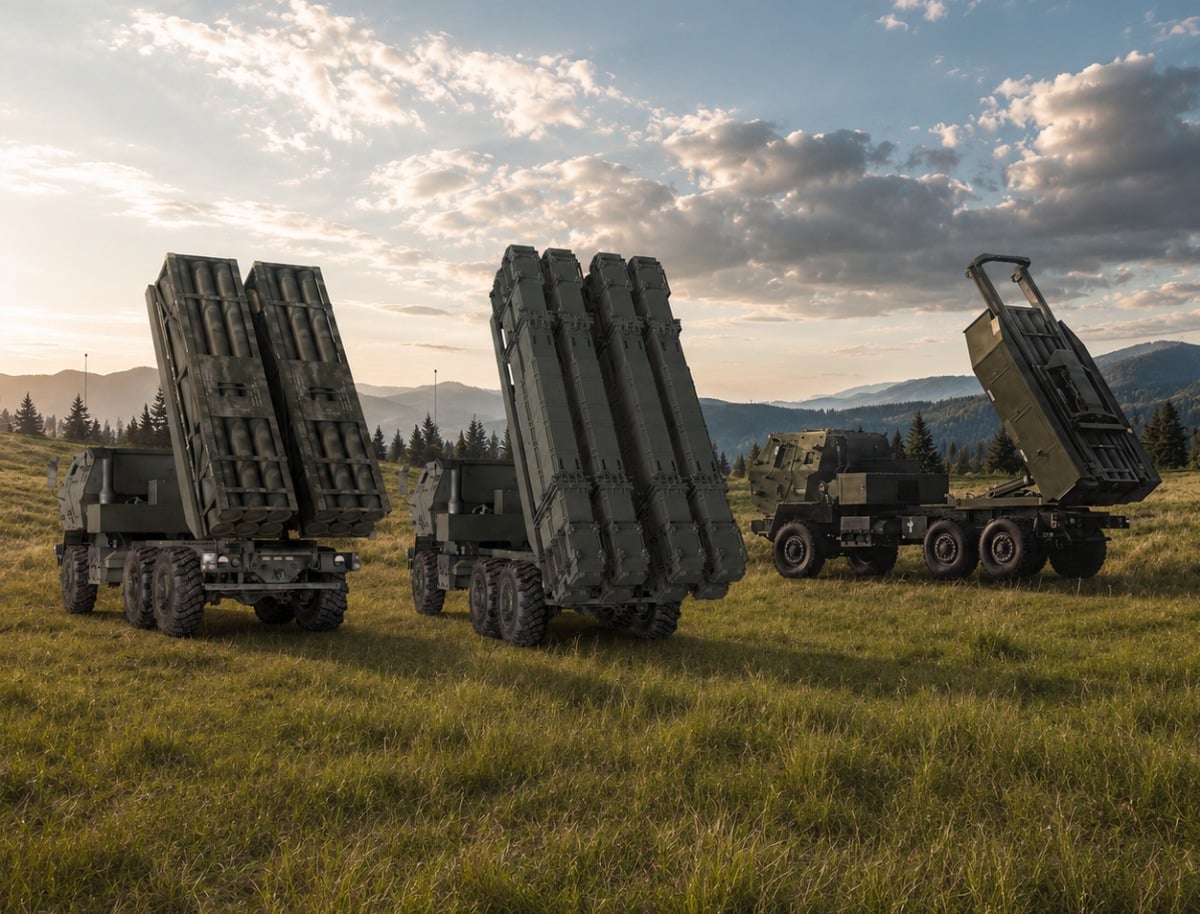
The traditional design constraint of the M142 High Mobility Artillery Rocket System (HIMARS) forced an absolute choice between strategic transportability and sustained fire volume. By carrying a single launch pod on a standard 5-ton Family of Medium Tactical Vehicles (FMTV) XM1140 chassis, the baseline system optimized for rapid air insertion via C-130 aircraft at the direct expense of instant salvo density. The introduction of the HIMARS FLEX architecture by Lockheed Martin alters this optimization equation. By transitioning to a modular, dual-pod configuration capable of doubling ready-to-fire munitions, the system shifts from a specialized niche asset into a high-density, multi-mission node.
Evaluating this evolution requires analyzing the physical and operational mechanics of the platform. Increasing the capacity of a wheeled rocket artillery system introduces significant engineering tradeoffs across structural loading, logistical cycles, and battlefield survivability.
The Dual-Pod Weight and Mobility Function
The mechanical foundation of the baseline M142 relies on balancing total system mass against the payload capacity of its tactical truck chassis. A standard combat-loaded M142 weighs approximately 16,283 kilograms (35,800 pounds). Incorporating a second launch pod via the FLEXFires technology ecosystem fundamentally changes the vehicle’s center of gravity, axle weight distribution, and overall mobility profile.
The structural modification introduces a clear relationship between payload expansion and operational constraints:
- Chassis Stress and Axle Loading: A single standard Guided Multiple Launch Rocket System (GMLRS) pod weighs approximately 2,270 kilograms. Adding a second pod shifts the vehicle out of the standard 5-ton FMTV gross vehicle weight rating (GVWR), requiring structural reinforcement of the frame or an evolution toward heavier tactical truck configurations, similar to the 8x8 configurations utilized in larger systems like GMARS.
- Tactical Air Mobility: The core doctrine of HIMARS Rapid Infiltration (HIRAIN) relies on the platform’s ability to drive onto a C-130J Super Hercules, fly to a forward location, land, deploy its munitions, and immediately egress. A standard C-130J has a maximum payload capacity of roughly 19,000 to 20,000 kilograms. While a single-pod baseline HIMARS fits comfortably within this envelope, a fully loaded dual-pod variant approaches or exceeds the structural and volumetric limits of a C-130J, restricting its rapid air-transport options to larger strategic airlifters such as the C-17 Globemaster.
- Off-Road Trafficability: Doubling the payload increases ground bearing pressure. In soft terrain, mud, or sand, a heavier dual-pod system experiences degraded maneuverability, lowering its top off-road speed and increasing its vulnerability to counter-battery tracking during transit.
Salvo Density and Lethality Math
The primary driver for implementing a dual-pod system is the exponential increase in short-window lethality, defined mathematically as salvo density over time. In highly contested environments featuring advanced electronic warfare and integrated air defense systems (IADS), the window of opportunity to strike a high-value target before it relocates—or before the launcher is detected—is narrow.
Baseline Launcher: 1 Pod  ---> 6 GMLRS OR 2 PrSM OR 1 ATACMS
FLEX Launcher:     2 Pods ---> 12 GMLRS OR 4 PrSM OR 2 ATACMS
This structural expansion directly addresses the target saturation problem. In modern peer-to-peer conflict, a single six-rocket GMLRS salvo can be partially mitigated by active defense systems or point-defense networks. Firing a twelve-rocket salvo from a single platform doubles the saturation volume, overwhelming point defenses via sheer kinetic mass without requiring multiple launch vehicles to coordinate positions over a data link.
Furthermore, the introduction of the Precision Strike Missile (PrSM) maximizes this dual-pod advantage. The baseline HIMARS holds two PrSMs per pod. The dual-pod configuration increases this to four ready-to-fire missiles with a range exceeding 499 kilometers. This allows a single vehicle to execute deep-strike interdiction against multiple disconnected command nodes or maritime surface targets simultaneously, doubling the destruction capacity per operational sortie.
The Logistics and Reload Bottleneck
While doubling firepower on the rail creates immediate tactical advantages, it shifts a massive burden onto the forward ammunition supply chain. The operational cycle of a rocket artillery unit is governed not by its firing time, but by its reload and replenishment timeline.
A single-pod HIMARS uses an integrated boom and hoist system to self-load a new pod in under five minutes. Managing a dual-pod configuration introduces two primary operational challenges:
- The Reload Cycle Time: Even with automated loading mechanisms, reloading two distinct pods doubles the stationary time of the launcher vehicle at an ammunition supply point. A vehicle that must remain stationary for ten to twelve minutes to achieve full combat readiness presents a significantly larger signature to adversary overhead surveillance drones than a system requiring only four minutes.
- Resupply Vehicle Footprint: Supplying a battery of dual-pod launchers requires twice the volume of medium tactical vehicles or heavy expanded mobility tactical trucks (HEMTTs) to haul replenishment pods. This increases the physical footprint of the supply convoy, making the entire artillery ecosystem more visible and easier to interdict behind the forward line of own troops.
Multi-Domain Mission Flexibility and Modular Payload Allocation
The defining characteristic of the new system is not merely the quantity of munitions, but the heterogeneity of the loadout. Traditional rocket artillery systems are linear; they fire surface-to-surface munitions against fixed coordinates. The modular architecture of the FLEX platform enables cross-domain tasking by decoupling the two launch cells.
This asymmetric loading capability creates entirely new tactical options:
- Offensive-Defensive Split: A single vehicle can dedicate one pod to offensive deep strikes (e.g., two PrSMs) while allocating the second pod to localized air and missile defense (e.g., Patriot PAC-3 MSE or Indirect Fire Protection Capability [IFPC] interceptors). This allows forward-deployed units to protect themselves from adversary counter-battery ballistic missiles or loitering munitions using their own organically carried assets.
- Asymmetric Salvo Composition: Operators can pair a rapid-area suppression weapon, like standard GMLRS, with a deep-penetration asset like ATACMS or PrSM. This permits simultaneous execution of suppression of enemy air defenses (SEAD) and high-value target destruction from a single platform, eliminating the communication lag inherent in coordinating separate artillery batteries.
Autonomy and Crew Attrition Dynamics
The inclusion of optional autonomy within the software ecosystem addresses a fundamental vulnerability of modern artillery operations: crew attrition. Traditional operations demand a three-man crew (commander, gunner, driver) to effectively manage communication, fire control, and driving.
Automating the fire control loops via upgraded digital architectures allows the platform to operate under degraded staffing conditions or as an unmanned ground vehicle (UGV). By removing the requirement for a continuous human presence inside the armored cab during high-risk firing sequences, autonomous variants can be deployed as forward-deployed "missile traps." These unmanned units can receive target data via secure, distributed networks (such as Variable Message Format or Link 16), execute the fire mission, and move to a secondary location automatically, completely removing human operators from the immediate radius of adversary counter-battery radar returns.
Strategic Allocation Matrix
Deploying the new system effectively requires matching the platform variant to the specific geographic and logistical constraints of the theater. The system should not be viewed as a universal replacement for the baseline single-pod variant, but as a complementary layer within a tiered fires strategy.
| Terrain / Operational Variant | Optimal Configuration | Primary Munition Loadout | Transport Method |
|---|---|---|---|
| Archipelagic / Distributed Environment (e.g., Indo-Pacific) | Baseline Single-Pod M142 | 2x PrSM (Anti-ship/Deep strike) | C-130J Tactical Air Infiltration |
| High-Intensity Continental Theater (e.g., Eastern Europe) | Dual-Pod FLEX Configuration | 12x GMLRS-ER or mixed Air Defense | Heavy Transporter / Organic Road March |
| Denial / Forward Buffer Zone | Autonomous Unmanned Variant | 4x PrSM or Saturation Rockets | Remote Insertion / Pre-staged Container |
Forces operating in theaters characterized by long logistics lines and minimal runway infrastructure must rely on the baseline single-pod configuration to preserve air-mobility options. Conversely, in continental environments where established road networks exist and volume of fire is the primary metric for halting mechanized advances, the dual-pod architecture provides the necessary firepower density to displace traditional, slower tracked artillery assets. The ultimate success of the platform depends on the operator's ability to balance the clear lethality benefits of increased salvo mass against the real operational drag of increased vehicle weight and expanded logistical signatures.