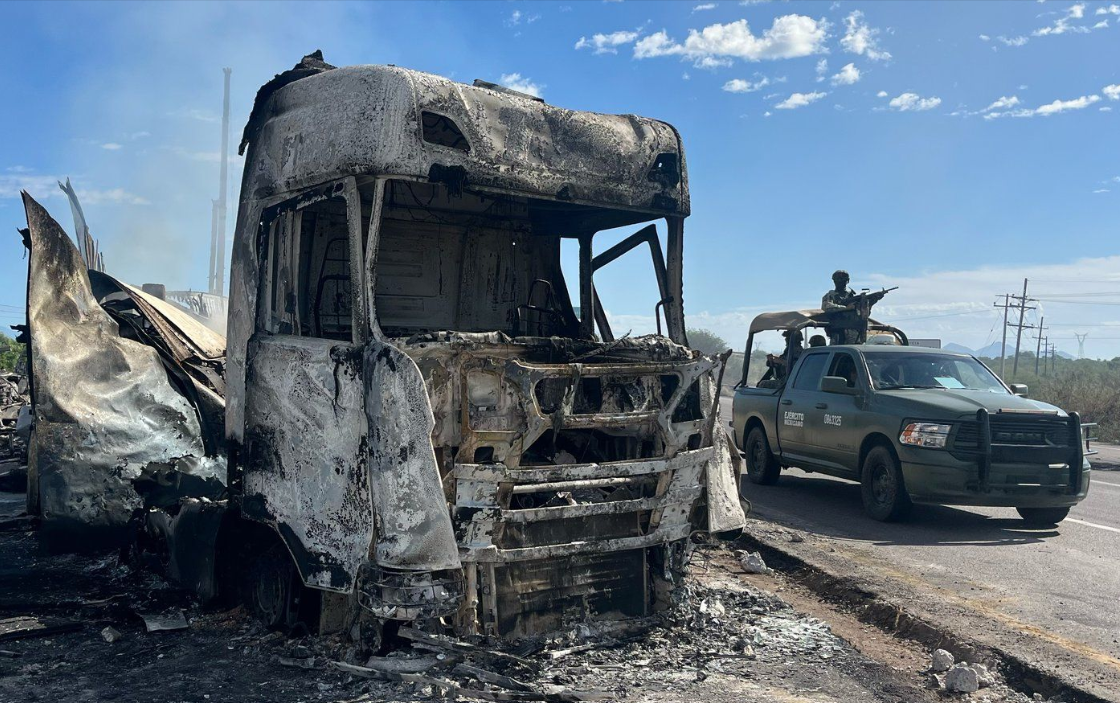
When federal forces capture a top cartel boss in northern Mexico, the immediate result is rarely peace. Instead, the arrest triggers an automatic, violent defensive reflex that leaves civilians dead and cities paralyzed, as seen in the recent flare-up across the north that claimed 11 lives. While official press releases frame high-profile captures as decisive blows against organized crime, the reality on the ground follows a grim, predictable script: the kingpin strategy fractures criminal hierarchies, sparks brutal succession wars, and forces armed factions to turn public infrastructure into a shield to deter state intervention.
To understand why eleven people die within hours of a single arrest, you have to stop viewing Mexican cartels as traditional corporate pyramids and start seeing them as decentralized, heavily armed insurgencies.
The Anatomy of a Narco Blockade
Most coverage of cartel violence treats the burning of buses, the hijacking of semi-trucks, and the sudden appearance of highway spike strips as chaotic spasms of rage. They are not. These actions, known locally as narcobloqueos, are calculated military tactics designed to buy time and create operational paralysis.
When security forces grab a high-value target, the clock starts ticking immediately. The arresting unit has to move that detainee from the capture site to a secure airfield or military base before local plaza bosses can mobilize a rescue operation. During that extraction window, cartel lieutenants issue a blanket order across encrypted radio channels: shut down the city.
Foot soldiers fan out to major intersections, force drivers out of commercial vehicles at gunpoint, and douse the cabs in gasoline. A burning tractor-trailer across a four-lane highway does two things at once. First, it physically blocks military reinforcements from reaching the extraction zone. Second, it forces local police and emergency responders to divert their attention away from the cartel's movements and toward putting out fires and rescuing trapped commuters.
The casualties in these opening hours—often a mix of municipal police caught at checkpoints, rival gunmen testing boundaries, and civilians trapped in the crossfire—are the direct collateral of a logistical maneuver. The cartel is not trying to defeat the Mexican Army in a pitched battle; it is trying to make the cost of holding the prisoner higher than the political benefit of arresting him.
Why the Kingpin Strategy Keeps Backfiring
For nearly two decades, security policy in North America has relied heavily on decapitation strikes. The logic seems straightforward on paper: remove the head of the snake, and the body dies. In practice, removing the head of a modern criminal syndicate simply creates three smaller, hungrier heads that immediately go to war with one another.
A cartel boss does more than just order shipments of fentanyl or methamphetamine across the border. He acts as a regulator, a financier, and an arbiter of internal disputes. He manages the complex web of bribes paid to local mayors, transit police, and customs officials. When that central figure vanishes into a maximum-security prison or gets extradited to the United States, those agreements expire overnight.
The Vacuum Effect
Beneath every top-tier leader sits a layer of regional commanders—the jefes de plaza—who control specific smuggling corridors, highways, and border crossings. While the boss is in charge, these commanders cooperate out of fear or financial self-interest. The moment he is arrested, trust evaporates.
One commander suspects another of having leaked the boss's location to federal intelligence in exchange for leniency or a rival's territory. Preemptive strikes follow within days. Gunmen who were taking orders from the same headquarters on Tuesday are hunting each other through residential neighborhoods by Friday.
The Diversification of Extortion
Worse still, splintered factions lose access to the massive capital reserves required to move multi-ton drug shipments internationally. International trafficking requires deep pockets, maritime logistics, and high-level political protection. When a group fractures, the smaller offshoots still have hundreds of armed young men on their payroll, and they need cash immediately to buy ammunition and pay salaries.
They turn inward on the local population. Instead of relying solely on export revenues, fractured cells aggressively expand into cobro de piso—systematic extortion of local businesses, avocado farmers, tortilla shops, and transport companies. Kidnapping for ransom spikes. Highway cargo theft becomes routine. The violence shifts from targeted hits between cartel operatives to generalized predation against anyone earning a paycheck in the region.
The Geography of Northern Volatility
Northern Mexico is not just another theater of the drug war; it is the economic lifeline of the entire criminal enterprise. Controlling a border state like Tamaulipas, Sonora, Chihuahua, or Nuevo León means controlling the plazas—the literal gates through which billions of dollars in illicit goods flow north and bulk cash and military-grade weapons flow south.
Because the profit margins at the border are exponentially higher than anywhere else in the supply chain, no faction ever concedes a northern territory voluntarily. A kilo of synthetic opioids that costs a few thousand dollars to manufacture in a clandestine lab in Sinaloa multiplies in value the second it crosses the Rio Grande or passes through a port of entry in Arizona.
This geographic reality explains why northern flare-ups are uniquely intense. The groups operating along the border are not ragtag street gangs; they are heavily equipped paramilitary units utilizing armored vehicles known as monstruos, commercial drones modified to drop explosives, and .50-caliber sniper rifles sourced through straw purchasers in Texas and Arizona. When the state intervenes in these corridors, it is stepping into a heavily fortified buffer zone where multiple syndicates are already locked in a cold war.
The Intelligence Trap and Bilateral Pressure
If security analysts, military commanders, and residents on the ground all know that capturing a cartel leader will trigger a wave of bloodshed, why do governments keep doing it?
The answer lies in the gap between tactical metrics and strategic reality.
Security policy in Mexico is rarely shaped in a vacuum; it operates under immense diplomatic and political pressure from Washington. When overdose deaths climb in the United States or border security becomes a dominant issue in American election cycles, the Mexican government faces intense demands to show tangible results. Arresting a notorious figure provides an immediate, undeniable headline. It satisfies bilateral benchmarks, demonstrates cooperation, and offers a clean visual victory—a handcuffed suspect being escorted onto a military transport plane.
Measuring success by dismantling the financial networks, prosecuting money launderers, and purging corrupt municipal police forces takes years. It produces boring spreadsheets instead of dramatic press conferences. Consequently, administrations repeatedly default to high-profile captures, trading long-term regional stability for short-term political capital.
The Role of Asymmetric Information
There is an uncomfortable truth that rarely makes it into official briefings: many major cartel arrests are not the result of pure, independent police work. They are frequently the product of internal betrayal.
Cartel leaders routinely feed intelligence on their rivals—or even their own troublesome subordinates—to military intelligence units. By tipping off authorities to a competitor's safe house, a rival faction gets the Mexican military to do its dirty work for free, eliminating a threat without risking its own gunmen or ammunition.
When the targeted faction realizes the raid was facilitated by an inside tip, the retaliatory violence becomes even more savage. The shootout that kills eleven people is often just the opening salvo of a broader purge designed to root out informants within the organization's own ranks. Bodies start appearing with cardboard signs warning against betrayal, and local journalists find themselves caught in a deadly squeeze between state censors and cartel enforcers demanding silence.
The Illusion of the Decisive Blow
Every major arrest in northern Mexico over the last twenty years—from the takedowns of Gulf Cartel bosses in the 2000s to the repeated captures of Sinaloa and Northeast Cartel commanders—has been hailed by officials as a turning point. Yet the flow of narcotics northward has adapted from marijuana to heroin, from heroin to methamphetamine, and from methamphetamine to synthetic fentanyl without skipping a beat.
The criminal networks have proven far more agile than the state apparatuses trying to dismantle them. They operate like franchise models. When one regional manager is removed, another steps in, rebrands the local cell, and negotiates new terms with whoever holds the local monopoly on force.
Until security strategy shifts away from theatrical decapitations and focuses on starving these organizations of their financial infrastructure, their supply of American-made weaponry, and their impunity within local political machines, the cycle will remain unbroken. The federal convoy will roll out of town with its high-value prisoner, the smoke from the burned-out buses will eventually clear, and the next lieutenant will quietly take his seat at the head of the table.

