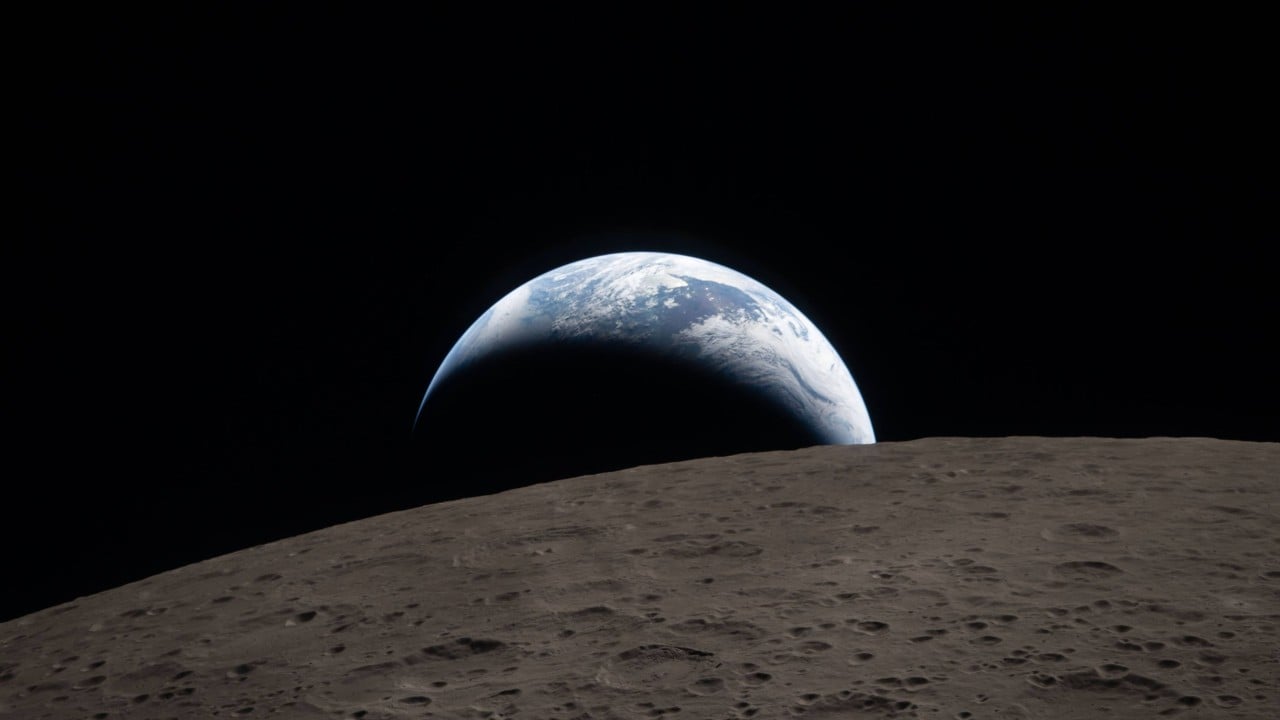
NASA just dropped a photo that makes every smartphone sunset you’ve ever taken look like a blurry thumbprint. As the Artemis crew began their trek back from the moon, they captured a high-resolution "Earthset." It shows our entire planet slipping behind the lunar horizon, a bright blue marble getting swallowed by the jagged, colorless edge of the moon. This isn't just another pretty space picture. It's the definitive proof that the era of low-Earth orbit boredom is over. We’ve spent decades circling the planet like a toy on a string. Now, we’re actually out there again.
The image was snapped from the Orion spacecraft as it whipped around the far side of the moon. You see the contrast immediately. The lunar surface is a dead, gray desert—brutal and unforgiving. Then, there’s Earth. It looks fragile. It looks small. Most importantly, it looks far away. That distance is what matters. When astronauts on the International Space Station take photos, they’re only about 250 miles up. They see cities and clouds, but they can't see the whole ball. Artemis is hundreds of thousands of miles out. This photo captures the "Overview Effect" in a way that actually hits home for those of us stuck on the ground.
Why this Earthset is different from Apollo 8
Everyone remembers the famous Earthrise photo from 1968. It changed how we thought about the environment and our place in the universe. But that was over fifty years ago. The new Artemis Earthset is fundamentally different because of the technology and the intent.
Back in the sixties, the cameras were film-based and required manual settings by astronauts who were often busy trying not to die. The Artemis imagery uses modern optical sensors that capture dynamic range we couldn't dream of during the Cold War. You can see the depth in the lunar craters in the foreground while still maintaining the vibrant, glowing blues of the Atlantic Ocean. It’s crisp. It’s sharp. It feels real in a way that grainy 20th-century shots don't.
More importantly, this photo isn't a "one-off" fluke. It’s part of a sustained campaign to establish a permanent presence. We aren't just visiting to plant a flag and leave some golf balls behind this time. The Orion capsule is designed to carry humans regularly. This photo is a postcard from a route that’s about to get a lot more traffic.
The technical wizardry behind the shot
Capturing a clear image of Earth from the moon is harder than it looks. You're dealing with extreme light contrasts. The moon reflects a lot of sunlight, but the blackness of space is absolute. If you expose for the moon, the Earth often looks like a blown-out white blob. If you expose for the Earth, the moon disappears into the shadows.
NASA’s engineers used a suite of cameras mounted on the spacecraft’s solar arrays. These cameras are built to withstand heavy radiation and wild temperature swings. They aren't just for PR. They help the ground crew monitor the health of the vehicle. But when the alignment is right, they turn into the most expensive GoPros in history. The "Earthset" happens because of the spacecraft's orbital velocity. As Orion moves behind the moon, the Earth appears to sink. It’s a trick of perspective that reminds you exactly how fast these people are moving. Thousands of miles per hour. No brakes. Just physics.
What this means for the Artemis II and III missions
If you think this photo is cool, wait until there are actual faces in the window. This specific mission was a dress rehearsal. The next step is Artemis II, which will put four humans in that exact spot. They’ll see this view with their own eyes. Imagine being Christina Koch or Victor Glover and watching your entire home world vanish behind a cratered rock.
The data gathered during this flight—including how the cameras performed in the deep space environment—directly informs how we’ll document the first woman and the next man walking on the lunar south pole. We’re going to get 4K video of the lunar surface. We’ll see the dust kick up in high definition. This Earthset photo is the baseline. It’s the "test pattern" for the greatest show on Earth, filmed from off-Earth.
The psychological impact of seeing home from 240,000 miles
There is a specific kind of loneliness in this image. In every other photo you take, the person holding the camera is on the planet. Here, the camera is "out there." Everything you’ve ever known—every war, every breakfast, every heartbreak—is contained within that tiny blue speck.
Astronauts often talk about how borders disappear from this height. You don't see countries. You see a closed system. You see a life-support ship. That’s essentially what Earth is. It’s a bigger version of the Orion capsule, drifting through a vacuum that wants to kill everything. Seeing the Earth set behind the moon drives home the reality that we are living on a very small island in a very big, dark ocean.
Stop waiting for the future because it’s happening now
A lot of people think space travel is still "science fiction" or something that will happen in twenty years. This photo says otherwise. The hardware is real. The orbits are being flown. The photos are being beamed back.
You should be following the NASA Artemis updates daily. Don't just look at the pictures on social media and scroll past. Go to the NASA website and look at the raw image files. Look at the telemetry. We’re watching the construction of a bridge to the rest of the solar system. The Earthset photo is the first milestone.
Get familiar with the names of the lunar craters. Learn the difference between the Service Module and the Crew Module. Most importantly, realize that the next time you see a photo like this, there might be a human being waving from the shadow. We are no longer a planet-bound species. This photo is the receipt.