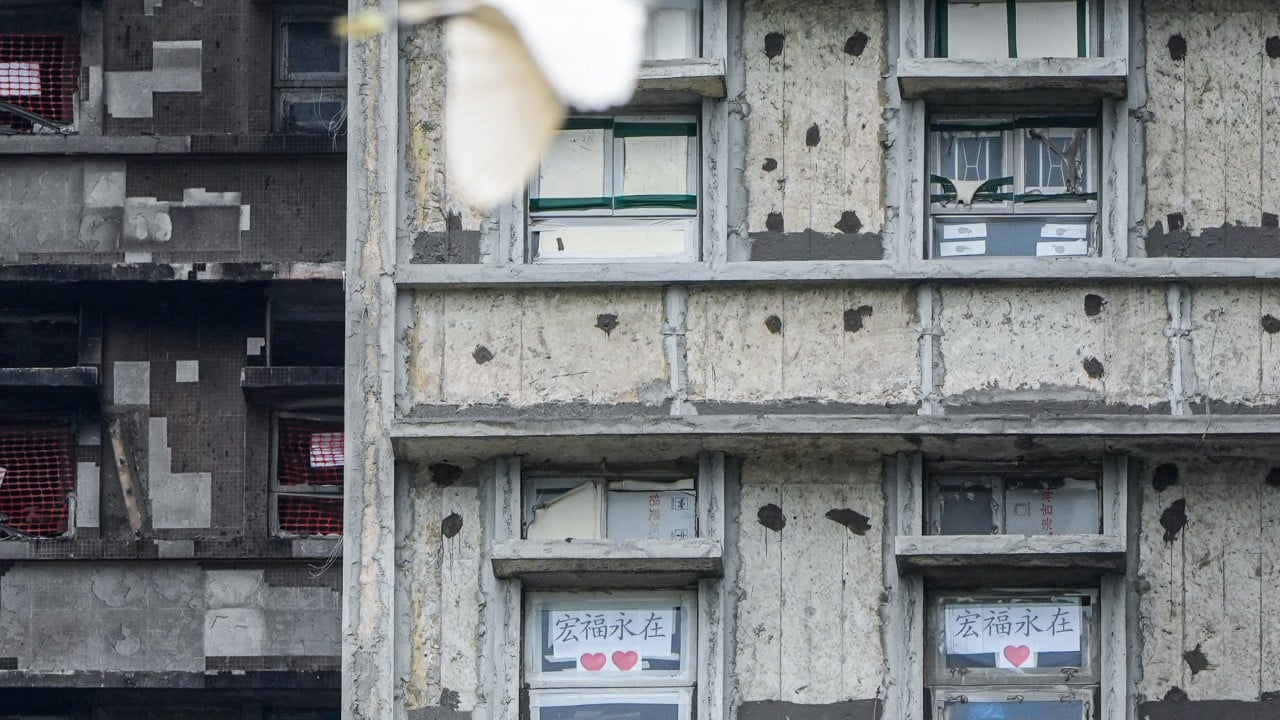
The smell of burnt plastic and damp concrete has a way of clinging to the back of your throat. It stays there for weeks. Long after the sirens fade and the news cameras pack up their tripods, the survivors of the Tai Po fire are left with a silence that feels heavier than the smoke ever did. For those living in the New Territories, the world changed in a single, searing afternoon. Homes became skeletal remains of twisted metal and soot. Memories were reduced to gray flakes drifting onto the pavement.
When your entire life is charred beyond recognition, the last thing you want to think about is a tax return.
Hong Kong is a city of relentless motion and rigid bureaucracy. It is a place where the skyline reaches for the clouds while the administrative machinery grinds away at sea level, tracking every dollar and every cent. Usually, this system is indifferent. It doesn't care if you're grieving or if you're sleeping on a donated cot in a community center. But sometimes, the gears shift.
The government’s decision to extend tax waivers for the residents displaced by the deadly Tai Po blaze is more than a fiscal adjustment. It is a rare moment of the state looking at a victim and seeing a person instead of a taxpayer ID.
The Weight of an Empty Mailbox
Consider a man we will call Mr. Chan. Before the fire, his life was defined by the predictable rhythms of Tai Po. He knew which floorboards creaked. He knew exactly where he kept the deed to his flat and the photos of his daughter’s graduation. After the fire, Mr. Chan owns the clothes on his back and a plastic bag of singed documents recovered by a firefighter.
He is staying in a temporary shelter. The air is thick with the scent of industrial cleaner and the quiet sobbing of neighbors. In this state, the arrival of a tax demand is not just a financial burden. It is an insult. It is the world demanding its due from someone who has nothing left to give.
The extension of the waiver acts as a buffer against this psychological weight. By removing the immediate pressure of the Inland Revenue Department, the city offers these families a commodity more precious than money: time. Time to mourn. Time to find a new place to sleep. Time to figure out how to start over when the starting line has been burned away.
The Invisible Stakes of Bureaucracy
We often talk about tax policy in the abstract. We debate percentages and thresholds as if they are mathematical puzzles. In the wake of a tragedy, however, tax policy becomes a moral instrument.
The Tai Po fire was not just an accident; it was a rupture in the social fabric. When people lose their homes, they lose their stability. When they lose their stability, their ability to contribute to the economy—the very thing taxes are designed to support—is compromised. If the government were to insist on immediate payment from people who are currently scavenging for basic necessities, it would be a form of institutional cruelty that serves no one.
The logic behind the extension is grounded in the reality of recovery. Experts in urban disaster management often point out that the first six months after a loss are the most volatile. This is the period where survivors are most likely to fall into debt or experience mental health crises. By waiving these obligations, the authorities are effectively subsidizing the resilience of the community. They are betting that by letting go of a little revenue now, they prevent a much larger social cost later.
It is a calculation of empathy.
A City Built on Fragile Foundations
Hong Kong’s relationship with its residents is often transactional. You work hard, you pay your way, and the city provides the infrastructure for you to do it all again tomorrow. But the Tai Po fire exposed the fragility of that contract. Many of those affected were living in older buildings, the kind of structures that form the backbone of the city's residential history but struggle to meet modern safety standards.
There is a bitter irony in being taxed for a home that the city’s safety regulations failed to protect.
While the tax waiver is a necessary gesture, it also highlights the deeper, unspoken anxieties of living in one of the densest places on Earth. We live on top of one another. We share walls, vents, and stairwells. When a fire breaks out in a place like Tai Po, it isn't just one person’s problem. It is a collective vulnerability. The government’s intervention recognizes this. It acknowledges that the victims didn't just suffer a personal loss; they suffered a failure of the environment we all inhabit.
The Mechanics of the Waiver
For those watching from the outside, the "extension" might seem like a simple clerical change. In reality, it involves a complex coordination between the Home Affairs Department and the Inland Revenue. It requires identifying specific households, verifying displacement status, and pausing the automated systems that trigger penalties for late filing.
For the survivors, the process shouldn't be another hurdle. The goal of such a policy is to be invisible.
The most effective form of government aid is the kind that removes obstacles rather than adding new ones. By proactively extending these waivers, the administration avoids forcing traumatized residents to fill out endless forms to prove they are, in fact, suffering. They already know. The smoke was visible from the harbor.
Beyond the Ledger
Money cannot replace a home. A tax break cannot bring back a lost pet or a box of heirlooms. But there is a specific kind of dignity in being told, "We see what happened, and we are stepping back."
It is a recognition of the human element in a city often criticized for its cold, financial focus. When the news cycles move on to the next scandal or the next market dip, the people of Tai Po will still be there, scraping soot off the few things they saved. They will be looking at blueprints for new lives, trying to remember what "normal" felt like.
As the sun sets over the New Territories, the charred remains of the building stand as a grim silhouette against the sky. Inside the temporary shelters, the lights stay on late. People talk in low voices about insurance, about family, and about where they will go tomorrow. The tax waiver won't rebuild the walls, but it might make the night a little less cold. It is a small, quiet mercy in a city that rarely slows down.
The true test of a society isn't how it functions when everything is going well. It is how it treats its citizens when the smoke is still clearing. In this instance, the ledger has been balanced in favor of humanity.
The debt isn't gone. It’s just waiting until the people of Tai Po can breathe again.