The pine needles do not burn first. They bake. Long before the flame touches the branch, the intense, suffocating heat of a southern French summer turns the sap into a volatile gas. By the time the spark arrives, the tree does not catch fire; it detonates.
For generations, the department of Gard in the Occitanie region has smelled of wild thyme, rosemary, and the crisp, green scent of Aleppo pines. It is a sensory landscape that millions of travelers seek out every year, chasing the postcard promise of the Mediterranean lifestyle. But when the Mistral wind screams down the Rhône Valley after a merciless heatwave, that postcard burns.
More than 1,200 hectares of this historic land now exist only as a gray, skeletal memory. To understand that number—1,200 hectares—it helps to look past the cold satellite maps and standard news tickers. Think instead of nearly 1,700 soccer pitches laid end-to-end, or a thick, black scar cutting through vineyards that have survived since the Roman Empire.
Behind that statistic are people.
Consider a winemaker like Jean-Louis, a hypothetical but deeply accurate composite of the independent vignerons who call this valley home. For three weeks, Jean-Louis watched the thermometer hover above 40 degrees Celsius. The soil, usually a rich, vibrant terracotta, turned to a fine, chalky powder that blew away in the breeze. He knew the grapes were suffering, their skins thickening to protect the precious juice inside from turning to raisins on the vine.
But he did not expect the smoke.
It started as a thin, purple smudge on the horizon toward Nîmes. Within two hours, the sky had turned a bruised, apocalyptic orange. The wind was the true villain that afternoon. The Mistral gusted at over 80 kilometers per hour, acting as a giant bellows that pushed the wall of fire through the dry scrubland faster than a person could run.
Jean-Louis stood on his terrace, tasting the bitter, oily residue of burning pine on his tongue. The air became heavy, hard to breathe, thick with the cremated remains of the surrounding forest. He had to make a choice that hundreds of locals and tourists faced that same afternoon: pack a single bag of valuables or trust that the firebreaks would hold.
He stayed just long enough to see the water bombers.
The roar of the Canadair planes is a sound that stays with you forever. It is a deep, chest-vibrating rumble that cuts through the howling wind. These yellow-and-red beasts swoop dangerously low over the burning hills, dropping tons of water mixed with red fire retardant. The pilots fly blind through shifting thermal currents and blinding smoke, risking everything to save a stranger’s roof, a stranger’s livelihood.
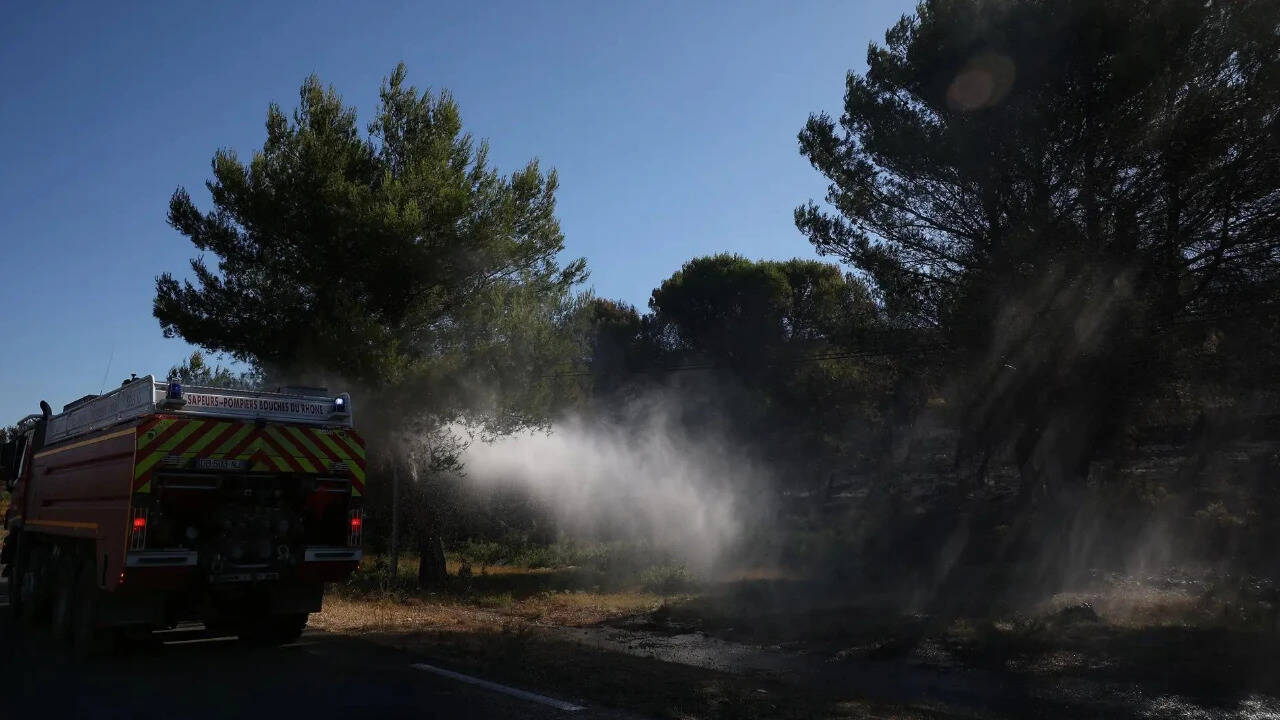
On the ground, more than 600 firefighters formed the thin red line between civilization and ash. They call them the Sapeurs-Pompiers. Many are volunteers—bakers, mechanics, and teachers who drop everything when the siren wails. They do not fight these fires from a safe distance. They stand in the choking black air, dragging heavy hoses through thorny brush, their heavy protective gear turning into a personal sauna as the ambient temperature reaches unbearable heights.
Fire is a living thing. It breathes. It shifts. A sudden change in the wind direction can trap a crew in seconds, turning a tactical retreat into a desperate scramble for survival.
The true tragedy of these modern wildfires is that they are no longer anomalies. They are becoming a seasonal rhythm. The deadly heatwave that preceded the outbreak acted as a massive dehydrator, sucking every molecule of moisture out of the earth. When the vegetation is that dry, a discarded cigarette butt, a spark from a tractor blade hitting a stone, or a poorly managed campfire is all it takes to trigger a catastrophe.
For the tourists evacuated from nearby campsites, the holiday ended in gymnasiums on makeshift cots, wrapped in foil blankets, listening to the distant thud of exploding propane tanks. Their dream of a sun-drenched escape dissolved into a lesson in climate vulnerability. They learned what the locals already knew: the Mediterranean paradise is fragile.
The fire is eventually contained. The wind dies down, the smoke clears, and the politicians arrive to promise aid. But when the emergency vehicles drive away, the silence that settles over a burnt forest is deafening. There are no birds. No insects. Just the occasional hiss of a smoldering stump.
Jean-Louis walked out into his northernmost vineyard the next morning. The fire had stopped just ten meters from his oldest vines, checked by the frantic efforts of a volunteer crew. The leaves were scorched yellow, and the grapes were coated in a fine layer of soot.
He picked a bunch, rubbed the ash from a single berry, and bit into it. The juice was sweet, but the aftertaste was unmistakable. Smoke taint. The smoke penetrates the skin of the grape, binding with the sugars. When fermented, it releases a flavor profile that tastes less like a fine vintage and more like an ash tray. The entire harvest was ruined.
The economic fallout of 1,200 hectares of charred earth will be felt for a decade. It takes years for a newly planted vine to yield usable fruit, and even longer for a forest to reclaim its canopy. The landscape will heal, but it will change. The dense pine forests may give way to more fire-resistant oak and scrub, altering the very identity of the region.
We tend to look at these disasters through the lens of numbers and percentages, as if a spreadsheet could capture the weight of a family watching their generational home burn. We talk about climate shifts in the abstract, as global targets and distant deadlines.
But the reality is much simpler, and much closer to home. It is found in the dirt of southern France, where a tired man in soot-stained clothes stands under a pale sun, looking at a blackened hillside, wondering if the winter rains will wash what remains of his topsoil into the sea.