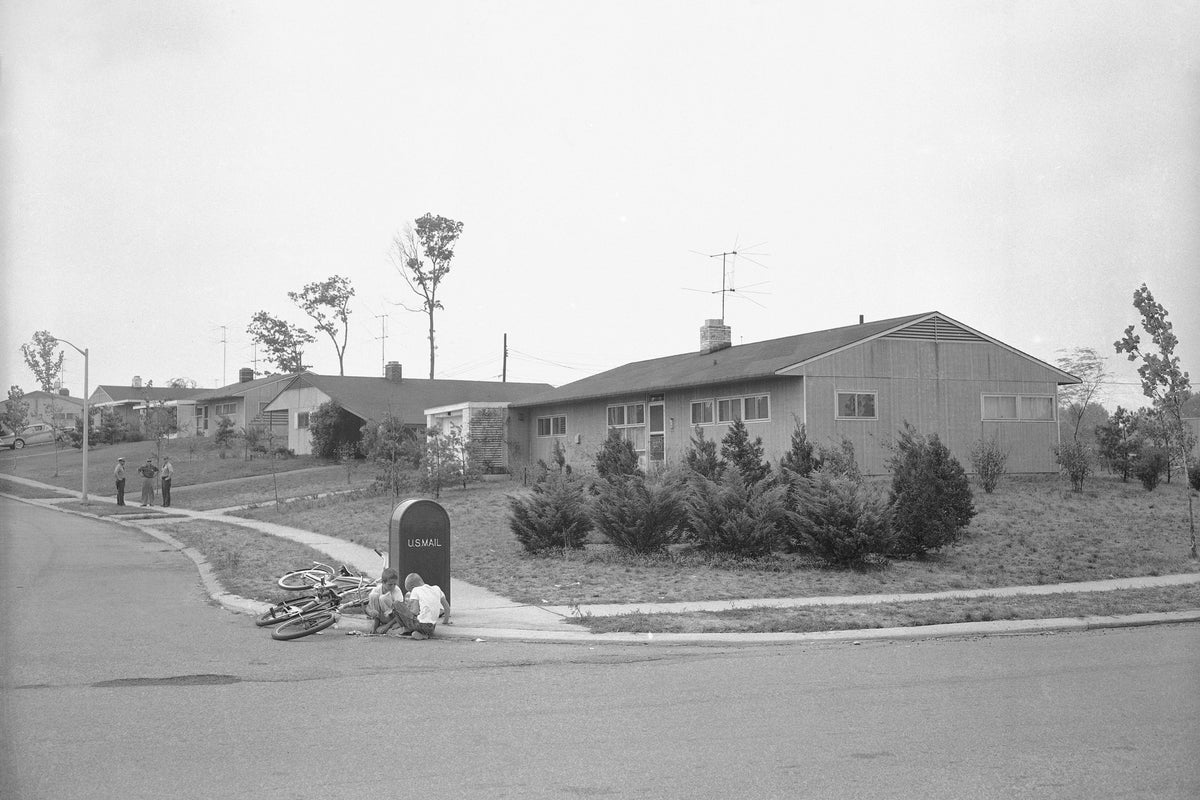
Levittown was never just a housing development. It was an industrial miracle that weaponized the assembly line to manufacture the American Dream at a rate of one house every sixteen minutes. By 1947, William Levitt had figured out how to turn a potato field in Long Island into a sprawling suburban utopia for returning World War II veterans, offering a slice of the middle class for a few hundred dollars down. But this miracle came with a poison pill. While the GI Bill provided the capital and Levitt provided the wood and nails, the Federal Housing Administration (FHA) provided the mandate for racial segregation. For decades, the narrative of Levittown has focused on the "whites only" clauses in the leases, but the reality is more systemic and more chilling. It was a massive, taxpayer-funded social engineering project designed to build a white middle class by intentionally draining the economic potential of Black Americans.
The Industrialization of the Home
Before Levittown, houses were built by craftsmen. It was slow, expensive, and bespoke. William Levitt changed that by treating the earth like a factory floor. He didn't move the product down a line; he moved the teams from house to house. One crew did nothing but lay slabs. Another did nothing but frame. A third did nothing but install the "Tracy" stainless steel sinks.
This efficiency dropped the price of a home to roughly $7,000, making it cheaper to buy a new house in the suburbs than to rent a cramped apartment in the city. The demand was feral. On the first day of sales, thousands of veterans lined up, some sleeping on the sidewalk for the chance to sign a contract. They weren't just buying four walls and a roof. They were buying a television, a built-in General Electric stove, and a manicured lawn. They were buying an identity.
However, the efficiency of the construction was matched by the efficiency of the exclusion. Levitt didn't just stumble into segregation. He calculated it. He famously stated that he could solve a housing problem or a social problem, but he couldn't do both. To Levitt, the "social problem" of integration was a threat to the "business problem" of profit. He believed that if a single Black family moved in, the property values of the other 17,000 homes would collapse. This wasn't just his personal prejudice; it was the documented policy of the United States government.
The FHA Underwriting Manual and the Gold Standard of Bias
The smoking gun of suburban segregation isn't found in a private diary, but in the FHA Underwriting Manual of the 1930s and 40s. This document was the bible for American lenders. It explicitly warned that "incompatible racial groups" should not live in the same communities. It went as far as to recommend the use of highways and even physical walls to separate white neighborhoods from Black ones.
When Levitt approached the FHA for the massive loans needed to build his developments, the government required him to include restrictive covenants in every deed. These clauses stated that the homes could not be "used or occupied by any person other than members of the Caucasian race."
This created a government-sanctioned monopoly on wealth. White veterans were given a low-interest, government-guaranteed escalator to the middle class. Black veterans, who had fought in the same trenches in Europe and the Pacific, were left on the sidewalk. They were forced into "redlined" inner-city neighborhoods where they couldn't get mortgages, or where the interest rates were usurious.
The Myth of the Natural Suburb
We often talk about the "suburbanization of America" as if it were a natural migration, like birds flying south for the winter. It wasn't. It was a forced march driven by policy. The government didn't just build Levittown; it built the infrastructure to support it. The Interstate Highway Act of 1956 carved paths through vibrant Black neighborhoods in the cities to make the commute easier for the white residents of the suburbs.
This created a cycle of disinvestment. As the white tax base fled to Levittown and its clones across the country, the cities lost the revenue needed to maintain schools, parks, and hospitals. The "urban decay" that became a buzzword in the 1960s and 70s was the direct, intended consequence of the suburban boom.
Investors often look at real estate as a passive asset, but in the mid-century, it was an active tool of wealth redistribution. The appreciation of a Levittown home over forty years represented a massive transfer of equity. A house bought for $7,990 in 1948 would be worth over $500,000 today. For the white families who got in on the ground floor, that equity paid for college educations, started small businesses, and provided a cushion for retirement. For Black families denied that entry, that half-million dollars of wealth simply never existed.
The Architecture of Conformity
Levitt’s control didn't stop at the skin color of the residents. He ran his developments like a military camp. There were rules for everything. You couldn't hang laundry on Sundays. You had to mow your lawn at least once a week. You couldn't build a fence.
The Standardized Life
- Uniformity: Every house looked nearly identical, which kept costs low but also enforced a sense of crushing social conformity.
- The Kitchen at the Center: The layout was designed to keep the "homemaker" in sight of the children playing in the backyard, a physical manifestation of 1950s gender roles.
- The Absence of Public Space: Levittown was built for cars and private backyards, not for walking or public gathering. This further isolated families from anyone outside their immediate socioeconomic circle.
This environment created a "utopia" that was also a pressure cooker. While the media of the time portrayed it as the peak of human civilization, writers like Lewis Mumford decried it as an "asylum" that destroyed the soul. But for the residents, the trade-off was worth it. They had a piece of dirt they could call their own, even if that dirt was under a government-mandated microscope.
The Violent Defense of the Perimeter
The tension between the dream and the reality broke in 1957. Bill and Daisy Myers, a Black couple, managed to buy a home in the Levittown development in Pennsylvania. They didn't buy it from Levitt; they bought it from a white homeowner who was moving out.
The reaction was a dark mirror of the American Dream. For days, mobs of hundreds of white residents surrounded the Myers' home. They threw stones. They burned crosses. They sang "Old Black Joe" late into the night. The police, many of whom were Levittown residents themselves, often stood by and watched.
The Myers stayed for four years, but the message was sent. The "peaceful" suburbs were protected by a layer of latent violence. This wasn't just "southern" racism; this was the refined, northern, suburban variety. It was the realization that the value of one's home—the primary store of wealth for the American family—was perceived to be tied to the exclusion of others.
The Legacy of the 16-Minute House
If you look at a map of American cities today, the borders of 1940s redlining are still visible. The neighborhoods that were denied FHA backing eighty years ago are the same neighborhoods that suffer from higher heat indices due to lack of trees, poorer air quality, and lower life expectancy.
Levittown wasn't a mistake. It was a masterpiece of industrial engineering and a tragedy of social design. We are still living in the houses that William Levitt built, whether we live in Long Island or a high-rise in Chicago. The wealth gap that exists today isn't a mystery; it’s a math problem that started with a $10 deposit and a "whites only" clause.
The modern housing crisis is the direct descendant of the Levittown model. We still prioritize the single-family home as the ultimate investment vehicle, a policy that naturally leads to NIMBYism (Not In My Backyard) and the exclusion of high-density, affordable options. We have swapped the explicit racial covenants for "exclusionary zoning" that mandates minimum lot sizes and bans multi-family units, achieving the same result through the language of "neighborhood character."
We continue to subsidize the suburban lifestyle through highway spending and the mortgage interest deduction, while the core infrastructure of our cities remains starved of capital. To understand why American politics is so polarized and why American wealth is so concentrated, you don't need to look at Twitter. You just need to look at a map of a potato field in 1947. The blueprint for the divide was drawn before the first slab was even poured.