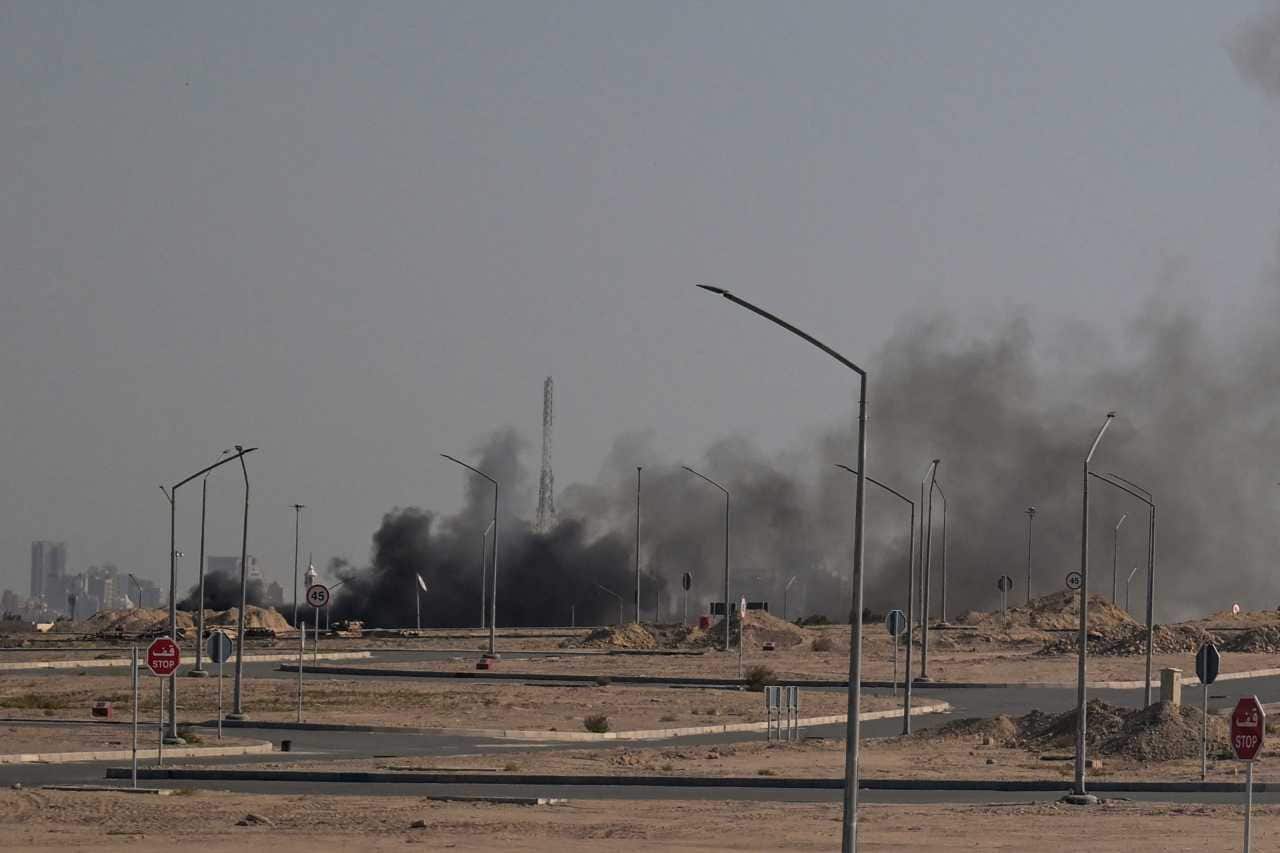
The intersection of physical insecurity and economic diplomacy creates a distinct operational friction. When a state attempts to signal international economic resilience while simultaneously managing airspace penetration by low-cost assets, it exposes a fundamental structural asymmetry. The defense of high-value administrative and economic hubs during high-profile international forums presents a dual challenge: maintaining a facade of absolute normalcy while deploying capital-intensive air defense assets to counter low-cost, long-range attrition vectors.
This dynamic is not merely a military complication; it is an economic calculus where the attacker forces the defender into an unsustainable cost-exchange ratio. To understand how defensive architecture reacts under these conditions, we must isolate the variables governing airspace defense during highly publicized economic events, using the recent interception of unmanned aerial vehicles (UAVs) over the Leningrad region—proximate to the St. Petersburg International Economic Forum (SPIEF)—as a baseline case study.
The Triad of Air Defense Friction during High-Profile Diplomatic Forums
Deploying air defense networks around a localized economic hub while an international summit is active introduces three distinct operational constraints. These constraints operate in a permanent state of tension, where optimizing for one inevitably degrades the efficiency of the others.
                  [1. Emission Security (EMCON)]
                                / \
                               /   \
                              /     \
                             /       \
  [2. Collateral Risk Mitigation] --- [3. Target Acquisition Velocity]
1. Emission Security (EMCON) vs. Passive Detection
Active radar systems emit radiofrequency energy that maps the precise coordinates of defensive batteries for hostile signals intelligence (SIGINT). During an international forum, the defender must shield these assets from detection to prevent pre-emption or targeted suppression. However, suppressing active radar emissions forces a reliance on passive optical or acoustic detection networks, which severely compresses the target acquisition window.
2. Collateral Risk Mitigation in Urban and Industrial Corridors
intercepting a UAV over an unpopulated agricultural sector carries nominal secondary risks. Intercepting that same asset over critical infrastructure—such as the oil terminal facilities or LNG plants native to the Leningrad region—introduces a high probability of collateral damage from falling debris or unspent defensive missile fuel. The defender's engagement criteria must therefore shift from "earliest possible intercept" to "geographically constrained intercept," reducing the effective engagement envelope.
3. Target Acquisition Velocity against Low-RCS Assets
Modern long-range strike UAVs routinely utilize composite materials and low-altitude flight profiles to minimize their Radar Cross Section ($RCS$). When these assets navigate through civilian air traffic corridors or close to industrial thermal plumes, the defender’s automated command-and-control systems experience high clutter-to-signal ratios, delaying the verification required before launching kinetic interceptors.
The Cost-Exchange Function of Asymmetric Air Defense
The foundational vulnerability of modern localized air defense lies in the mathematical divergence between the cost of the offensive vector and the cost of the defensive countermeasure. This asymmetry can be expressed through a simple cost-exchange ratio ($CER$):
$$CER = \frac{C_{defense}}{C_{offense}}$$
Where $C_{defense}$ includes not just the unit cost of the interceptor missile, but the fully loaded operational cost of radar wear, fuel, and personnel, while $C_{offense}$ is the literal procurement cost of the strike drone.
Cost Factor (Logarithmic Scale)
^
|       [Kinetic Interceptors: S-400 / Pantsir-S1] ($100k - $1M+)
|       ---------------------------------------------------------
|
|
|       [Offensive Long-Range Strike Drones] ($10k - $50k)
|_________________________________________________________________> Time / Volatility
When an offensive actor deploys a long-range, propeller-driven UAV manufactured with commercial-grade GPS components and fiberglass housing, the production cost fluctuates between $10,000 and $50,000. Conversely, a point-defense system like the Pantsir-S1 or a medium-range system like the S-350/S-400 utilizes guided interceptors that cost anywhere from $100,000 to over $1,000,000 per launch.
This yields a $CER$ that routinely exceeds 10:1, and can spike as high as 100:1 in favor of the attacker.
The strategic intent of the attacker in this scenario is rarely the total physical destruction of the economic forum; rather, it is the forced imposition of this cost function. By forcing the defender to deplete finite stockpiles of high-tier guided missiles against low-tier targets, the attacker achieves structural attrition. Furthermore, the necessity of launching multiple interceptors to guarantee a probability of kill ($P_k$) close to 1.0 further skews the math, accelerating the depletion of localized magazines.
Logistical Bottlenecks and the Reality of Airspace Denial
While official statements frequently emphasize the successful neutralization of aerial threats via electronic warfare or kinetic means, they routinely omit the underlying supply-chain vulnerabilities that govern these engagements.
The primary limiting factor in sustained airspace denial is not tracking capability, but the magazine reload cycle.
A standard short-to-medium-range air defense battery carries a fixed number of ready-to-fire missiles (typically 6 to 12 per transport-erector-launcher vehicle). Once these cells are exhausted, the battery is functionally offline during the reload window, which requires specialized heavy machinery, logistics personnel, and a secure supply line back to regional ammunition depots.
[Target Detection] -> [Engagement Choice] -> [Magazine Depletion] -> [Reload Window (Vulnerable)]
Electronic warfare (EW) systems offer an alternative by disrupting the satellite navigation signals (such as GPS or GLONASS) or the radio command links used by drones. In the Leningrad region, widespread GPS spoofing and jamming have historically been deployed to force UAVs off-course or induce automated crash protocols. However, this defensive mechanism creates a secondary economic bottleneck. Persistent, high-power EW jamming degrades civilian telecommunications, disrupts automated port logistics, and interferes with commercial aviation transponders. The defender must therefore balance the tactical necessity of electromagnetic dominance against the economic friction it inflicts on local commercial operations.
Strategic Reorientation: The Real-Time Defense Playbook
To decouple from an unsustainable cost-exchange ratio while protecting high-value diplomatic assets during major summits, state actors must transition from a reactive kinetic posture to a layered, predictive defense model. The final strategic play requires executing a three-tiered optimization protocol:
- Deploy Non-Kinetic Layered Buffers: Establish permanent high-power, localized directed-energy weapons (DEWs) or automated electronic countermeasure grids explicitly around the venue perimeters, shifting the $CER$ back toward parity by eliminating the use of expensive missile interceptors for low-tier targets.
- Establish Geographic Kinetic Kill Zones: Mandate automated intercept protocols exclusively within pre-defined, non-residential corridors (e.g., over water bodies or restricted industrial wastelands) to entirely mitigate collateral economic damage from falling debris.
- Decentralize Early Warning Infrastructure: Disperse acoustic and passive infrared sensor networks across the outer approach vectors to extend the target verification window without expanding the active radar emission signature.
The success of an economic summit in a contested security environment depends on the invisible management of this defensive architecture. If the defender fails to compress the cost-exchange ratio, the physical protection of an economic forum is achieved at the expense of long-term material insolvency.