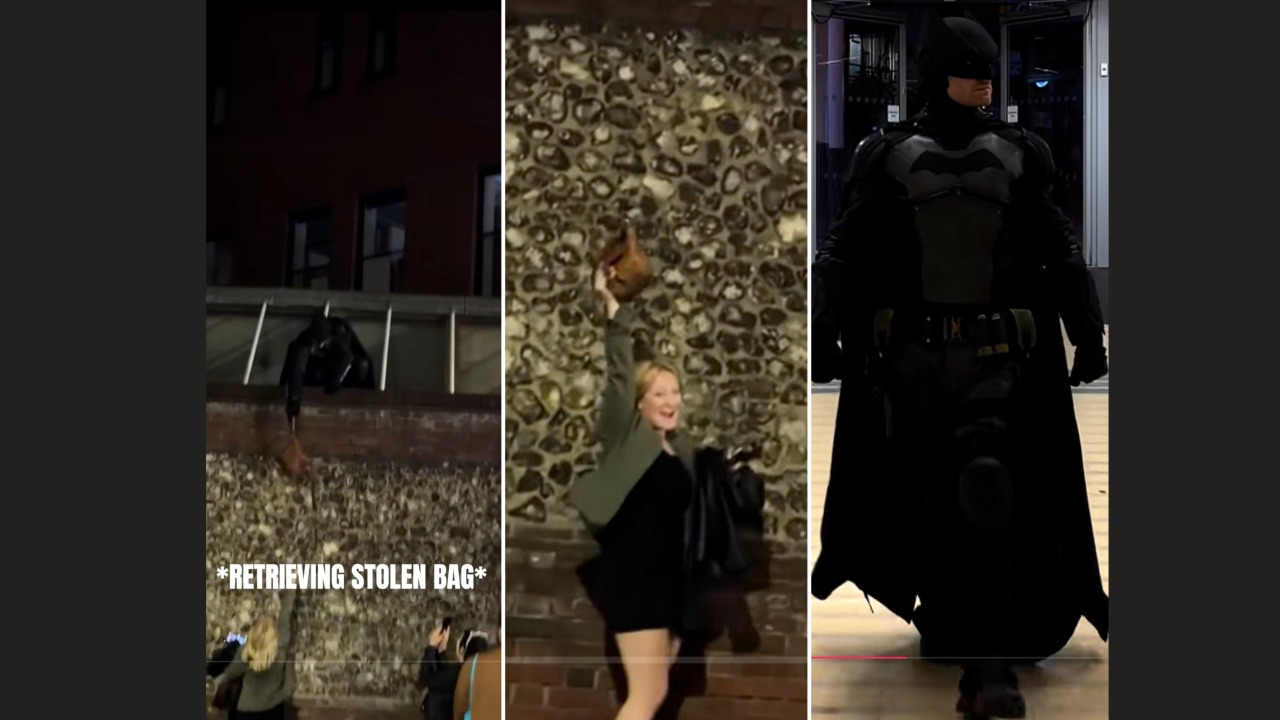
Street-level property crime relies on a predictable asymmetry of motivation. An opportunistic thief calculates that bystanders lack the physical capacity, risk tolerance, and social incentive to pursue a fleeing perpetrator across complex urban terrain. When an individual dressed as Batman intercepts a bag snatcher and scales the exterior stonework of Norwich Cathedral to recover stolen property, the incident exposes the structural mechanics of informal deterrence, architectural friction, and viral attention economics.
Standard local news coverage treats such events as whimsical anomalies—human-interest curiosities defined by novelty rather than operational mechanics. That framing obscures what actually occurred. The intervention succeeded because it inverted three standard variables of street robbery: psychological disruption, physical pursuit capability, and environmental navigation. In similar news, read about: What Most People Get Wrong About That $12.8 Million Circle K Lottery Ticket Lawsuit.
The Mechanics of Opportunistic Street Theft
To understand why a costumed intervention works, we must first model the baseline behavior of an opportunistic bag snatcher. Unlike organized retail theft or planned burglary, street-level snatching operates on rapid, low-friction execution. The perpetrator selects a target based on perceived vulnerability and unobstructed exit vectors.
The Three-Variable Risk Equation
Every street theft involves an implicit calculation across three operational constraints: The New York Times has also covered this important topic in great detail.
- Time-to-Separation: The duration required to put sufficient physical distance between the point of theft and the victim to prevent immediate recovery. In dense pedestrian zones like Norwich city center, a perpetrator needs roughly 15 to 30 seconds of unimpeded sprinting to break line-of-sight.
- Bystander Inertia: The diffusion of responsibility among witnesses. Under the bystander effect, the probability of any single observer intervening drops sharply as crowd density increases, because each person assumes another will act or fears physical retaliation.
- Terrain Complexity: The physical layout of the escape route. Thieves favor environments with high pedestrian clutter, narrow alleys, or architectural barriers that slow down unmotivated pursuers while offering multiple branching paths.
In a standard scenario, the victim experiences acute cognitive freeze—an involuntary stress response triggered by sudden loss and physical shock. By the time the victim processes the event and vocalizes a call for help, the perpetrator has already cleared the primary line-of-sight threshold. Bystanders, lacking clear visual confirmation of the crime and unwilling to absorb personal injury risk for a stranger's insured property, remain stationary.
Psychological Disruption and the Costumed Anomaly
The introduction of a recognizable, hyper-visible figure in full tactical cosplay alters the psychological dynamics for both the perpetrator and the surrounding crowd. This is not merely theatrical; it functions as a cognitive pattern interrupt.
Breaking the Cognitive Script
Opportunistic criminals operate within an expected behavioral script. They anticipate shouting, hesitation, and passive observation. A pursuer dressed as a nocturnal vigilante violates that script entirely. When the brain encounters an extreme visual anomaly during a high-adrenaline escape, processing speed slows. The perpetrator must momentarily allocate cognitive bandwidth to assess an unfamiliar threat profile.
This hesitation degrades the thief's primary advantage: momentum. Instead of executing a clean break along a pre-selected exit vector, the perpetrator is forced into reactive evasion. Reactive evasion increases error rates—missed turns, dropped items, and suboptimal route selection.
The Identity Shield Effect
From the intervenor's perspective, wearing a full cowl and cape fundamentally changes personal risk tolerance. Behavioral psychology demonstrates that anonymity and role adoption reduce self-consciousness and lower inhibitions against assertive action.
In standard civilian attire, a bystander weighs the social awkwardness of a failed intervention alongside the physical risk. If they chase a thief and fail, or misread the situation, they suffer public embarrassment. Adopting an archetype like Batman eliminates personal social risk while imposing an implicit behavioral expectation: the persona demands decisive action. The costume acts as a psychological commitment device, locking the wearer into an assertive response before rational hesitation can override the impulse to act.
Architectural Friction and Vertical Evasion
The defining operational feature of the Norwich incident is not the pursuit itself, but the vertical dimension of the recovery: scaling the exterior wall of Norwich Cathedral. Historic ecclesiastical architecture introduces extreme physical constraints that separate casual observers from capable intervenors.
Stonework Morphology and Climbing Mechanics
Norwich Cathedral, constructed primarily of Caen stone in the Romanesque style, presents a vastly different climbing surface than modern glass-and-steel commercial buildings.
- Surface Texture and Holds: Centuries of weathering, mortar joints, buttresses, and decorative stonework create micro-ledges, crimps, and structural handholds. While hazardous and unstable, Norman masonry provides purchase points that smooth modern facades lack.
- The Cost-Benefit Asymmetry of Elevation: Criminals occasionally use verticality—such as low roofs, scaffolding, or walled courtyards—to ditch pursuing police or security guards who are bound by strict occupational health and safety protocols. Law enforcement officers cannot legally or practically free-solo historic monuments to retrieve a handbag due to liability and injury protocols.
- Unconstrained Pursuit: A civilian operating outside institutional safety mandates faces no administrative barrier to vertical pursuit. By matching the thief's vertical escalation—or retrieving property discarded on an elevated ledge—the intervenor neutralizes the perpetrator's final environmental advantage.
Gravitational and Equipment Penalties
Scaling masonry while wearing a heavy cape, cowl, and boots introduces severe biomechanical penalties. Capes snag on stone projections and shift the center of gravity unpredictably. Masks restrict peripheral vision and impair depth perception, both of which are critical when gauging handholds and footholds on uneven stone.
Executing a climb under these constraints indicates either prior athletic conditioning—such as bouldering, parkour, or route-setting experience—or an acute adrenaline-driven override of standard self-preservation instincts. In either case, the physical execution transforms a standard foot chase into a high-risk vertical extraction.
The Limits of Vigilante Deterrence
While the recovery of the handbag represents a tactical success, treating costumed citizen intervention as a scalable model for urban safety introduces severe operational and legal hazards. Strategy requires separating an isolated positive outcome from systemic viability.
Legal Exposure and Liability Frameworks
Under UK law—specifically Section 3 of the Criminal Law Act 1967—any person may use such force as is reasonable in the circumstances in the prevention of crime, or in effecting or assisting in the lawful arrest of offenders. However, the legal protection afforded to citizen intervenors is narrow and unforgiving.
- Proportionality Thresholds: Using physical force to recover property is scrutinized heavily by prosecutors. If a confrontation escalates and the intervenor inflicts disproportionate injury on the thief, the intervenor faces arrest and prosecution for assault.
- Weaponization of Gear: Tactical costumes often include rigid gauntlets, weighted capes, or utility belts. Under the Prevention of Crime Act 1953, carrying any article made, adapted, or intended for causing injury in a public place is an offense. Even decorative props can be reinterpreted as offensive weapons during a physical altercation.
- Heritage Damage Liability: Scaling a Grade I listed building like Norwich Cathedral risks damaging fragile medieval stonework. Historic England and cathedral authorities strictly prohibit unauthorized climbing, meaning an intervenor risks civil liability or criminal damage charges even while performing a public service.
The Escalation Trap
Opportunistic thieves rarely carry firearms in the UK, but the prevalence of bladed articles in street crime remains a persistent operational reality. A civilian intervenor lacks body armor, stab-resistant vests, radio backup, and medical extraction teams. A cape and foam cowl offer zero protection against a concealed knife.
When a perpetrator is cornered—especially on an elevated structure with restricted exit routes—the psychological dynamic shifts from flight to fight. Cornering a desperate individual removes their escape option, forcing them to deploy whatever weapon they carry to create an opening. The intervenor who pursues a suspect into a vertical cul-de-sac maximizes their own vulnerability to lethal force.
Media Economics and the Viral Amplification Loop
The trajectory of the Norwich Cathedral story illustrates how modern digital media processes localized street crime. A standard handbag snatching in a regional city generates zero national coverage; it is logged as a routine crime statistic and forgotten. Adding a superhero motif transforms a mundane property offense into a high-performing media asset.
The Algorithmic Value of Absurdity
Digital newsrooms operate on attention metrics—click-through rates, time-on-page, and social share velocity. Stories that combine genuine real-world stakes (crime, physical danger) with absurd visual elements (a superhero scaling a medieval cathedral) trigger high engagement across demographic segments.
- Headline Compression: The core narrative fits cleanly into a single visual-heavy sentence, requiring zero background context for the reader to grasp the incongruity.
- Visual Shareability: Even without high-resolution video footage, the mental image generated by the headline drives social media reposting. Readers share the story not to inform others about Norwich crime rates, but to signal humor and astonishment to their networks.
- Institutional PR Alignment: Local authorities, cathedral officials, and police forces often adopt a measured, lightly humorous tone when commenting on non-violent costumed interventions. Condemning a citizen who returned a stolen bag to a victim creates a public relations deficit, even when the behavior violates safety protocols.
The Copycat Hazard
The primary systemic risk of viral amplification is behavioral contagion. When media outlets celebrate costumed intervention without emphasizing the physical and legal hazards, they incentivize untrained individuals to replicate the behavior.
A trained climber or martial artist intervening in a non-violent theft represents one risk profile. An untrained enthusiast wearing vision-obscuring masks and tripping hazards attempting to confront armed perpetrators in urban environments represents a predictable fatality waiting to happen. Media framing consistently omits the survivor bias inherent in these stories: we hear about the climber who safely retrieved the bag, not the intervenor who fell from wet limestone or suffered a knife wound in an unlit alley.
Operational Protocol for Urban Bystander Intervention
Organizations, security teams, and civic planners looking to reduce street-level property crime cannot rely on costumed anomalies. Effective deterrence requires replicating the structural advantages of the intervention—rapid response, psychological disruption, and environmental control—without exposing civilians to extreme physical or legal liability.
Tactical Intervention Hierarchy
When a street theft occurs in a public space, bystanders and private security personnel should execute a tiered response designed to disrupt the thief's timeline while preserving personal safety:
- Immediate Acoustic Disruption: Shout clear, specific descriptions rather than generic screams. Calling out "Stop the man in the grey hoodie with the red bag" breaks bystander inertia by giving surrounding pedestrians actionable target identification. This eliminates the ambiguity that causes witnesses to freeze.
- Vector Denial Over Physical Grappling: Position yourself to obstruct exit routes or force the perpetrator into open, well-lit, camera-monitored plazas rather than attempting physical tackles. Forcing a thief to change direction repeatedly degrades their momentum and increases the likelihood they will abandon the stolen item to gain speed.
- Digital Telemetry Capture: Prioritize capturing clear video of the perpetrator's footwear, gait, and exit direction over facial features, which are easily obscured by hoods or masks. Law enforcement investigators rely heavily on distinctive footwear and movement patterns to track suspects across municipal CCTV networks.
- Vertical Containment: If a suspect climbs onto scaffolding, walls, or historic structures, establish a perimeter at ground level rather than pursuing upward. Gravity and time favor the ground team; once the perpetrator is isolated on an elevated structure, their escape options drop to zero, allowing trained emergency responders to execute a safe containment and arrest.
Civic authorities and venue managers in historic city centers must harden architectural vulnerabilities around monuments like Norwich Cathedral by installing discrete perimeter lighting, eliminating low-level climbing aids near drainpipes and buttresses, and integrating rapid-response security patrols during peak foot-traffic hours. Relying on theatrical vigilantes to patch gaps in urban security is a failure of municipal design; true deterrence comes from systematically removing the low-friction escape routes that make opportunistic theft viable in the first place.