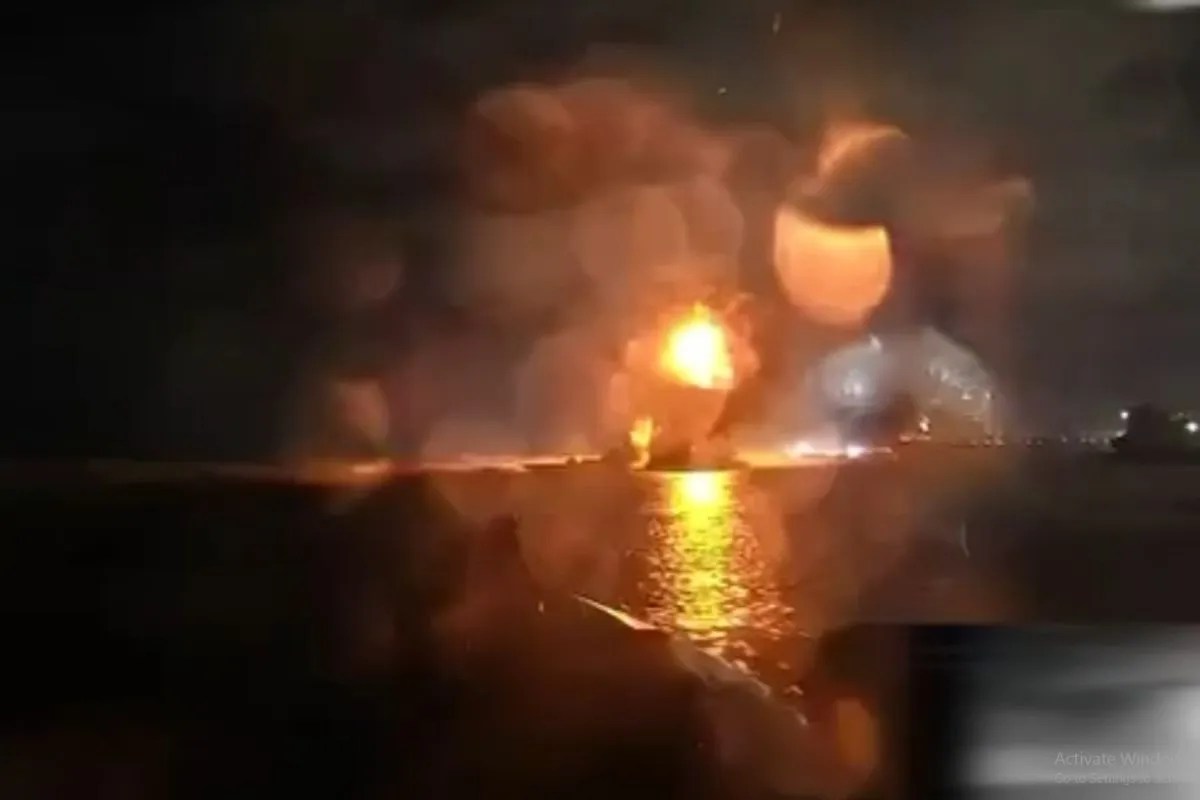
When a land-constrained or Black Sea-focused military uses unmanned surface vessels to sink a Russian corvette and strike a logistics ship off Benghazi on November 22, 2026, the story is not merely a distant tactical surprise. It exposes a structural shift in how out-of-theater supply lines, port security, and third-party sovereign territories interact under asymmetric pressure. Standard headline reporting treats the strike on the corvette Merkury and the cargo ship MV Angara—accompanied by video released by Ukrainian President Volodymyr Zelenskyy—as a linear sequence of action and reaction. That framing misses the operational mechanics that allowed unmanned maritime systems to operate roughly 2,400 kilometers from Ukraine's front lines, as well as the diplomatic and military friction generated in eastern Libya.
This analysis maps the logic of the underlying report, separates verified facts from educated hypotheses, and examines the strike through four strategic lenses: The Cost-Exchange Asymmetry of Unmanned Naval Warfare, Logistics Interdiction Across Secondary Theaters, Sovereignty Friction in Fragmented States, and Information Signaling and Verification. Discover more on a connected subject: this related article.
Deconstructing the Competitor's Narrative Logic
A conventional news report around the headline "लीबिया के तट पर यूक्रेन का बड़ा हमला, रूस का युद्धपोत मर्करी डुबोया; जेलेंस्की ने जारी किया ऑपरेशन का वीडियो" typically follows a straightforward chronological chain:
- Event Trigger: Ukrainian forces launch a drone strike near Libya targeting Russian naval and cargo vessels.
- Official Confirmation and Media Proof: President Zelenskyy confirms the operation, states that seven Ukrainian-made naval drones were used to sink the corvette Merkury—reportedly commissioned in 2023 along with an on-board Ka-27 helicopter—and notes a strike on the cargo ship MV Angara alleged to carry military supplies, while releasing video footage.
- Secondary Context and Local Reaction: Reporting adds that a Russian vessel in Benghazi experienced an explosion around the same window, notes Russian logistics links, and records statements from eastern Libyan authorities objecting to a breach of sovereignty and warning of potential responses.
The logic in that structure is easy to follow, yet analytically incomplete. First, it treats reach as a simple distance number rather than a multi-stage logistics and launch architecture involving forward support, mothership deployment, or regional staging. Second, it treats two vessels (Merkury and MV Angara) as parallel targets rather than complementary nodes in a maritime convoy and resupply system. Third, it lists Libyan diplomatic pushback and casualties as an afterthought rather than a core strategic constraint that shapes future operations in the Mediterranean. Additional reporting by Reuters explores related perspectives on the subject.
Facts Versus Educated Hypotheses
Rigorous strategy requires separating confirmed reporting from analytical inference so operational assumptions do not harden into certainty.
Confirmed Facts
- Timing and Targets: On November 22, 2026, strikes hit Russian-linked maritime assets in or near Benghazi, Libya, affecting the corvette Merkury and the cargo vessel MV Angara.
- Ukrainian Leadership and SBU Framing: President Zelenskyy and Ukraine's Security Service (SBU) publicly linked the operation to Ukrainian forces and indigenous naval drones, stating that Merkury was sunk along with a Ka-27 helicopter and that MV Angara was targeted for its role in military logistics.
- Visual Verification: Released footage and satellite/media reporting examined the strikes near Benghazi, while Libyan officials reported casualties—including Libyan naval personnel among those killed or injured—and eastern Libyan authorities condemned the action as a violation of sovereignty.
- Broader Diplomatic Context: Following the strikes, French Foreign Minister Jean-Noël Barrot defended Ukraine's right to self-defense against Russian bombardment, while U.N. officials warned against turning Libya into a battleground for external conflicts.
Educated Hypotheses
- Launch and Support Architecture: Because small unmanned surface vessels have finite endurance and navigation constraints over long distances, long-range operations near North Africa likely rely on forward staging, covert local support, or a surface/support "mothership" positioned closer to the operational area rather than unassisted transit from the Black Sea.
- Escort-Cargo Coupling: Targeting both a naval escort (Merkury) and a cargo vessel (MV Angara) suggests an intent to degrade both protection and hull capacity simultaneously rather than conducting an isolated symbolic hit.
- Escalatory Containment: Eastern Libyan authorities face a balancing act between asserting sovereign protest and avoiding direct, unsustainable kinetic escalation against a better-armed external actor, making diplomatic pressure, joint inquiry rhetoric, or port-security tightening more probable than full-scale retaliation.
The Cost-Exchange Asymmetry of Unmanned Naval Warfare
In classical naval economics, surface combatants represent high capital concentration: specialized hulls, sensor suites, air- and surface-defense systems, crew training, and embarked aviation such as a Ka-27 helicopter. Even a modern corvette commissioned during wartime carries years of industrial and human investment that cannot be replaced quickly.
Unmanned surface vessels flip the cost-exchange ratio—the comparison between what the attacker spends to field a system and what the defender loses when a platform is damaged or sunk. Even when defensive fire intercepts several incoming drones, as Libyan military officials indicated in initial assessments, a small fraction penetrating outer defenses can cause catastrophic damage or sinking.
Why Port and Near-Shore Berths Create Vulnerability
A vessel moored in port or operating near a coastal approach faces distinct constraints compared to open-ocean maneuvering:
- Restricted Maneuver Room: Harbor basins and coastal channels limit high-speed evasive turns and force predictable transit paths.
- Sensor Clutter and Line-of-Sight Limits: Pier structures, nearby vessels, and coastal terrain complicate radar discrimination and short-range engagement timelines.
- Asymmetric Saturation: Defending against low-profile surface drones requires continuous watchfulness, layered close-in firepower, and counter-drone coordination; missing even one or two units in a wave can prove decisive.
Consider a practical operational example: a naval planner protecting a docked corvette and an adjacent supply ship must allocate scarce ammunition, radar attention, and reaction time across multiple approach vectors at once. If four drones are intercepted but two reach the hull, the defender's high interception rate still ends in a strategic loss.
Logistics Interdiction Across Secondary Theaters
A common mistake in war coverage is treating distant theaters as disconnected sideshows. In reality, modern conflict networks link primary front lines with secondary logistics corridors across the Mediterranean and Africa.
Strikes against MV Angara and Merkury target the supply and escort function supporting Russian military logistics and external deployments. By hitting cargo transport alongside an escorting warship, the attacker raises three types of cost for the defending logistics network:
- Direct Hull and Cargo Loss: Damaged or sunk vessels remove immediate transport capacity and risk destroying equipment or fuel.
- Routing and Insurance Friction: Vessel operators and logistics coordinators face higher risk premiums, longer transit times, slower port turnarounds, and heightened scrutiny on sanctioned or military-linked ships.
- Escort Reallocation: Every surface combatant lost or tied down to protect logistics convoys reduces the pool of ships available for other missions.
The first operational consequence is geographic expansion: sanctuary no longer automatically attaches to distance from the Black Sea. The second consequence is force dispersion: protecting distant logistics nodes forces the defending navy to spread air defense, anti-drone measures, and naval patrols across more bases and anchorages.
Sovereignty Friction in Fragmented States
Operating near or inside a politically divided country introduces sovereignty and third-party risk that does not exist in an uncontested warzone. In Libya, rival power centers, foreign actors, and contested security arrangements create overlapping jurisdictions and competing interests.
When strikes occur in or off Benghazi, eastern Libyan authorities frame the incident as an infringement on national sovereignty and maritime security, while casualties among local personnel intensify political pressure. At the same time, international observers and U.N. officials warn against turning Libyan territory and waters into an arena for proxy or external conflict.
Trade-Offs of Out-of-Theater Strikes
| Strategic Dimension | Potential Advantage | Operational or Political Cost |
|---|---|---|
| Operational Reach | Disrupts distant logistics and signals that no port is automatically safe | Requires complex forward support, covert coordination, or mothership staging |
| Diplomatic Leverage | Demonstrates technical adaptability and imposes costs on adversary networks | Risks alienating local authorities and drawing international criticism over third-party harm |
| Escalation Control | Targets military and logistics assets rather than purely civilian infrastructure | Creates risk of collateral casualties, miscalculation, or retaliatory measures in contested waters |
Notice the core limitation: kinetic strikes in third-party littoral zones are not a silver bullet. They can degrade specific vessels and impose psychological and logistical friction, but they also carry diplomatic blowback, local resentment, and operational security risks if staging routes or local links are exposed.
Information Signaling and Verification
Releasing combat video immediately after a high-profile strike serves a dual purpose: domestic and international signaling on one side, and contested verification on the other.
Video clips showing drones closing on targets, explosions, and smoke provide rapid narrative momentum and reinforce claims of operational capability. Yet video alone rarely settles every factual question. Analysts and investigators cross-check footage against satellite imagery, maritime tracking, local official statements, and timing metadata to separate confirmed impacts from partial damage or unverified claims.
In high-stakes information environments, disciplined verification requires checking four elements before drawing conclusions:
- Platform Identity: Confirm whether visual features, hull markings, or context match the named vessel (Merkury or MV Angara) rather than an adjacent ship.
- Extent of Damage: Distinguish between surface fire, structural flooding, immobilization, and full sinking, which may take hours or days to verify via satellite or harbor reporting.
- Interception Rates: Compare attacker claims of drones deployed against local or independent reports of drones intercepted or missed.
- Third-Party Impact: Account for non-combatant or host-nation casualties and infrastructure effects that alter the diplomatic fallout.
Strategic Play for Decision-Makers
For defense planners, maritime risk analysts, and security policymakers tracking post-strike developments in the Mediterranean, the immediate strategic play is to fortify harbor counter-drone perimeters while pairing maritime interdiction with strict diplomatic de-escalation. Any port hosting military-linked vessels or supply convoys should treat unmanned surface and air threats as a baseline harbor-defense requirement—combining perimeter surveillance, rapid-response vessels, net or boom barriers where feasible, and layered short-range kinetic and electronic defenses—rather than relying on open-sea naval escorts alone. Simultaneously, external actors conducting or reacting to long-range strikes near contested coastlines must ring-fence third-party sovereignty to prevent collateral incidents from turning local factions into active adversaries or triggering broader regional instability.